ITD to Hold Public Hearing Regarding Thorncreek Road to Moscow Project


The Idaho Transportation Department invites the public to comment on the draft environmental impact statement (DEIS) at its public hearing that presents alternatives to improve U.S. Highway 95 between Thorncreek Road and the city of Moscow.  The hearing will be from 2:00 to 8:30 pm on Wednesday, January 23, at the Best Western Plus University Inn, 1516 West Pullman Road.  The public can also view more information at US95ThornCreek.com or visit the Moscow Chamber to review a copy of the DEIS and pick up a free informational DVD and brochure.

Highway 95 Forum and Field Trip 1-19-13


In early January 2013, the Idaho Transportation Department (ITD) released its U.S. 95 Thorncreek Road to Moscow draft environmental impact statement (DEIS) and technical reports on three alternatives for proposed realignment of the dangerously accident-prone 6.5-mile stretch of Highway 95 just south of Moscow. Its preferred E-2 alternative mirrors 10A of the 2002 ITD environmental assessment that the Paradise Ridge Defense Coalition and its allies successfully challenged, secured a federal injunction, and forced ITD to complete the current DEIS review process. The purportedly shorter and safer E-2 eastern route would climb 400 to 500 feet up the western, exposed shoulder of scenic Paradise Ridge, while compromising weather-related highway traveler safety, area aesthetics and noise levels, wetland preservation, and protection of rare remnants of native Palouse Prairie habitat and wildlife. It would also inflict the greatest detrimental effects on pine stands, ungulate conservation and collisions, endangered species, and ecosystem restoration, as it imposes more stream tributary crossings, impervious surfaces, pollution runoff, and weed infestations. The U.S. Environmental Protection Agency and Fish and Wildlife Service as well as the Idaho Department of Fish and Game have strongly recommended against this eastern Highway 95 corridor, likely advanced by ITD to accommodate international industrial traffic like tar sands megaloads.

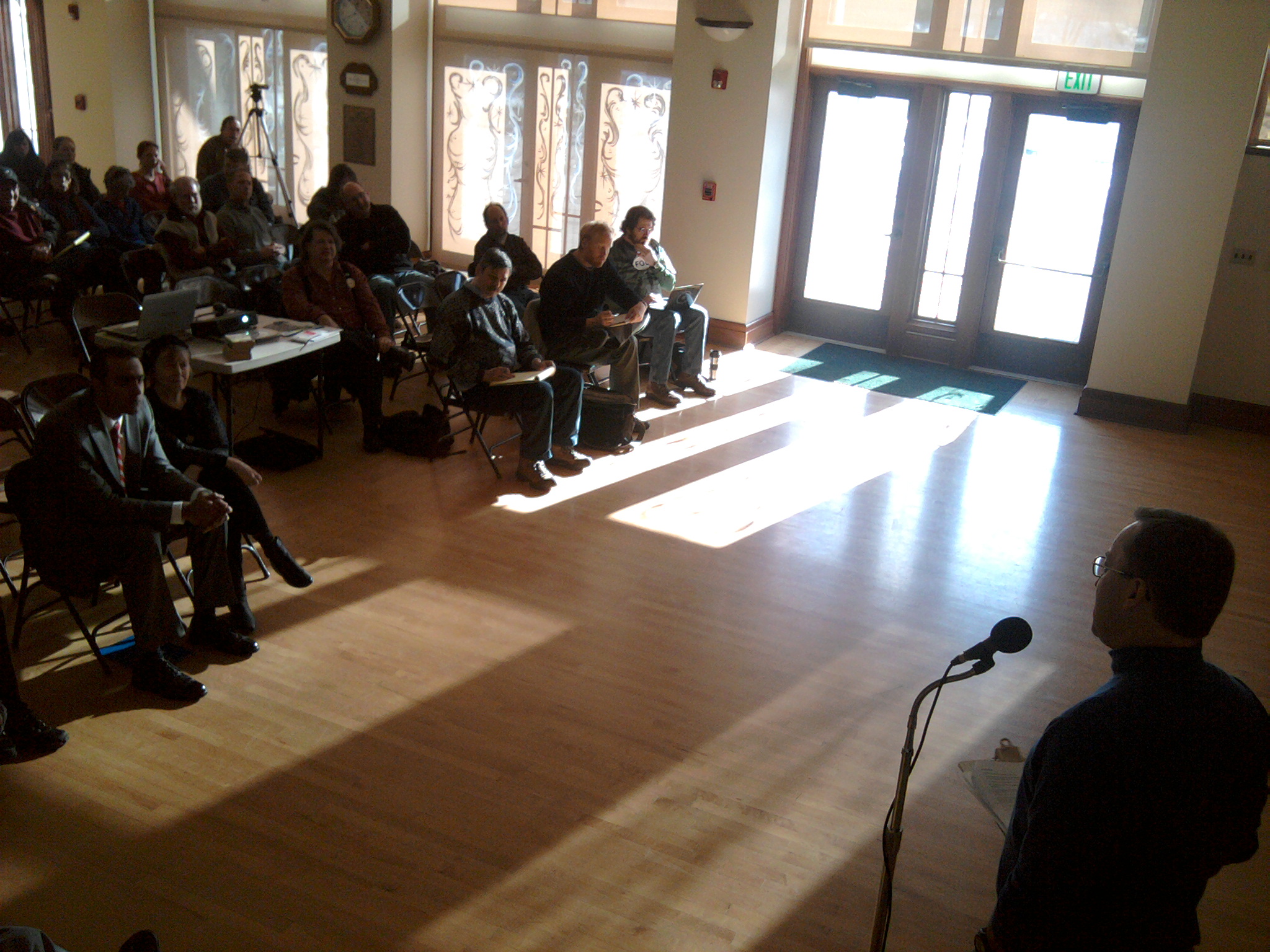
The Paradise Ridge Defense Coalition, Palouse Environmental Sustainability Coalition, and concerned Moscow area citizens and groups welcomed public involvement and discussion at the Highway 95 Forum and Field Trip, a knowledge-sharing session in the 1912 Center Great Room in Moscow, followed by E-2 realignment site visits on Saturday, January 19, 2013. Between noon and 2 pm, community members Al Poplawsky, Cass Davis, Tim Hatten, and Brett Haverstick summarized the DEIS, presented arguments in opposition to the eastern alternative, and opened the informational meeting to questions and insights. From 2 until 5 pm, event organizers and participants carpooled and staged a field trip to locations along and near the proposed eastern Highway 95 route described in the DEIS. Several Paradise Ridge residents hosted pertinent site explorations and talks off Eid and Paradise Ridge roads in the sunny, early evening light. For further information about the Highway 95 Forum and Field Trip, see the event descriptions on facebook and on the Wild Idaho Rising Tide (WIRT) website. Ongoing issue updates, articles, and interviews appear in the Highway 95 Re-Route section of the WIRT website.

0119131238

0119131243a

0119131242

Continue reading

More Answers Needed from ITD


Joann Muneta, Moscow

The Moscow-Pullman Daily News 1/19/13

Recent letters to the editor about the Idaho Transportation Department’s (ITD) proposed rerouting of U.S. Highway 95 have been highly disappointing.

It is unfair and misleading to blame those interested in our environment for errors and omissions made by ITD.  No one in our community advocated waiting ten years to reconsider the highway issue.  Let’s acknowledge that everyone has now, and has had, safety as a primary concern.

Step one is to find out if E-2 is indeed safer, given the higher elevation of that route, which can lead to more ice, snow, and fog.  Other ITD claims for choosing E-2 don’t seem to be reasonable – such as saying E-2 is better because it is shorter, when there is only .09 of a mile difference between the C-3 and E-2 routes.

After safety, it is necessary to consider other issues, including the integrity of Paradise Ridge, one of Moscow’s treasured landmarks, as well as the well-being of the irreplaceable native Palouse Prairie and local flora and fauna.  Ten years ago, I attended every public meeting, focus group, and monthly breakfast meeting held by ITD on this subject. Continue reading

Rebuttal to Snake River Oil and Gas Could Start Drilling in Payette County this Spring


Brad,

It would have been fantastic if you had given a bit of time to some of the local citizens opposed to this development!

Industry has been very successful at convincing everyone else across the state that they do not have anything to worry about – that they are just going to operate a few wells in Payette and Washington counties and that they are not going to frack (at least, that is what we were told originally).

The problem is that does not exactly jive with what they have been doing these past couple of years.

Idaho House Bill 464 went through the legislature last year and totally strips the municipal governments of ANY control over the siting of oil and gas wells in Idaho.  What used to be a process that involved an application to the city/county – a formal public notice and public hearing process – has now became a rubber-stamp process at the state level.  There are only two ways that the state can deny a well permit: if there would be a wasting of the resource and/or if groundwater would be contaminated.  Good luck proving that water will be contaminated BEFORE it happens!  And if it happens – because the state is not requiring ANY baseline testing of well water in the drilling areas – it would be this side of impossible to PROVE that well water was contaminated by drilling activities!  Just ask Mr. Brown if Snake River Oil and Gas or AM Idaho did ANY baseline testing of area water wells.  Ask him if they are required to do any testing! Continue reading

WIRT Newsletter: Coal Export & Megaload Protests, Payette County Gas Flaring, Idaho County Frackers


Regional Activists,

Coal Export Resistance Solidarity Actions (This Weekend!)

Expressions of coal export dissent have raged against the corporate machine in Missoula, Moscow, and Spokane over the last week.  Wild Idaho Rising Tide (WIRT) activists and allies are grateful to share relentless, robust, regional activism with you and will do all that we can to support Montana initiatives against coal mining and trains and Sandpoint and Spokane campaigns against coal trains.  We are staging two or more (snow-postponed) demonstrations at 5:30 pm on Saturday evening, January 19, in Pullman, Washington, and on Sunday afternoon, January 20, in Sandpoint, Idaho, where we will meet at the same place and time (northwest Safeway parking lot at 3 pm).  WIRT hopes that our Occupy Spokane comrades can also join us for a spotlighted message projection in Sandpoint after nightfall.  Please peruse the event announcement for Coal Export Resistance Solidarity Actions on the WIRT website and participate and comment over the next few days, before the January 21 comment period deadline for the proposed Gateway Pacific coal terminal near Bellingham.  We plan to assemble the photos and descriptions of all of these protests on our facebook and website pages and into a comprehensive media report and pictorial comment of resistance to not only government rubber-stampers but also directly to the coal corporations.  Keep it up!

Wild Idaho Rising Tide, Moscow, January 11: Peace Gains, Not Coal Trains

“Cold but committed through another winter on the frontlines, Wild Idaho Rising Tide activists turned out by the dozens to protest Northwest coal exports at the weekly Friday evening Peace Vigil in Moscow.  They never fail to amaze their comrades, our carbon-conflicted continent, and the climate chaos that they work to calm.  WIRT offers heartfelt gratitude to Bill, Bob, Cass, Ellen, Frank, Fritz, Gail, Helen, Henry, Jacki, Jeanne, Kathleen, Linda, Miriam, Rodna, Sally, Ting, Tom, and everyone who rallied for bold peace and the end of energy wars worldwide.  We send our special thanks to Tom Hansen of Moscow Cares, who captured and posted 43 great images and a video of the January 11 Moscow action.”

Blues Skies Campaign, Missoula, January 12: Coal Export Resistance Solidarity Action

“Out in 14-degree weather on Saturday, January 12, encouraging people to submit public comments to the Montana Department of Environmental Quality and the U.S. Army Corps of Engineers: Submit your comments at CoalExportAction.org/DEQ/.  Our action consisted of a banner drop on the pedestrian overpass that crosses the tracks here in town.  And we got lucky – a train went by, right when we were up there!  It’s so great to be working in solidarity with WIRT, Occupy Spokane, and all the other amazing groups fighting the coal trains.”

Occupy Spokane, Spokane, January 16: Return of the Cardboard Coal Train

Michael Beasley: “Great turnout on such a cold night, with warm hearts and warm souls all looking forward to another new year of successful action.  Congratulations, Spokane, for the tremendous turnout at the No Coal Hearing, and we look forward to even bigger and better things ahead.  I tip my hat to the Sierra Club and the many others involved in this effort.  Sorry that I neglected to bring my camera to this gathering, I got a few shots with my phone.  Tremendous thanks to all.”  WIRT applauds Occupy Spokane for arranging this demonstration at the Volunteer Appreciation Party – No Coal Exports, hosted by Coal-Free Spokane.

Coal Export Resistance Solidarity Actions: 1-11 to 1-20-13 (four-action photos) Continue reading

Local Groups to Host Highway 95 Forum and Field Trip


The Paradise Ridge Defense Coalition, Palouse Environmental Sustainability Coalition, and concerned Moscow area citizens and groups will hold an informational meeting on Saturday on new routing proposed for U.S. Highway 95 from Thorn Creek Road north to Moscow, followed by a site visit.

On November 26, the Idaho Transportation Department approved a draft environmental impact statement (DEIS) and technical reports on three alternatives for realignment.

From noon to 2 pm in the Great Room of the 1912 Center, 412 East Third Street, community members will summarize the DEIS, present arguments against the state-preferred eastern alternative, and hold a discussion.  Between 2 and 5 pm, event organizers and participants will carpool to locations along and near the proposed “E2” alternative.

Concerned about Safety


David Hall, Moscow

The Moscow-Pullman Daily News, 1/18/13

Regarding Wayne Olson’s letter, Time for U.S. 95 Realignment (Letters, January 16, 2013):

Members of the Paradise Ridge Defense Coalition (PRDC) do not believe that the proposed eastern alignment is the safest option.  One reason for doing the environmental impact study (besides that it is required by law) was to include a good analysis of the relative safety of each proposed alignment.  It is apparent to most residents that the weather is “worse” in winter up on the ridge than it is along the current alignment – there is often more snow and fog up on the shoulder of the ridge, which makes driving more hazardous.

The highway could have been completed years ago if the Idaho Transportation Department had upgraded the highway along the present alignment, just as they did for the section to the south.  And they could have put measures into place to make the existing road safer in the interim.  They chose to do neither but instead insist on moving the highway into an arguably less-safe location.  Part of their rationale for the eastern route is that it is the shortest, but it is a mere 0.09 of a mile shorter than the central alignment – a few hundred feet.

It is misguided to lay blame on PRDC and other folks who are as concerned about the public safety as is everyone else.

Anyone who wishes to learn more about this issue is invited to attend a forum at noon on Saturday at the 1912 Center in Moscow.

U.S. Highway 95 DEIS Opinion


Through excerpts of an interview originally aired on the Monday, January 14, Climate Justice Forum radio program, a local conservationist describes the flaws of a recently released draft environment impact statement (DEIS) proposal by the Idaho Transportation Department (ITD) to widen and reroute U.S. Highway 95 over Paradise Ridge south of Moscow.  Listen to Al Poplawski of Paradise Ridge Defense Coalition Critiques ITD Draft EIS Preferred Alternative Route on U.S. 95 Re-Alignment South of Moscow, broadcast between 9:45 and 1:43 of the Wednesday, January 16, 2013, KRFP Radio Free Moscow Evening Report, U.S. 95 EIS Opinion.

Highway 95 Forum and Field Trip


Don't Pave Paradise

On November 26, the Idaho Transportation Department (ITD) approved a draft environmental impact statement (DEIS) and technical reports on three alternatives for proposed realignment of U.S. Highway 95 between Thorn Creek Road and Moscow.  It published the DEIS in early January 2013 and scheduled a public information/comment hearing between 2 and 8:30 pm on Wednesday, January 23, at the Best Western University Inn, 1516 Pullman Road in Moscow, and a public comment period ending on February 23.  Of the three DEIS alternatives of 11 options considered by ITD – an eastern route climbing the western shoulder of scenic Paradise Ridge (E2), a central corridor realigning the middle section of the present 6.5-mile stretch of road (C3), and a western, longer route veering close to Washington (W4) – the ITD-preferred eastern alternative shifts the highway up 400 to 500 feet in elevation and 2,000 feet east, between the Primeland Cooperative grain elevators south of Moscow and the top of Reisenauer Hill.

This E2 route in the recently released DEIS mirrors alternative 10A in a previous environmental assessment (EA) of Highway 95 re-construction plans.  That 2002 version provoked regional citizen concerns for climate-related highway traveler safety, urban sprawl, area aesthetics, wetland preservation, and protection of rare remnants of native Palouse Prairie habitat and wildlife.  The Paradise Ridge Defense Coalition (PRDC) emerged and, along with the Palouse Group of the Sierra Club and the Idaho Conservation League, successfully challenged the EA, secured a 2003 injunction from U.S. District Judge B. Lynn Winmill, and forced ITD to complete the current DEIS review process mandated for all federal highway redesign projects that widen or re-route roadbeds.

A reactivated group of prior and new PRDC members have identified many potential environmental, economic, and social consequences of the purportedly shorter, faster, and safer eastern realignment of Highway 95.  Besides the same ongoing objections, they note that the DEIS E2 alternative would impose the greatest detrimental effects on pine stands, ungulate (deer, moose) conservation and collisions, endangered species, and ecosystem restoration.  It would also create more stream tributary crossings, impervious surfaces, and pollution runoff and challenge flood control.  The U.S. Environmental Protection Agency and Fish and Wildlife Service as well as the Idaho Department of Fish and Game have strongly recommended against this eastern Highway 95 corridor, likely advanced by ITD to accommodate international industrial traffic like tar sands megaloads. Continue reading

Snake River Oil and Gas Could Start Drilling in Payette County this Spring


Snake River Oil and Gas is testing three of its gas wells in Payette County.  Gas left over from the testing is flared off.

While 2012 was a year of acquisition and information gathering for Snake River Oil and Gas, 2013 is poised to be a year of drilling for natural gas in southwestern Idaho.

“We will probably start drilling in the spring,” said Richard Brown, CEO of Snake River Oil and Gas.  His company has close to 130,000 acres of gas and oil leases in Payette and Washington counties as well as seven productive wells.  Snake River bought the wells last year from Bridge Resources, which initially drilled the productive wells.

Along with buying the wells and negotiating leases with landowners, Snake River spent $14 million last year exploring its new holdings, using large, earth-shaking trucks and high tech sensors in the ground to get three-dimensional data on how natural gas is situated underground.  That data is still being analyzed.  It looks promising, according to company officials.  Now the company is testing three of its seven wells to learn more about the gas reservoir underneath the wells.  After that could come drilling to extract that gas.

If all goes well, the next step for the drillers would be building a pipeline to connect the wells.  They are close to the multi-state gas pipeline as well as Idaho Power’s new Langley Gulch gas-fired power plant near New Plymouth.  Brown speculates that pipeline work could start in the summer. Continue reading