Wild Idaho Rising Tide (WIRT) confronts the root causes of climate change, water degradation, and air pollution, by asserting direct actions and promoting locally organized solutions, in solidarity with frontline communities of resistance and an international, volunteer, grassroots network of activists.
Tar Sands Action: Rising Tide Portland in Solidarity
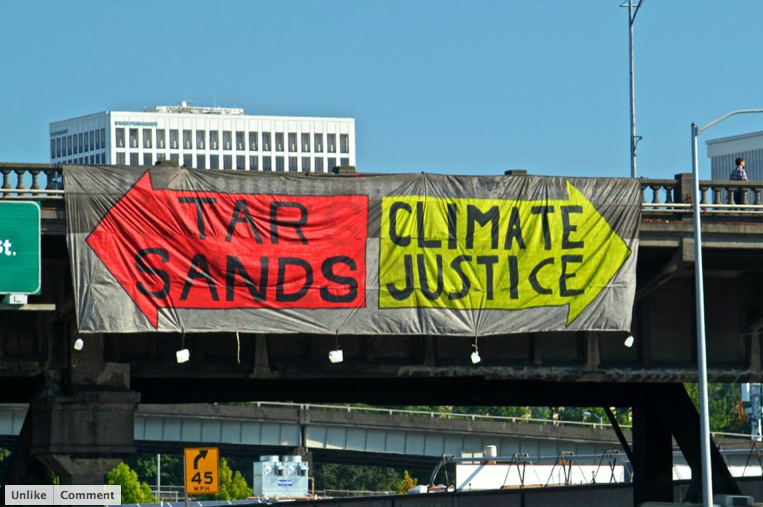
“Portland Rising Tide dropped an anti-tar sands banner today from the Burnside Bridge. The group is acting in solidarity with communities, organizations and individuals resisting tar sands development across North America.
Rising Tide’s action comes on the heels of the 2-week Tar Sands Action campaign in Washington DC. 1,253 American’s were arrested in an act of civil disobedience at the White House to send a message to President Obama, asking him to stand up to Big Oil and deny the Keystone XL tar sands pipeline permits.”
“The Keystone XL pipeline is required for Big Oil to profit off of the social and environmental disaster that is the Alberta tar sands. Current tar sands mining has brought increased cancer rates, polluted water, and mass die-offs of birds and fish in the largely First Nation communities of northern Alberta.
Tar Sands Action organizers have put a call out for activists to hold the date October 7th for further action. This is the final Congressional hearing on the Keystone XL pipeline. Regionally, people are encouraged to visit their local Obama 2012 headquarters and inform staffers that you will withhold your support in the upcoming presidential elections until the pipeline is stopped.”
(Ed. Note: This footage was originally posted on YouTube by a critic. I believe an open dialog is essential to advancing an honest dialog between the various stakeholders involved. Misinformation and disinformation need to be addressed on both sides so that an understanding of the facts can be attained.)
Information is the Key
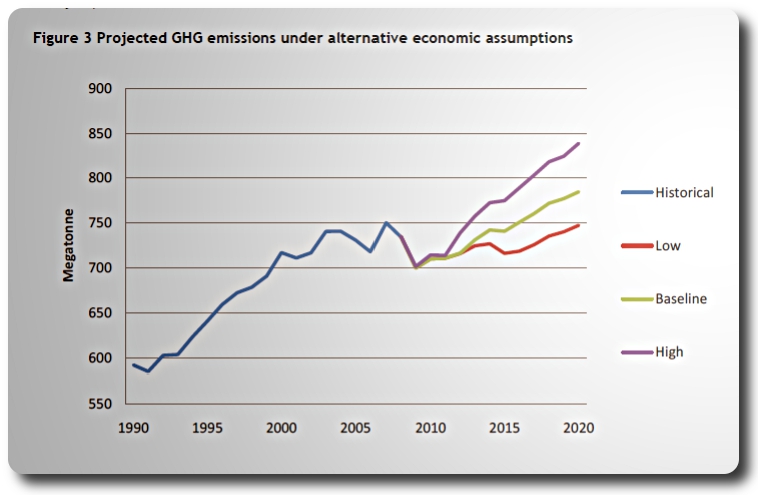
“The future path of greenhouse gas emissions in Canada will depend on a number of factors including: government actions, technological change, the growth in the economy, and developments in energy markets. Without incorporating the impacts of future government measures that have not yet been specified, the projections presented in this report are based on expectations of the evolution of key economic and energy drivers (such as the world oil price, gross domestic product, and population growth) derived from a variety of authoritative sources. However, as with any projection of this type, the likely outcome associated with each specific driver is subject to a high degree of uncertainty. As such, the emissions scenarios presented here should be seen as representative of a number of possible greenhouse gas emissions outcomes to 2020, depending on economic and other developments, as well as future government measures.”
(Ed. Note: Specific mention is made of the impacts due to the expansion of tar sands development on p24-27. GHG emissions are projected to rise in Canada in part because of increases in the exploitation of bitumen as a source of unconventional oil.)
“Canada’s boreal region contains one-quarter of the world’s remaining original forests. It is home to a rich array of wildlife including migratory songbirds, waterfowl, bears, wolves and the world’s largest caribou herds. Canada’s boreal is a major part of the global boreal region that encircles the Earth’s northern hemisphere, storing more freshwater in its wetlands and lakes and more carbon in its trees, soil, and peat than anywhere else on the planet. The Canadian boreal forest is also the location of one of the world’s largest deposits of oil – Alberta’s oil sands.
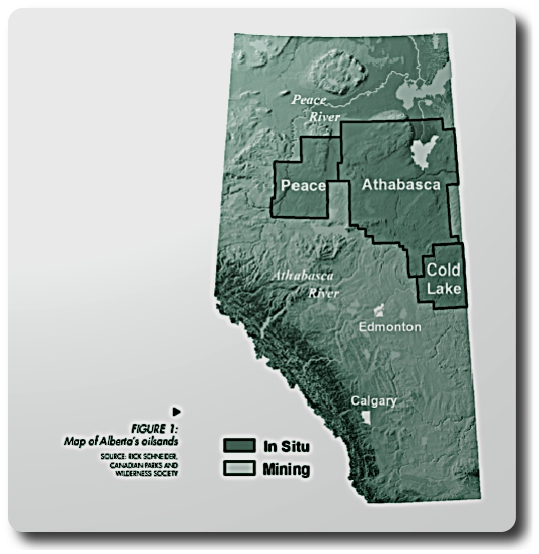
With conventional oil reserves in North America in steady decline, Alberta’s oil sands have begun to attract significant attention, both locally and internationally. Currently, the majority of oil sands production comes from open-pit mining facilities, and it is these shovel and truck operations that most people have come to associate with oil sands development. The mining zone currently extends across approximately 3,300 km2 of northern Alberta and, when fully developed, will likely qualify as the world’s largest open-pit mining complex.
What is not well known is that only a fraction of the total available oil sands deposits are close enough to the surface to be mined. The bulk of the established reserves (81%) must be extracted using in situ techniques.”
(Ed. Note: Canada’s boreal region extends beyond the proposed oil sands extraction sites and comprises almost 60% of the country’s land area.)
“… [I]n situ development of Alberta’s oil sands will result in unprecedented impacts to Alberta’s forests and pose grave risks to regional wildlife populations. Existing in situ leases already total 3.6 million ha (hectares), which is more than ten times the size of the mineable oil sands region. To put this in perspective, we are talking of an intensive industrial use zone larger than Vancouver Island. If existing leases are subjected to the same industrial footprint as the Long Lake project then 296,000 ha of forest will be cleared for SAGD infrastructure and over 30,000 km of access roads will be built. Furthermore, new leases continue to be awarded at a rapid pace, and new technologies for extracting less accessible reserves are continually being developed. If the entire area underlain by oil sands is eventually developed, in situ infrastructure could impact almost 14 million hectares of forest – a land area the size of Florida.”

 Wild Idaho Rising Tide