Tar Sands Myth Busters: Oil


We don’t need the tar sands oil to give us “enough” oil or to free us from oil connections in the Middle East.

1) We have so much oil that the USA is exporting oil.  If we need more, we can export less.

U.S. Awash in Oil and Lies, Report Charges

For more in-depth information, click on “new report” to download a detailed pdf document.

2) We may not need dirty oil from the ground at all pretty soon.  We can pull excess carbon dioxide out of thin air and recycle it into carbon neutral fuel.

Enzyme Holds the Key to Renewable Hydrocarbons

3) We can also have ethanol without starving Africa or triggering frenzied corn speculation.  Many plants that can grow on land not suitable for major food crops can be used to make ethanol.  Agave is just one of them.

Mexico & Agaves: Moving from Tequila to Ethanol

4) Hemp offers many possibilities for cleaner and sustainable fuels.

Hemp Fuel

(Information compiled by Sharon Cousins.)

The True Cost of Oil


Filmed at TEDxVictoria on November 19, 2011, photographer Garth Lenz shares shocking pictures of the environmental devastation of Alberta tar sands mining projects and the beautiful and vital ecosystems they jeopardize.  For almost twenty years, Garth’s photography of threatened wilderness regions, ecological destruction, and impacts on indigenous peoples has appeared in the world’s leading publications.  His recent images from the boreal region of Canada have helped lead to significant victories and large new protected areas in the Northwest Territories, Quebec, and Ontario.  Garth’s major touring exhibit about the tar sands premiered in Los Angeles in 2011 and recently appeared in New York.  Garth is a fellow of the International League of Conservation Photographers.

Another Megaload Snow Job


[Thursday transports postponed: see note below.]  Neither snow, nor rain, nor gloom of night seems to stop the incessant onslaught of tar sands construction traffic through Moscow.  Why would it, when ExxonMobil, one of the largest corporations on Earth, has never played by Nature’s rules, not to mention the weather restrictions of its Idaho Transportation Department permits.  But with a 50 to 100 percent chance of one to two feet of snow and/or rain predicted for the megaload parking/staging area near Lookout Pass during the rest of the week, the three mini-megaloads each on Tuesday and Thursday nights, weighing between 55,000 and 85,000 pounds, could soon upend into the ditch as easily as a recent Lochsa highway fuel truck. Continue reading

Two Injured in U.S. 95 Collision


Two Idaho men were released from the hospital following a rear-end collision Tuesday night near Viola on U.S. Highway 95 that law enforcement claims occurred when one driver stopped to talk with a flagger awaiting Imperial Oil shipments bound for the Idaho/Montana border.

According to the Latah County Sheriff’s Office, Shawn Dewitt, 36, of Princeton, stopped his vehicle on the highway to investigate flashing lights belonging to a flagger awaiting three shipments of refinery equipment and ask how he should proceed. Continue reading

Nightmare on Haul Street


Join Wild Idaho Rising Tide (WIRT) activists, the Moscow Volunteer Peace Band, and local community members on Tuesday and Thursday evenings, November 8 and 10, in vigorously protesting three more ExxonMobil/Imperial Oil megaloads transgressing our dark Idaho highways each night to Alberta tar sands hell.  Although these components of a bitumen upgrader plant mysteriously vanished on Moscow streets during Halloween week, please belatedly wear your most ghoulish and gruesome costumes to demonstrate the death and destruction these megaloads bring to our climate and planet. Continue reading

Survey: Congressional/White House Focus on Fossil Fuel/Nuclear Power Is Out of Touch with Mainstream American Views


An October 2011 survey revealed that MOST Americans favor federal subsidies, construction loans, and investments in wind/solar/efficient energy (but not for fossil fuel/nuclear energy), dislike disproportionate corporate influence on national energy policy and a federally passive approach to energy markets, support phasing-out coal-fired power plants, are concerned about water shortages and pollution and how natural gas fracking affects water quality, connect recent extreme weather-related disasters to climate change, understand the environmental and human health costs of energy sources, and want the U.S. to be a global leader in clean energy technology.

Survey: Congress, White House Focus on Fossil Fuels, Nuclear Power is Out of Touch with Views of Mainstream America


Protesting is Essential


UI Student, Moscow

University of Idaho Argonaut 11/1/11

I am writing to take to task the recent opinion piece written by Katy Sword. The views contained in her critical assessment of the value of protesting are not supported by facts and are typical of the anti-intellectualism rampant among a number of students at the University of Idaho.

The assertion that the protests have not accomplished anything other than “forcing local police to work overtime” is baseless. The protests in Moscow have garnered national attention. Bill McKibben, a well-known environmental activist, has cited the protests in Idaho as a sign of nation-wide opposition to the exploitation of Alberta’s tar sands. The legal battles and protests have also cost ExxonMobil money and successfully set back the project in Canada. These costs have given various stakeholders some bargaining power in seeking concessions from the oil company in its approach to the development of this resource.

Read more: Protesting is Essential

Group Urging Spokane Opposition to Coal Ports


The Sierra Club brings its anti-coal campaign to Spokane on Thursday, urging local residents to oppose terminals at Washington seaports that would ship coal to Asia.

Coal producers are seeking permits to build terminals near Bellingham and Longview to ship up to 130 million tons of coal mined in Montana’s and Wyoming’s Powder River Basin to China, India, Korea, and Japan.

The coal would reach Washington’s coast by rail. Communities along the route, including Spokane, could see dozens more trains loaded with coal rolling through their towns if the terminals are built, said Robin Everett, part of the Sierra Club’s “Beyond Coal” campaign.

Read more: Group Urging Spokane Opposition to Coal Ports

(By Betsy Kramer, The Spokesman-Review)

Port of Lewiston Expansion Application Comments by Saturday


On Wednesday, a dozen regional anti-megaload activists attended and provided oral testimony at the U.S. Army Corps of Engineers public hearing about the Port of Lewiston expansion application.  Please lend an ear to the Thursday, October 20, KRFP Evening Report between 11:03 and 9:16 for a brief summary of the arguments presented by opponents and proponents of the Port’s proposal to gravel a storage yard, move a mooring dolphin, and extend the dock into the Clearwater River, explicitly to accommodate larger shipments.  Because most of the public comments voiced at the Lewiston hearing supported Port expansion, your comments are crucial to requesting a full environmental impact statement, accompanying public involvement, and ultimate denial of this expensive and short-sighted project.  Please peruse the previous WIRT Port of Lewiston Permit Application Comments for writing prompts.  The Corps has received 140 written comments to date: let’s double that number with your expansion-denouncing input by Saturday, October 29, at midnight.

(From WIRT Newsletter)

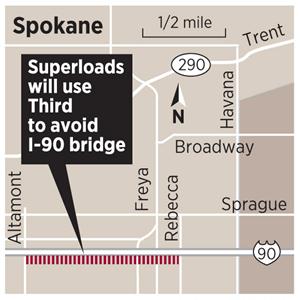
Superloads Will Divert to Third Avenue


(The Spokesman-Review/Kimberly Lusk image)

Unclear if 250 oversize loads are bound for Alberta oil project

A series of superloads coming through Spokane will travel down a portion of Third Avenue during the next several months because they don’t fit under a bridge over Interstate 90.

Residents along the affected stretch of Third received notices Oct. 11 from the city of Spokane Neighborhoods Services stating the loads would exit I-90 at Altamont Street and travel down Third for several blocks because they are too big to fit under the nearby pedestrian bridge. They will re-enter the interstate at Rebecca Street.

Read more: Superloads Will Divert to Third Avenue

(By Chelsea Bannach, The Spokesman-Review)