Friday: Tell Idaho Representatives to Vote No on Senate Bill 1339!


On Friday, March 4, at an unknown time, the full Idaho House of Representatives will hold the final vote on Senate Bill 1339 (S1339) [1, 2]. The Senate Resources and Environment Committee passed S1339 to the Senate floor on Friday, February 19, after an Alta Mesa oil and gas company attorney pushed for bill hearing closure, before all of the subsequently angry citizens present could testify.  Only Democrat committee member Michelle Stennett voted against this bill that, if passed by the Idaho Legislature and codified as an emergency law by Governor Otter’s signature, would expedite Idaho oil and gas development permitting procedures and further severely limit due process, associated public input and appeals, and information available to citizens, some forced to develop their mineral interests and most concerned about fossil fuel project impacts to private and public lands, water, air, and property rights [3-5].

According to Betsy Russell’s Eye on Boise, “after a two-hour debate, the Idaho Senate voted 31-4 in favor of SB 1339, a controversial proposal to streamline the process for issuing permits for oil and gas wells. The bill drew close to 100 people to an earlier hearing, most of them opposed…The bill now moves to the House side.  The Senate vote came just after 6:30 p.m. Boise time, half an hour after the Senate had been scheduled to conclude its late-afternoon session, which started at 4:30.  It was the only bill taken up.” [6]  On Tuesday, March 1, the Idaho House Resources and Conservation Committee held a hearing on this industry-promoted bill and passed S1339 on a two-to-one ratio [7].  Wild Idaho Rising Tide (WIRT) emailed letters of opposition to both Senate and House committees.

Meanwhile, on Monday, February 22, over 150 citizens participated in a rally on the Capitol steps in Boise, protesting the bill and oil and gas industry and infrastructure abuses of Idaho citizen health, private property rights, and essential air, water, and soil quality, at the Don’t Frack Idaho Statehouse Rally, hosted by Citizens Allied for Integrity and Accountability [8-12]. Organizing protests and rallies against oil and gas development around the state since 2012, WIRT activists are grateful that more than a few dozen Idahoans are finally displaying widespread resistance.

If the Idaho legislature could possibly defend your interests, please contact all of the state representatives, to oppose full Idaho House floor passage of S1339. See the comprehensive list of representative email addresses at citation 7 and talking point suggestions at the following links [13, 14].  NOW is your last chance to write to or call them on this issue, urging them to vote against this legislation that forces oil and gas development on unwilling land and mineral rights owners and that dismisses the public’s best interests and participation in permitting decisions.  Thank you! Continue reading

Friday Oil & Gas Bill Hearing & Monday Boise Protest/Carpools


Please take urgent action on these two significant Idaho oil and gas resistance events.  Thanks to Citizens Allied for Integrity and Accountability (CAIA) of Fruitland, Idaho, for organizing and sharing news about them!  Contact CAIA with your questions and suggestions at info@integrityandaccountability.org, IntegrityAndAccountability.org, or 208-963-5707.

Friday: Oppose Idaho Senate Bill 1339

The first oil and gas bill of the 2016 session is printed and scheduled to be heard on Friday, February 19, at 1:30 pm MST, first on the day’s agenda of the Idaho Senate Resources and Environment Committee [1, 2].  Attorney Kate Haas of the law firm Kestrel West, representing the primary Idaho oil and gas development company, Alta Mesa, will present Senate Bill 1339 (S1339) in Room WW55 of the Idaho Capitol in Boise [3].  Please participate in this hearing by attending in support of bill opponents, submitting your written comments in advance or in person, and/or speaking against S1339 for up to three minutes.  Contact Committee members by phone or email before the hearing.

Call 208-332-1323 and/or email sres@senate.idaho.gov, to extend your comments to all of the committee members together, or write to each and all of them at their individual addresses: Steve Bair <sbair@senate.idaho.gov>, Clifford Bayer <cbayer@senate.idaho.gov>, Marv Hagedorn <mhagedorn@senate.idaho.gov>, Lee Heider <lheider@senate.idaho.gov>, Roy Lacey <rlacey@senate.idaho.gov>, Sherry Nuxoll <snuxoll@senate.idaho.gov>, Jeff Siddoway <jsiddoway@senate.idaho.gov>, Michelle Stennett <mstennett@senate.idaho.gov>, Steve Vick <sjvick@senate.idaho.gov>.

S1339 would expedite all Idaho oil and gas development applications and further exclude Idahoans from crucial public input, as described in the following and attached, useful, talking points.  As an emergency bill, effective with Governor Otter’s signature, S1339 would essentially and immediately strip all due public process from oil and gas permitting in Idaho, risking the integrity of Idaho law and private and public property rights.  Compounding ongoing oil and gas industry degradation of the health and safety of Idahoans and their environment, this legislation, if passed over strong citizen objections, would: Continue reading

WIRT Comments on Tesoro Savage Vancouver Energy Project Draft Environmental Impact Statement


January 22, 2016

Sonia Bumpus, EFS Specialist, & EFSEC Members

Energy Facility Site Evaluation Council (EFSEC)

State of Washington

1300 S. Evergreen Park Drive SW

P.O. Box 43172

Olympia, Washington 98504-3172

sbumpus@utc.wa.gov

Sent via email and attachment

WIRT Comments on Tesoro Savage Vancouver Energy Project Draft Environmental Impact Statement

Members of the Energy Facility Site Evaluation Council,

On behalf of over 3200 members, friends, and allies of Wild Idaho Rising Tide (WIRT), including potentially impacted, concerned north Idaho residents near the proposed and existing rail routes affected by this proposal, I respectfully offer and request inclusion in the public record of these comments regarding the Tesoro Savage Vancouver Energy Project draft environmental impact statement (DEIS), during the public agency and citizen review period from November 24, 2015, until January 22, 2016 [1]. WIRT and associates collectively object to state permitting of the Tesoro Savage oil train terminal planned for the Port of Vancouver, Washington, which would impart myriad, significant risks and only marginal rewards for communities along the rail tracks and bridges, rivers, and lakes of Tesoro’s and Savage’s profitable thoroughfare to crude oil export.  In support of this official letter of resistance to Washington state Energy Facility Site Evaluation Council (EFSEC) approval of this application and resulting, destructive, implementation activities, we thoroughly concur with, contribute toward, and incorporate the concerns, oral testimony, and comments of all project opponents.

The Tesoro and Savage corporations intend to build the biggest crude-oil-by-rail terminal in the U.S. at the Port of Vancouver, potentially transferring an estimated 360,000 barrels per day of explosive Bakken shale oil and volatile Alberta diluted bitumen (tar sands) to tank farms across the Columbia River from Portland, Oregon, and to huge, ocean-going oil tankers shipping it to West Coast refineries and the world market [2]. Inevitable, disastrous, consequent oil spills into river, lake, or sea waters along rail and ocean routes, especially releases of thick tar sands oil that sinks to the bottom of waterways, would devastate local and regional waters and environments, fisheries, tribal lifeways, communities, and economies.

While moving enormous volumes of oil that ultimately impact our shared global climate, the Tesoro Savage facility would also increase the risk of fiery oil train accidents in countless communities along Northwest rail lines, from the Hi-Line around U.S. Highway 2 in Montana, to U.S. Highway 95 corridor towns from Bonners Ferry to Rathdrum in northern Idaho, to the dangerously elevated bridge and track funnels through the Sandpoint, Idaho area and downtown Spokane, Washington, to the Columbia River Gorge between eastern Oregon and Washington, to Vancouver [3, 4]. Every day, the huge oil terminal would bring four or more 100-car, mile-long trains toward the West Coast, hauling flammable cargo through climate-change-drying forests, increasingly dense cities, and ever more precious water bodies.  Public officials and emergency responders across the Northwest have raised concerns about the severe threats of oil train derailments, explosions, and pollution, as such incidents continually proliferate [5-7].

Many WIRT and allied group members who carpooled from Moscow and Sandpoint, Idaho, and Pullman, Washington, participated in the regional community rally of terminal opponents and orally testified at the public hearing on the project’s DEIS, hosted by EFSEC on Thursday evening, January 14, 2016, in Spokane Valley, Washington [8-10]. These activists spoke against the Tesoro Savage proposal, the deficiencies of its DEIS findings, greater hazards imposed by this massive project of significant oil spills, air pollution, loaded train derailments, explosions, fires, and accidents causing numerous injuries and deaths, increased rail and waterway traffic of oil tankers, harm to federally protected salmonids and aquatic species, detrimental effects on tribal treaties, cultures, and resources, susceptibility of the facility to earthquakes, more and longer vehicle delays at railroad crossings, and overall exacerbation of climate change [11].  These myriad, significant, environmental, social, and human health harms cannot be fully mitigated by the project proponents or local, state, and federal agencies.  Moreover, the project DEIS does not even consider the predictable potential impacts of this oil terminal beyond Washington state. Continue reading

Inland NW Oil Train Terminal Rally & Hearing


Tesoro Savage Hearing Train

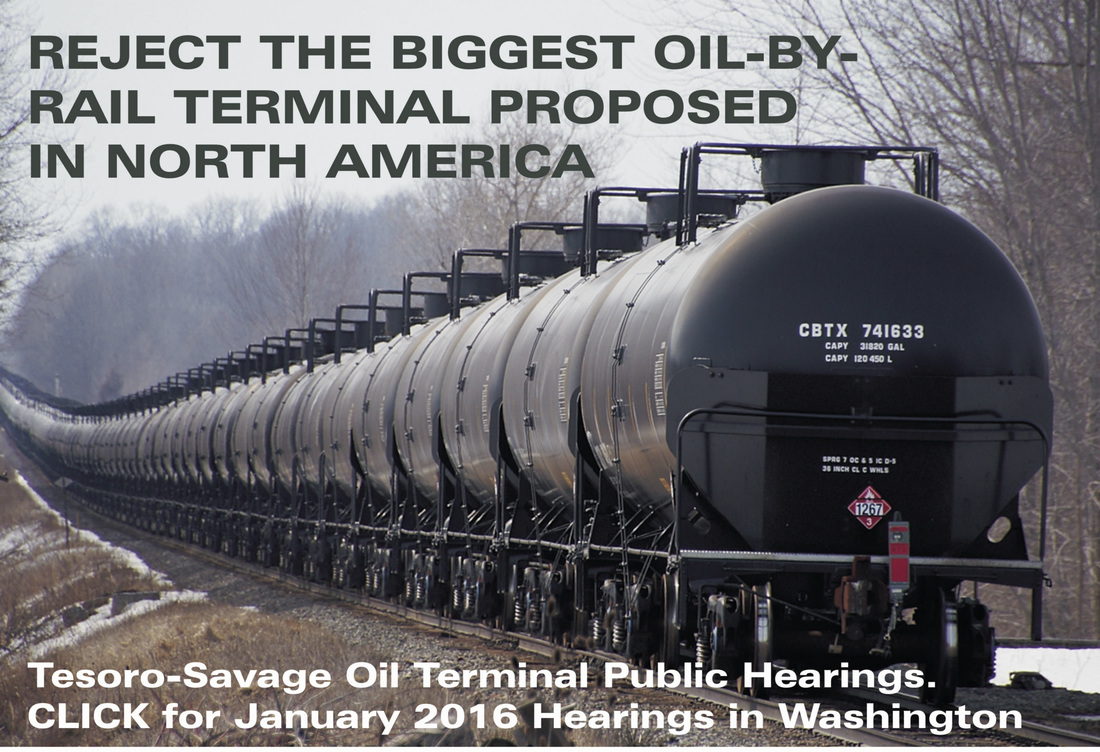
On Thursday, January 14, 2016, please join Wild Idaho Rising Tide (WIRT) and allied groups carpooling from Moscow and Sandpoint, Idaho, and Pullman, Washington, to participate in the 4:30 pm regional community rally against the Tesoro-Savage Vancouver Energy Project, an oil train terminal proposed for the Port of Vancouver, Washington. At the same location – Centerplace Regional Event Center at 2426 North Discovery Place in Spokane Valley, Washington – the Washington state Energy Facility Site Evaluation Council (EFSEC) is hosting a public hearing on the project’s draft environmental impact statement (DEIS), from 5 to 11 pm or until the last testifier, hopefully late at night after many opposing speakers [1, 2].

Big Oil plans to build the largest crude-by-rail terminal in North America, potentially transferring an estimated 360,000 barrels per day of explosive Bakken shale oil and volatile Alberta diluted bitumen (tar sands) to tank farms across the Columbia River from Portland, Oregon, and to huge, ocean-going oil tankers shipping it to West Coast refineries and the world market [3]. Inevitable, resulting oil spills into river, lake, or sea waters along rail and ocean routes, especially releases of thick tar sands oil that sinks to the bottom of waterways, would disastrously affect local and regional environments, communities, and economies.

While moving enormous volumes of oil that ultimately impact our shared global climate, the Tesoro-Savage facility would also increase the risk of fiery oil train accidents in countless communities along Northwest rail lines, from the Hi-Line around U.S. Highway 2 in Montana, to U.S. Highway 95 corridor towns from Bonners Ferry to Rathdrum in northern Idaho, to the dangerously elevated bridge and track funnels through the Sandpoint, Idaho area and downtown Spokane, Washington, and down the Columbia River Gorge between eastern Oregon and Washington to Vancouver [4, 5]. The huge oil export terminal would bring four more 100-car trains hauling flammable cargo through climate-change-drying forests, increasingly dense cities, and ever more precious water bodies every day.  Public officials and emergency responders across the Northwest have raised concerns about the severe threats of train derailments, explosions, and pollution, as such incidents continually proliferate [6-8].

Northwesterners have successfully delayed, re-routed, and/or stopped similar fossil fuel infrastructure plans over the last five years, most notably tar sands mining and refining megaloads, coal export terminals, and just this week, a Grays Harbor oil terminal [9]. Faced with a flood of proposed coal, oil, and liquefied natural gas terminals in the Pacific Northwest, hundreds of concerned citizens like you have attended hearings to tell decision-makers no.  Altogether, people power has delayed nine fossil fuel terminals and stopped nine others in Oregon and Washington.

In Spokane Valley on January 14, your help is essential to protecting the safety, health, and environment of the Idaho panhandle and inland Northwest, by halting this oil terminal and its additional trains crossing the region [10]. Although jumping through government/industry-imposed hearing hoops held up to placate the public is not radical climate activism – wherein citizens, not their oppressors, define the terms of engagement – we encourage you to speak out and show the advising Washington EFSEC and decision-maker Governor Jay Inslee that the dirty and dangerous Tesoro-Savage proposal is all risk and no reward for our communities.  Hundreds of terminal opponents are already making history at these three important public meetings [11].  Native nations, civic groups, environmental organizations, firefighters, health and emergency professionals, and other individuals will similarly attend the Spokane Valley hearing. Continue reading

Help Stop ITD Paving Paradise by Monday!


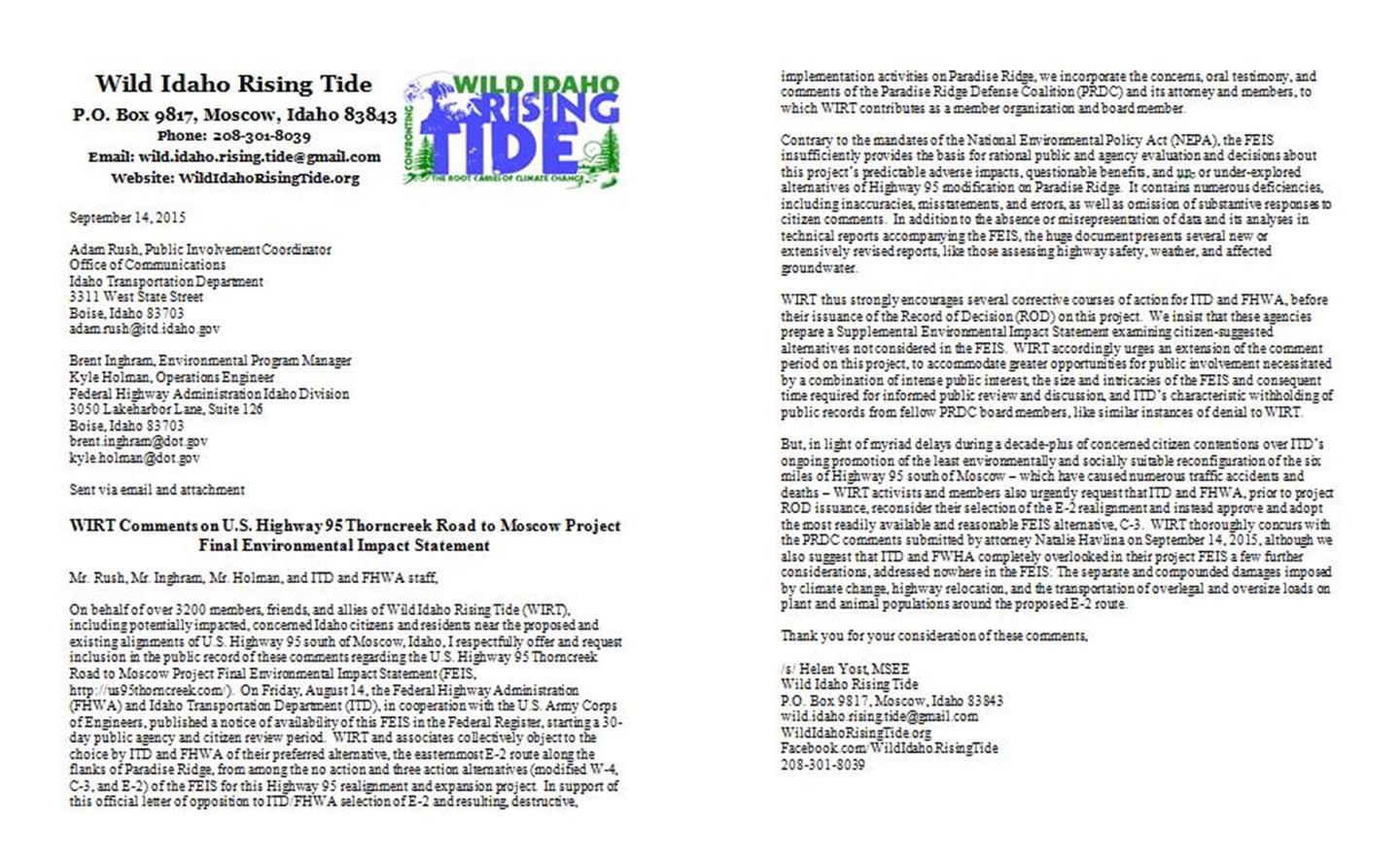
Please excuse the lateness of this message, but Wild Idaho Rising Tide (WIRT) could not miss this chance to alert you to the opportunity to comment on and support resistance to the final environmental impact statement (FEIS) on the U.S. Highway 95 Thorncreek Road to Moscow project. On Friday, August 14, the Federal Highway Administration (FHWA) and Idaho Transportation Department (ITD), in cooperation with the U.S. Army Corps of Engineers, published a notice of availability of the FEIS for the Highway 95 realignment and expansion project in the Federal Register, starting a 30-day public (citizen and agency) review period. After myriad delays during a decade of concerned citizen contentions and “intense review and study,” ITD and FHWA have again indicated their preference for the easternmost route, E-2 along the flanks of Paradise Ridge, from among the no action and three action alternatives (modified W-4, C-3, and E-2) of the FEIS.

The Paradise Ridge Defense Coalition (PRDC), to which WIRT contributes as a member organization and board member, received this news from its attorney a few days before FEIS release. The huge document, accessible electronically on an ITD website and available for public viewing through printed paper copies at various locations like libraries, city halls, and chambers of commerce, offers corrections to the January 2013 draft environmental impact statement (DEIS) and thousands of pages of combined public comments on the DEIS, ITD responses, appendices, and technical reports (some presenting new information). Its size alone, not to mention its numerous shortcomings, warrant an extension of time to review its analyses of project effects on natural and human environments. Nonetheless, PRDC board members and their lawyer have been urgently scrutinizing the FEIS, applying their greatly appreciated, collective expertise, diligence, and doggedness, to identify and develop legally defensible arguments refuting multiple aspects of the FEIS. They have recently held a special and regular monthly meeting, and intend to submit final comments before the September 14, 2015 deadline.

At an unknown time after the 30-day review period, FHWA will issue a record of decision (ROD) for the highway improvement project purportedly improving the safety and capacity of the 6.3-mile segment of U.S. 95 between mileposts 338 and 344 – Thorn Creek Road to the South Fork Palouse River Bridge in Latah County, Idaho. PRDC and WIRT will send updates on the situation and opportunities for your involvement, as PRDC and its lawyer review the FEIS and consider as quickly as possible potential litigation and supporting actions such as membership meetings and recruitment of impacted residents, fundraising events and mechanisms to cover legal costs, and effective public protests.

PLEASE HELP BY MONDAY! Continue reading

Panhandle Paddle!


Panhandle Paddle Flyer

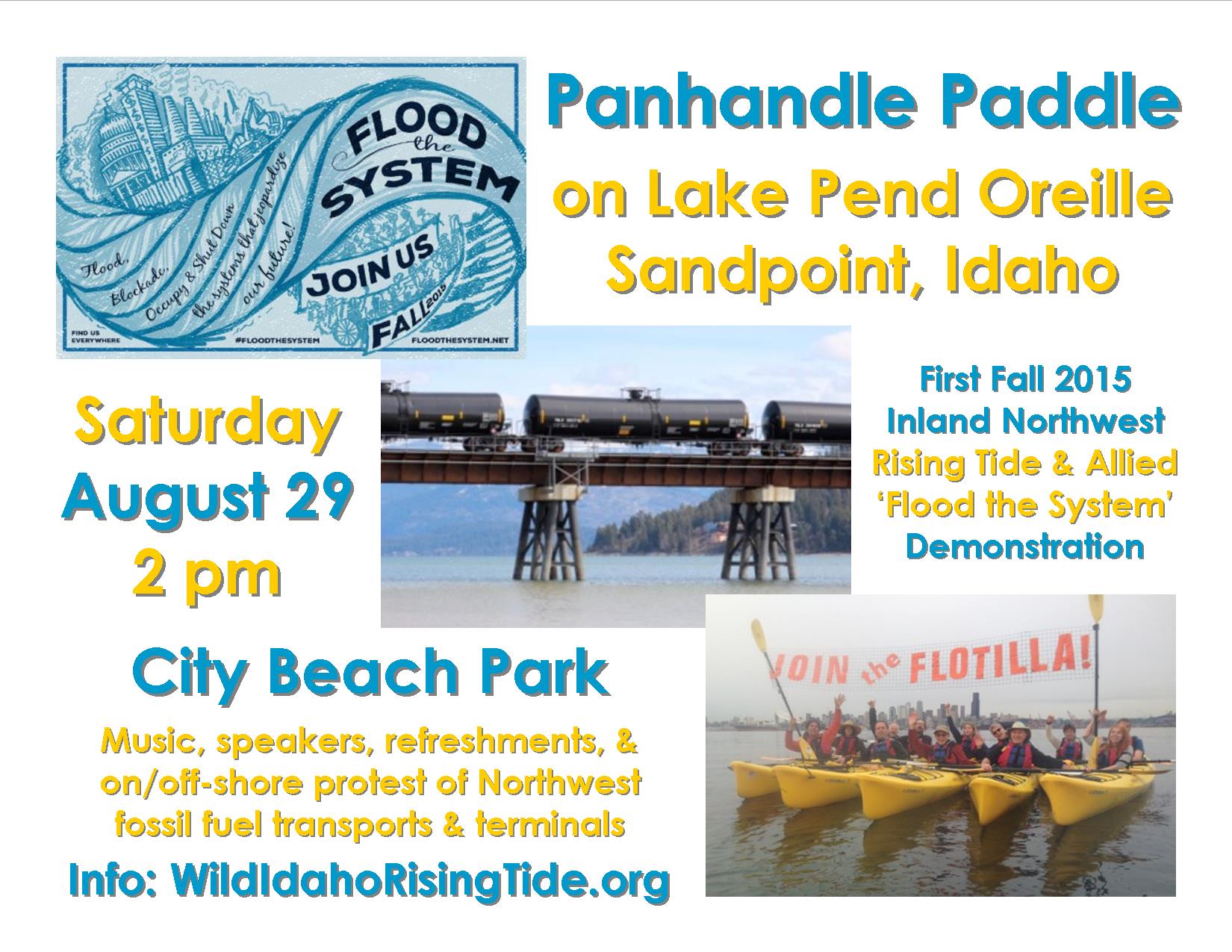
Organizing the first in a series of coordinated, region-wide, fall 2015 Flood the System actions and ongoing mobilization of frontline, inland Northwest communities impacted by fossil fuel incursions and unjust economic, social, and political conditions, Wild Idaho Rising Tide (WIRT) and allied activists in Sandpoint, Moscow, Spokane, and beyond are excited to announce and host the Panhandle Paddle on Saturday, August 29 [1]! After further WIRT outreach and education between 9 am and 1 pm at the Farmers’ Market at Sandpoint, WIRT members and friends are converging at 2 pm at City Beach Park in Sandpoint, Idaho, for music, speakers, refreshments, and on- and off-shore protests of Northwest fossil fuel transports and terminals and rail bridge expansion on Lake Pend Oreille. In the wake of four Flood the System slide shows and discussions in Idaho and Washington and parallel Montana initiatives, we are eager to “flood, blockade, occupy, and shut down the systems that jeopardize our future” [1-3].

Join in some summer fun on the water and beach to show Big Oil, King Coal, their railroad industry haulers, and government facilitators that north Idahoans will not stand for their reckless endangerment of our lives, communities, water, air, and climate, with their explosive Alberta tar sands and Bakken crude oil trains and their heavy, dusty Powder River Basin coal cars. Northwesterners have plenty to celebrate about our shared resistance, as dozens of proposals for new and expanded fossil fuel infrastructure falter and fall [4]. Please participate in these Panhandle Paddle activities: Continue reading

Sandpoint Stops Oil Trains Week of Action 2015 Report


20150711_001823

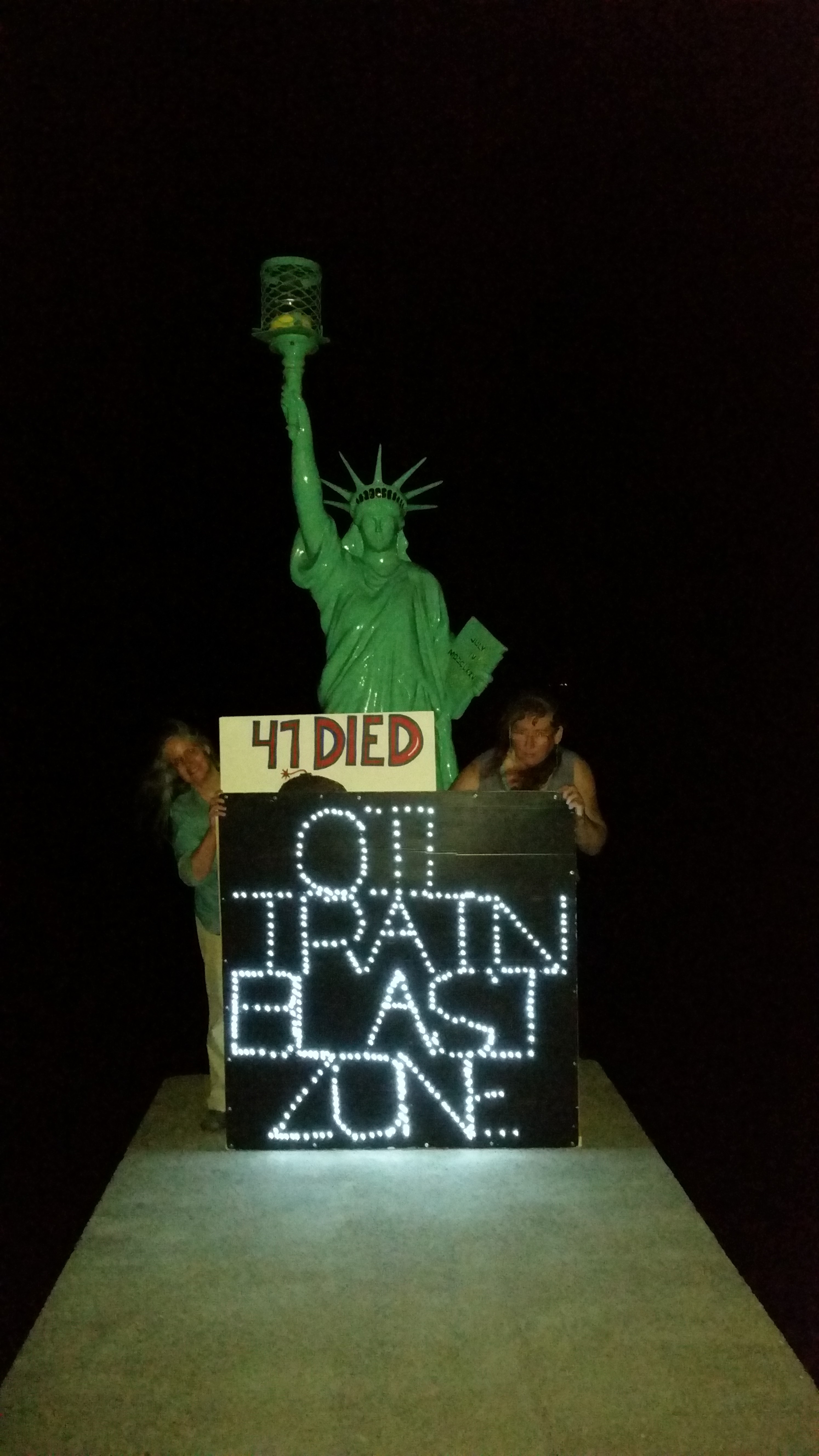
On Monday evening, July 6, through Sunday afternoon, July 12, activists of Wild Idaho Rising Tide (WIRT), Spokane Rising Tide (SPORT), and the Occupy movement participated in several demonstrations of the Sandpoint Stops Oil Trains Week of Action 2015, to halt oil train traffic while commemorating the second anniversary of the July 6, 2013, Lac Mégantic, Quebec oil train catastrophe that took 47 lives [1, 2]. Together with climate, environmental, and social justice activists across North America, WIRT and allies organized and staged over 100 powerful and effective, local demonstrations during the Stop Oil Trains Week of Action [3, 4]. These events in the United States and Canada stood in solidarity, defense, and protection of the residents of Lac Mégantic, who lost 47 people killed by an exploding oil train, and other frontline, rail corridor communities and our shared global climate, all caught in the crosshairs of the oil and rail industries’ pipelines on wheels.

Although dozens of horrifying, fiery, extreme energy train wreck disasters have occurred over the last two years since the grim Quebec accident, northern Idaho and eastern Washington citizens continue to endure the unsafe, risky, and expanding rail transportation of potentially explosive Alberta tar sands dilbit, moved by the Union Pacific Railroad, and fracked Bakken shale oil, hauled by the Burlington Northern Santa Fe Railway (BNSF), both to Washington and West Coast refineries. BNSF has previously reported that 16 to 19 mile-long oil trains traverse the interior Northwest every week. Additionally on the 70-mile-long, railroad chokepoint between the Sandpoint and Spokane downtown areas, referred to as “the funnel,” BNSF carries dusty, diesel-towed coal from the Powder River Basin along the Montana/Wyoming border to coastal terminals for export. Recently revised federal regulations no longer require BNSF to report the number of oil trains that pass through the region, and have never forced disclosure of Union Pacific tar sands by rail volumes.

With their hazardous loads and reckless resource and policy exploitation, Big Oil and Rail discount and transgress the millions of lives, the human and environmental health and safety repercussions, and the associated carbon and other toxic pollution within the mile-wide, track-side, oil train blast zones, along their paths to profit around the Pacific Rim [5]. In appropriate response, thousands of concerned citizens gathered for 63 events in July 2014, including multiple protest and outreach actions in Sandpoint and Spokane [6]. 2015 participants joined in actions to publicly call attention to the growing threat of “bomb trains,” to display the growing power of the worldwide climate movement, and to demand an immediate ban on all crude oil trains. Continue reading

Sandpoint Stops Oil Trains Week of Action 2015


Stop Oil Trains

Monday, July 6, marks the second anniversary of the tragic Lac Mégantic, Quebec, oil train catastrophe that killed 47 people in 2013.  Despite dozens of almost as horrifying, fiery disasters over the last two years, the oil industry continues to dramatically expand Alberta tar sands and Bakken crude oil train transport throughout Canada and the United States.  There is no safe way to transport such explosive oil and, with carbon and associated toxic pollution rising, oil trains wreck public and environmental health and safety and the global climate of communities across the continent.

The tragic Lac Mégantic accident grimly reminds us all that Big Oil will stop at nothing to extract, transport, and burn every drop of oil in the ground.  Its primary northern Idaho/eastern Washington haulers, Burlington Northern Santa Fe Railway (BNSF) carrying fracked Bakken shale oil and Union Pacific Railroad moving Alberta tar sands dilbit through the Sandpoint, Idaho, and Spokane, Washington, areas, discount the communities they transgress with hazardous loads.  Recent, industry-friendly, federal regulation revisions will not check their recklessness.  The risks, costs, and millions of lives within the mile-wide, bomb train blast zones along their paths to profit around the Pacific Rim represent only collateral damage to the oil and railroad industries.

In July 2014, thousands of concerned citizens gathered at 63 events for the first Stop Oil Trains Week of Action, including multiple protest and outreach actions in Sandpoint and Spokane [1].  As Wild Idaho Rising Tide (WIRT) and allies continue to actively oppose Alberta tar sands and Bakken shale oil exploitation and train and pipeline transportation, we refuse to let Big Oil play Russian roulette with our families, friends, homes, businesses, and climate!  On July 6 to 12, 2015, people across North America are defending their communities and climate, to halt extreme energy in its tracks and end the oil and rail industries’ pipeline on wheels [2].  We will call attention to the growing threat of oil trains, as we demonstrate the growing power of our movement, organizing more than 100 events across the U.S. and Canada, which demand an immediate ban on oil trains.

Please join WIRT and allies at local demonstrations during the Stop Oil Trains Week of Action, and/or host or attend an event in your vicinity between July 6 and 12.  Together with climate, environmental, and social justice activists across North America, we are organizing various tactics and resources to stage powerful and effective actions and documenting them with photos, videos, audio, and social media, to defend and protect frontline, rail corridor communities and our shared climate.  Stand with residents of Lac Mégantic and other communities in the crosshairs of Big Oil, to stop oil trains this July, by participating in one or all of these five actions. Continue reading

WIRT Newsletter: BLM Oil & Gas Lease Protest Report & Postponed State Auctions, Integration Applications, & WIRT Meetings


July WIRT Meetings

We have rescheduled the twice-monthly Wild Idaho Rising Tide (WIRT) potluck/pizza meetings in July, due to the Fourth of July holiday and July/August WIRT availability in Sandpoint.  Please join WIRT activists at 7 pm next Thursday, July 9, at The Attic, up the back stairs of 314 East Second Street in Moscow, Idaho, and at 7 pm on Saturday,  July 18, at Second Avenue Pizza, 215 South Second Avenue in Sandpoint, Idaho.  WIRT and allies are scheming multiple summer events expanding the movement against extreme energy, through powerful convergences, training camps, and direct actions for a livable future.  Please visit often the constantly updated Events Calendar on the WIRT website and/or contact WIRT for the descriptions, logistics, carpools, and directions to climate justice activities in the inland Northwest region [1].  Get involved in emerging, grassroots, fossil fuels resistance and solidarity with our comrades across the continent, confronting the root causes of climate change!

State Oil and Gas Lease Auction Postponed (Again)!

Throughout 2015, WIRT has been promising, preparing for, and posting about our planned protest of the next auction of oil and gas leases on state lands and minerals by the Idaho Department of Lands (IDL).  The IDL website now notes that “this [July 1] auction has been postponed [for the fourth time this year (January, April, June, and July)!] until the fall of 2015, with an exact date to be determined [October 21, 2015?].  Information on the auction is subject to change.” [2]  Idaho has leased none of its public holdings for oil and gas exploitation this year!

Drilling Unit Integration Applications Stalled!

Another Idaho gasland “set-back” for oil and gas developers Alta Mesa!  The 21-day period for formal public comments and responses from impacted land and minerals owners to the Idaho Oil and Gas Conservation Commission ended on June 29 and 30, for two Alta Mesa Services applications for integration (forced pooling by the state of non-compliant, private, potential oil and gas leasers), dated June 8 and 9.  But according to the Idaho Department of Lands website, “IDL requested additional information from the applicant, and an amended application is expected [3].  The applications posted here are for public informational purposes only and are not being considered by IDL or the Commission at this time.”  Congratulations to our southern Idaho comrades for their great work in holding off the gashole frackers! [4, 5]

Idaho BLM Oil and Gas Lease Protest Report

At a public auction in Boise, Idaho, on Thursday, May 28, the U.S. Bureau of Land Management (BLM) leased 6,349 acres in the Little Willow Creek watershed in Payette County for oil and gas exploration drilling [6, 7].  A lone Wild Idaho Rising Tide protester clad in an organizational T-shirt attended the auction, confronting the BLM with every question she could muster, witnessing possibly rigged, procedural discrepancies, and learning that allies had filed complaints of which few people aware [8]. Continue reading