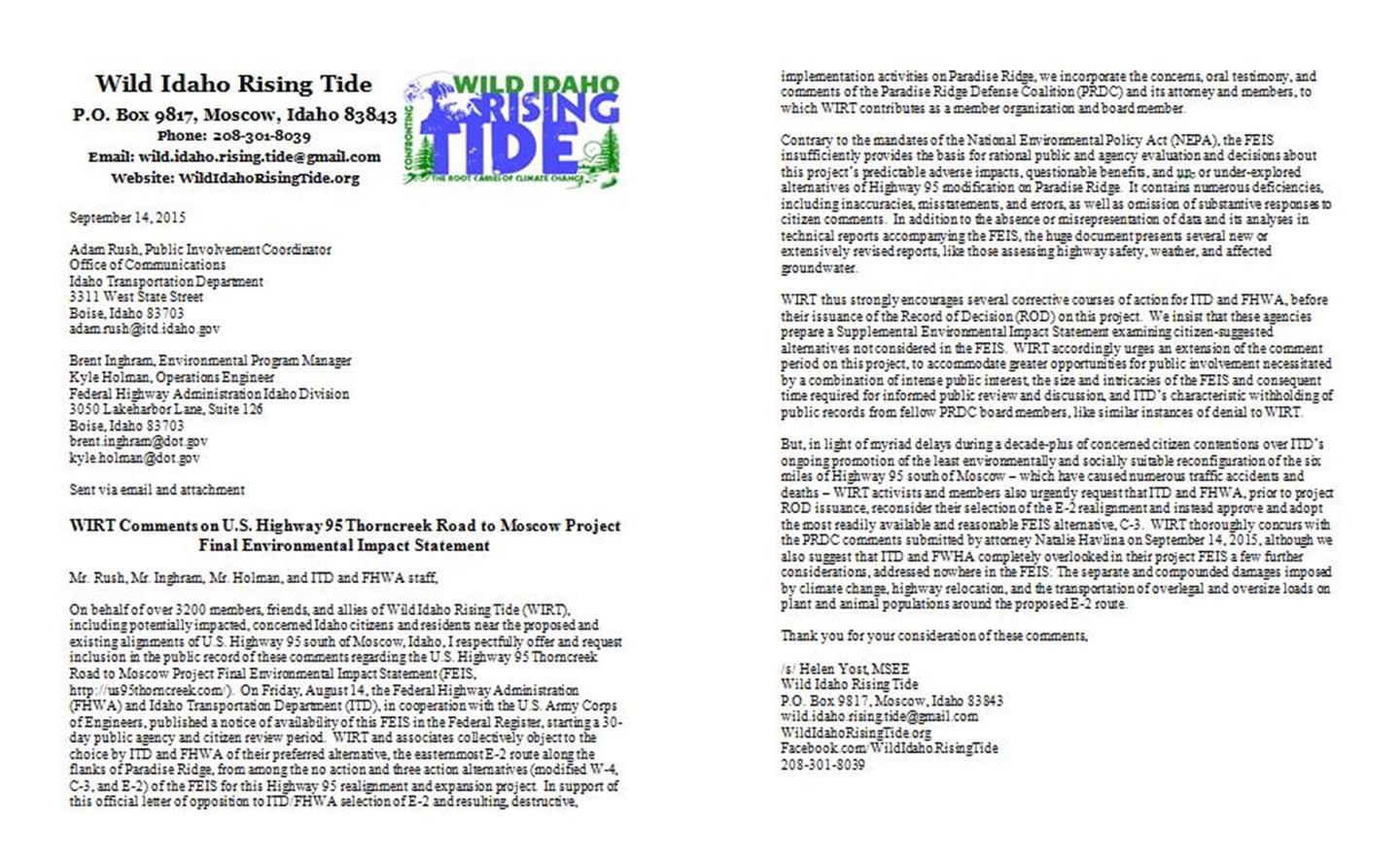
WIRT Comments on U.S. Highway 95 Thorncreek Road to Moscow Project FEIS
Please excuse the lateness of this message, but Wild Idaho Rising Tide (WIRT) could not miss this chance to alert you to the opportunity to comment on and support resistance to the final environmental impact statement (FEIS) on the U.S. Highway 95 Thorncreek Road to Moscow project. On Friday, August 14, the Federal Highway Administration (FHWA) and Idaho Transportation Department (ITD), in cooperation with the U.S. Army Corps of Engineers, published a notice of availability of the FEIS for the Highway 95 realignment and expansion project in the Federal Register, starting a 30-day public (citizen and agency) review period. After myriad delays during a decade of concerned citizen contentions and “intense review and study,” ITD and FHWA have again indicated their preference for the easternmost route, E-2 along the flanks of Paradise Ridge, from among the no action and three action alternatives (modified W-4, C-3, and E-2) of the FEIS.
The Paradise Ridge Defense Coalition (PRDC), to which WIRT contributes as a member organization and board member, received this news from its attorney a few days before FEIS release. The huge document, accessible electronically on an ITD website and available for public viewing through printed paper copies at various locations like libraries, city halls, and chambers of commerce, offers corrections to the January 2013 draft environmental impact statement (DEIS) and thousands of pages of combined public comments on the DEIS, ITD responses, appendices, and technical reports (some presenting new information). Its size alone, not to mention its numerous shortcomings, warrant an extension of time to review its analyses of project effects on natural and human environments. Nonetheless, PRDC board members and their lawyer have been urgently scrutinizing the FEIS, applying their greatly appreciated, collective expertise, diligence, and doggedness, to identify and develop legally defensible arguments refuting multiple aspects of the FEIS. They have recently held a special and regular monthly meeting, and intend to submit final comments before the September 14, 2015 deadline.
At an unknown time after the 30-day review period, FHWA will issue a record of decision (ROD) for the highway improvement project purportedly improving the safety and capacity of the 6.3-mile segment of U.S. 95 between mileposts 338 and 344 – Thorn Creek Road to the South Fork Palouse River Bridge in Latah County, Idaho. PRDC and WIRT will send updates on the situation and opportunities for your involvement, as PRDC and its lawyer review the FEIS and consider as quickly as possible potential litigation and supporting actions such as membership meetings and recruitment of impacted residents, fundraising events and mechanisms to cover legal costs, and effective public protests.
PLEASE HELP BY MONDAY! Continue reading

Organizing the first in a series of coordinated, region-wide, fall 2015 Flood the System actions and ongoing mobilization of frontline, inland Northwest communities impacted by fossil fuel incursions and unjust economic, social, and political conditions, Wild Idaho Rising Tide (WIRT) and allied activists in Sandpoint, Moscow, Spokane, and beyond are excited to announce and host the Panhandle Paddle on Saturday, August 29 [1]! After further WIRT outreach and education between 9 am and 1 pm at the Farmers’ Market at Sandpoint, WIRT members and friends are converging at 2 pm at City Beach Park in Sandpoint, Idaho, for music, speakers, refreshments, and on- and off-shore protests of Northwest fossil fuel transports and terminals and rail bridge expansion on Lake Pend Oreille. In the wake of four Flood the System slide shows and discussions in Idaho and Washington and parallel Montana initiatives, we are eager to “flood, blockade, occupy, and shut down the systems that jeopardize our future” [1-3].
Join in some summer fun on the water and beach to show Big Oil, King Coal, their railroad industry haulers, and government facilitators that north Idahoans will not stand for their reckless endangerment of our lives, communities, water, air, and climate, with their explosive Alberta tar sands and Bakken crude oil trains and their heavy, dusty Powder River Basin coal cars. Northwesterners have plenty to celebrate about our shared resistance, as dozens of proposals for new and expanded fossil fuel infrastructure falter and fall [4]. Please participate in these Panhandle Paddle activities: Continue reading
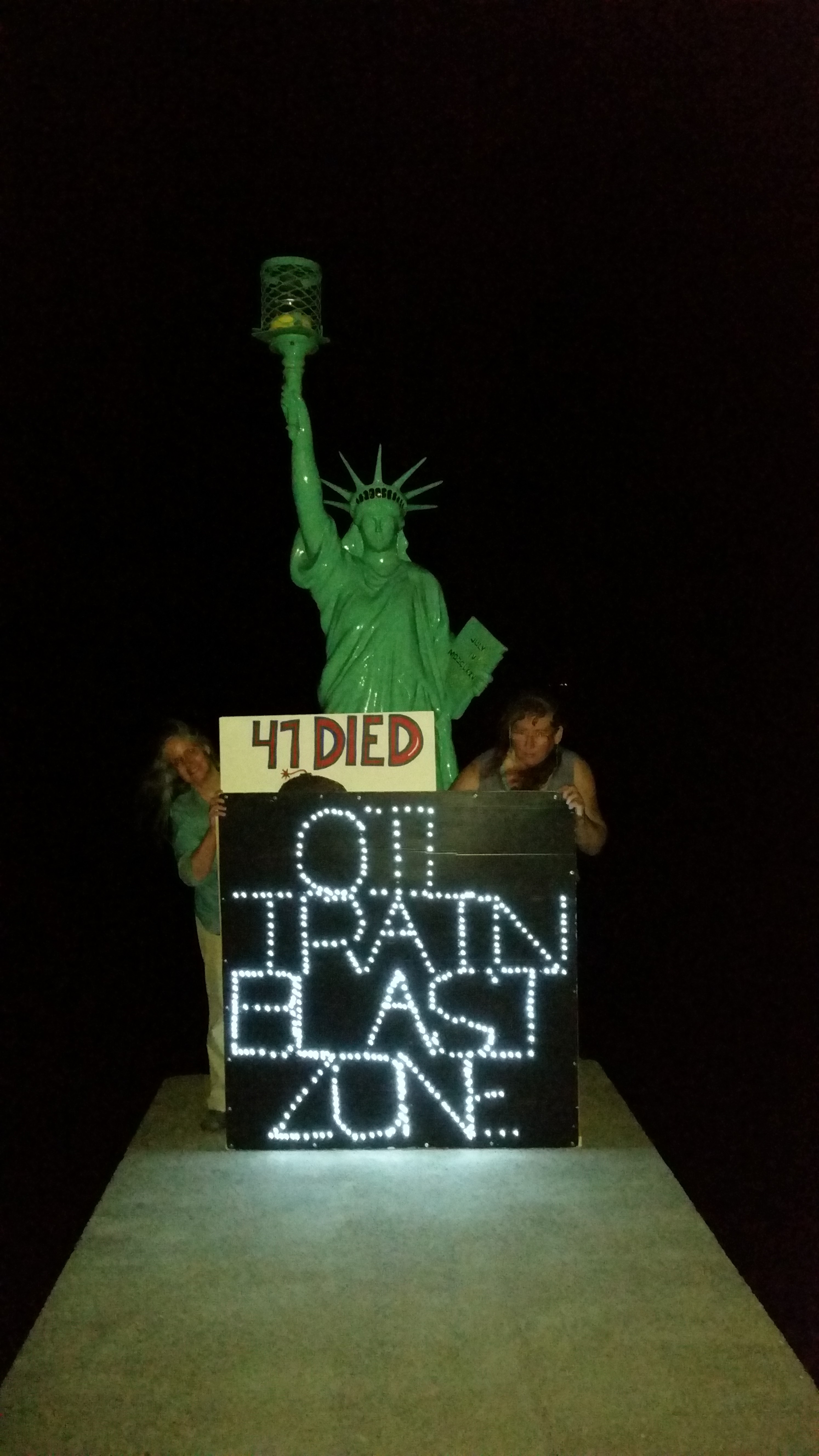
On Monday evening, July 6, through Sunday afternoon, July 12, activists of Wild Idaho Rising Tide (WIRT), Spokane Rising Tide (SPORT), and the Occupy movement participated in several demonstrations of the Sandpoint Stops Oil Trains Week of Action 2015, to halt oil train traffic while commemorating the second anniversary of the July 6, 2013, Lac Mégantic, Quebec oil train catastrophe that took 47 lives [1, 2]. Together with climate, environmental, and social justice activists across North America, WIRT and allies organized and staged over 100 powerful and effective, local demonstrations during the Stop Oil Trains Week of Action [3, 4]. These events in the United States and Canada stood in solidarity, defense, and protection of the residents of Lac Mégantic, who lost 47 people killed by an exploding oil train, and other frontline, rail corridor communities and our shared global climate, all caught in the crosshairs of the oil and rail industries’ pipelines on wheels.
Although dozens of horrifying, fiery, extreme energy train wreck disasters have occurred over the last two years since the grim Quebec accident, northern Idaho and eastern Washington citizens continue to endure the unsafe, risky, and expanding rail transportation of potentially explosive Alberta tar sands dilbit, moved by the Union Pacific Railroad, and fracked Bakken shale oil, hauled by the Burlington Northern Santa Fe Railway (BNSF), both to Washington and West Coast refineries. BNSF has previously reported that 16 to 19 mile-long oil trains traverse the interior Northwest every week. Additionally on the 70-mile-long, railroad chokepoint between the Sandpoint and Spokane downtown areas, referred to as “the funnel,” BNSF carries dusty, diesel-towed coal from the Powder River Basin along the Montana/Wyoming border to coastal terminals for export. Recently revised federal regulations no longer require BNSF to report the number of oil trains that pass through the region, and have never forced disclosure of Union Pacific tar sands by rail volumes.
With their hazardous loads and reckless resource and policy exploitation, Big Oil and Rail discount and transgress the millions of lives, the human and environmental health and safety repercussions, and the associated carbon and other toxic pollution within the mile-wide, track-side, oil train blast zones, along their paths to profit around the Pacific Rim [5]. In appropriate response, thousands of concerned citizens gathered for 63 events in July 2014, including multiple protest and outreach actions in Sandpoint and Spokane [6]. 2015 participants joined in actions to publicly call attention to the growing threat of “bomb trains,” to display the growing power of the worldwide climate movement, and to demand an immediate ban on all crude oil trains. Continue reading
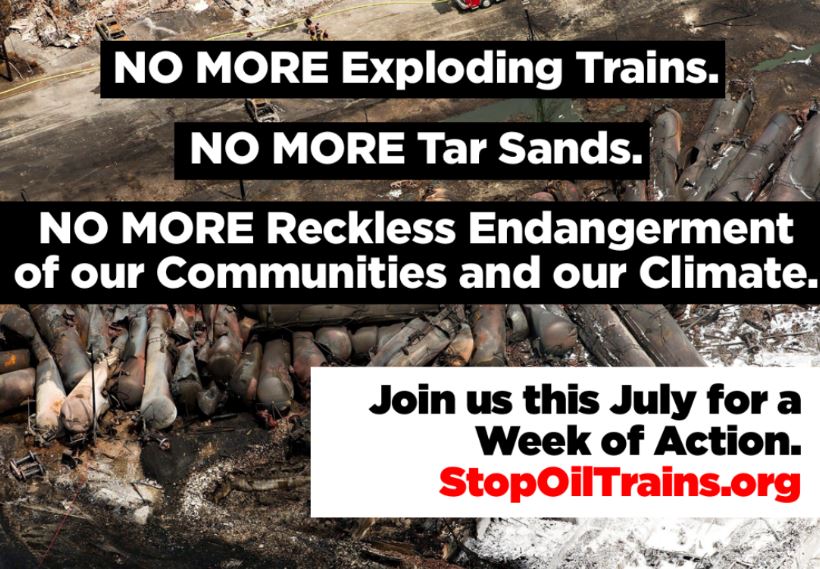
Monday, July 6, marks the second anniversary of the tragic Lac Mégantic, Quebec, oil train catastrophe that killed 47 people in 2013. Despite dozens of almost as horrifying, fiery disasters over the last two years, the oil industry continues to dramatically expand Alberta tar sands and Bakken crude oil train transport throughout Canada and the United States. There is no safe way to transport such explosive oil and, with carbon and associated toxic pollution rising, oil trains wreck public and environmental health and safety and the global climate of communities across the continent.
The tragic Lac Mégantic accident grimly reminds us all that Big Oil will stop at nothing to extract, transport, and burn every drop of oil in the ground. Its primary northern Idaho/eastern Washington haulers, Burlington Northern Santa Fe Railway (BNSF) carrying fracked Bakken shale oil and Union Pacific Railroad moving Alberta tar sands dilbit through the Sandpoint, Idaho, and Spokane, Washington, areas, discount the communities they transgress with hazardous loads. Recent, industry-friendly, federal regulation revisions will not check their recklessness. The risks, costs, and millions of lives within the mile-wide, bomb train blast zones along their paths to profit around the Pacific Rim represent only collateral damage to the oil and railroad industries.
In July 2014, thousands of concerned citizens gathered at 63 events for the first Stop Oil Trains Week of Action, including multiple protest and outreach actions in Sandpoint and Spokane [1]. As Wild Idaho Rising Tide (WIRT) and allies continue to actively oppose Alberta tar sands and Bakken shale oil exploitation and train and pipeline transportation, we refuse to let Big Oil play Russian roulette with our families, friends, homes, businesses, and climate! On July 6 to 12, 2015, people across North America are defending their communities and climate, to halt extreme energy in its tracks and end the oil and rail industries’ pipeline on wheels [2]. We will call attention to the growing threat of oil trains, as we demonstrate the growing power of our movement, organizing more than 100 events across the U.S. and Canada, which demand an immediate ban on oil trains.
Please join WIRT and allies at local demonstrations during the Stop Oil Trains Week of Action, and/or host or attend an event in your vicinity between July 6 and 12. Together with climate, environmental, and social justice activists across North America, we are organizing various tactics and resources to stage powerful and effective actions and documenting them with photos, videos, audio, and social media, to defend and protect frontline, rail corridor communities and our shared climate. Stand with residents of Lac Mégantic and other communities in the crosshairs of Big Oil, to stop oil trains this July, by participating in one or all of these five actions. Continue reading
July WIRT Meetings
We have rescheduled the twice-monthly Wild Idaho Rising Tide (WIRT) potluck/pizza meetings in July, due to the Fourth of July holiday and July/August WIRT availability in Sandpoint. Please join WIRT activists at 7 pm next Thursday, July 9, at The Attic, up the back stairs of 314 East Second Street in Moscow, Idaho, and at 7 pm on Saturday, July 18, at Second Avenue Pizza, 215 South Second Avenue in Sandpoint, Idaho. WIRT and allies are scheming multiple summer events expanding the movement against extreme energy, through powerful convergences, training camps, and direct actions for a livable future. Please visit often the constantly updated Events Calendar on the WIRT website and/or contact WIRT for the descriptions, logistics, carpools, and directions to climate justice activities in the inland Northwest region [1]. Get involved in emerging, grassroots, fossil fuels resistance and solidarity with our comrades across the continent, confronting the root causes of climate change!
State Oil and Gas Lease Auction Postponed (Again)!
Throughout 2015, WIRT has been promising, preparing for, and posting about our planned protest of the next auction of oil and gas leases on state lands and minerals by the Idaho Department of Lands (IDL). The IDL website now notes that “this [July 1] auction has been postponed [for the fourth time this year (January, April, June, and July)!] until the fall of 2015, with an exact date to be determined [October 21, 2015?]. Information on the auction is subject to change.” [2] Idaho has leased none of its public holdings for oil and gas exploitation this year!
Drilling Unit Integration Applications Stalled!
Another Idaho gasland “set-back” for oil and gas developers Alta Mesa! The 21-day period for formal public comments and responses from impacted land and minerals owners to the Idaho Oil and Gas Conservation Commission ended on June 29 and 30, for two Alta Mesa Services applications for integration (forced pooling by the state of non-compliant, private, potential oil and gas leasers), dated June 8 and 9. But according to the Idaho Department of Lands website, “IDL requested additional information from the applicant, and an amended application is expected [3]. The applications posted here are for public informational purposes only and are not being considered by IDL or the Commission at this time.” Congratulations to our southern Idaho comrades for their great work in holding off the gashole frackers! [4, 5]
Idaho BLM Oil and Gas Lease Protest Report
At a public auction in Boise, Idaho, on Thursday, May 28, the U.S. Bureau of Land Management (BLM) leased 6,349 acres in the Little Willow Creek watershed in Payette County for oil and gas exploration drilling [6, 7]. A lone Wild Idaho Rising Tide protester clad in an organizational T-shirt attended the auction, confronting the BLM with every question she could muster, witnessing possibly rigged, procedural discrepancies, and learning that allies had filed complaints of which few people aware [8]. Continue reading
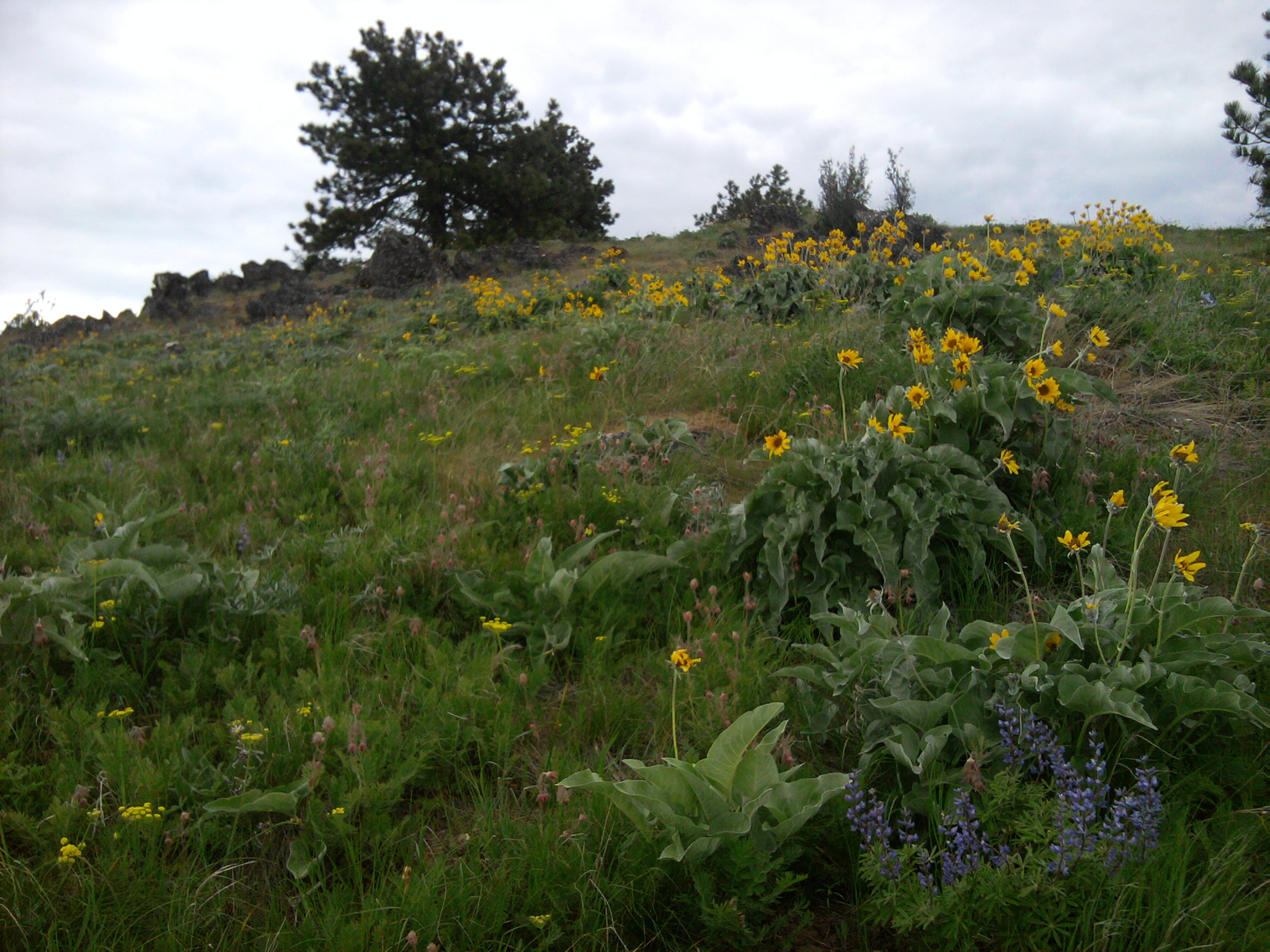
To avert potential damages to fragile, remnant Palouse Prairie during this outing, the Paradise Ridge Defense Coalition (PRDC) is limiting participation in a guided wildflower hike on Paradise Ridge to PRDC members and member organizations (Palouse Audubon Society, Palouse Broadband of the Great Old Broads for Wilderness, Palouse Environmental Sustainability Coalition, Palouse Group of the Sierra Club, and Wild Idaho Rising Tide). Please meet at 1:30 pm on Sunday, May 31, at the University of Idaho Arboretum parking lot off Palouse River Drive, west of Highway 95 in Moscow, Idaho. Attendees will carpool to the starting point for a hike to the top of Paradise Ridge, where we will visit the best sites of the last one percent of original Palouse Prairie. Wear good walking/hiking shoes and bring a water bottle. Event coordinators plan to offer plenty of opportunities for questions during the event lasting 2 1/2 to 3 hours, including travel time. PRDC board members invite you to join as a member and a Sunday hike participant!
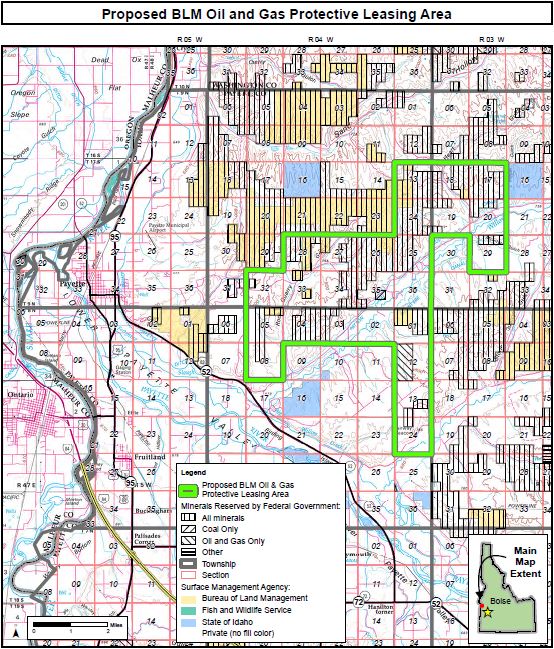
On Thursday, May 28, 2015, Wild Idaho Rising Tide and allied activists plan to protest the Bureau of Land Management (BLM) oral auction and sale of leases of public oil and gas and minerals in the Little Willow Creek watershed six miles east of Payette, Idaho [1]. Managing 700 million acres of sub-surface minerals and more acreage (245 million) than any other federal agency, mostly in the western U.S. and Alaska, the BLM operates under the U.S. Department of the Interior. Its Idaho State Office, at 1387 South Vinnell Way in Boise, will open registration to the public and prospective buyers at 7:45 am on Thursday and will begin the auction at 9 am in the Sagebrush Conference Room, offering five parcels totaling 6,475 acres for minimum lease bids of $2 per acre, following the national standard. According to a map of the BLM proposed Little Willow Creek oil and gas leasing area, only one of the smaller parcels is available for oil and gas development, while the majority of the tracts could provide opportunities for private extraction of all federal minerals present [2].
Although the BLM asserts that this lease sale would “prevent federally owned oil and gas from being drained without compensation to the United States in the form of royalties,” “by law the Bureau of Land Management cannot auction off public lands to the oil and gas industry unless drainage is actually occurring” [2, 3]. For years, the primary architect of recent oil and gas wells, a processing plant expanded before completion, and gathering lines connecting all of this Payette County infrastructure, Alta Mesa Idaho (AMI) has pressured the BLM to open its public resources to its pursuits. AMI’s environmentally, socially, and financially irresponsible onslaught of development has begrudged mandated, protracted, public review of BLM leasing proposals within the context of broader federal regulations, significantly more stringent that state oversight. The Boise-based BLM Four Rivers Field Office confirmed in April 2015 that “no surface occupancy and no subsurface occupancy will be permitted until the Four Rivers Resource Management Plan is completed, which is scheduled for 2016” [1]. Continue reading
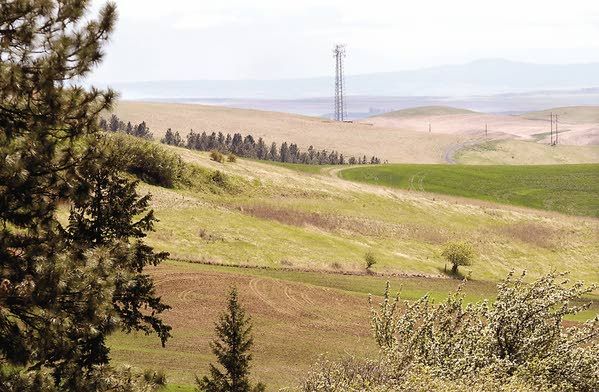
If built on the eastern route referred to as E-2, a new section of U.S. Highway 95 would start near this cell tower, travel north through a grove of trees, and continue across this grassland (Geoff Crimmins /Moscow-Pullman Daily News photo).
The scene to the west of U.S. Highway 95 – and its three proposed realignment route choices – is breathtaking from Paradise Ridge, with rolling green meadows and the occasional picturesque structure in spacious rural settings.
The existing highway is off in the distance and only takes up a small section of the view as cars and trucks appear to be rolling specks. But look down at the knoll underfoot and prairie flowers – iris, camas, lupine, groundsel, lomatium, prairie smoke and arrow leaf balsamroot within other native plants, invasive weeds and planted grass – pop up here and there.
Thin, long deer trails also run through the grass.
Steve and Mary Ullrich, both members of the Paradise Ridge Defense Coalition, live nearby the section of the ridge, where they marked a site with a long line of red balloons stretching about 600 feet. The section is one where plenty of animals roam and some ponds are on the far side of the balloons.
The balloons marked the approximate width and location where the highway realignment preferred by the Idaho Department of Transportation would run. ITD refers to it as E-2. That plan and the other two options, C-3 and W-4, will improve 6 1/2 miles of the highway running south from Moscow to Thorncreek Road.
Fight against state’s route for wider road south of Moscow reaching critical point
About 50 people attending the annual meeting of the Paradise Ridge Defense Coalition on Thursday night focused on how to stop the Idaho Transportation Department from carrying out its preferred plan to realign and widen U.S. Highway 95 south of Moscow to Thorncreek Road.
The coalition is vehemently opposed to the plan that would use a 6 1/2-mile route referred to as “E-2.”
Several key members of the coalition set up displays in a meeting room of the Unitarian Universalist Church of the Palouse in Moscow, and fielded questions about topics such as recreation, area history, and numerous environmental characteristics of the location.
Coalition member Steve Flint talked about safety issues in areas surrounding E-2 that don’t seem to be adequately addressed: potential for more collisions with big game, weather-related accidents because of heavier snowfall in that area, and continued accidents on the portion of U.S. 95 that would become a county road. Continue reading
 Wild Idaho Rising Tide