Second Rail Bridge Meeting & Earth First! Workshops & Gathering


Activist groups RADAR and Wild Idaho Rising Tide (WIRT) and north Idaho residents opposing a second Burlington Northern Santa Fe (BNSF) rail bridge across Lake Pend Oreille invite community members to three rescheduled events on Thursday and Friday, June 22 and 23, in Sandpoint, Idaho. To accommodate outcomes envisioned by numerous participants converging from across the region, including indigenous activists, we have revised the times and dates of these opportunities.

1) Second Lake Rail Bridge Meeting #2 at 6 pm on Thursday evening, June 22, at Dog Beach Park south of Sandpoint

A few dozen local, opposition group members and visitors will share issue information and brainstorm tactics and strategies (besides the usual, regulatory hoops pushed by mainstream, green groups) close to the BNSF pile load test site. Please propose subjects for discussion, bring camp chairs, and RSVP for bike trailer transportation for participants who cannot walk to the park.

2) Earth First! Road Show and Direct Action Camp from 9 am until 5 pm on Friday, June 23, at a wooded, private farm in the Selle Valley, about nine miles north of Sandpoint

The Earth First! Road Show collective crew will offer training workshops on a variety of assertive, protective, activist skills chosen by participants, for resistance to fossil fuels, climate change, and harmful infrastructure. See the following, linked, updated announcements for further logistics, and contribute potluck and donated food, if possible [1, 2].  We will disclose the event location address only to people attending, so please RSVP to WIRT.

3) Social gathering, campfire, music, etc. at 6 pm and beyond, on Friday evening, June 23, at several Sandpoint area places

Organizers encourage fellow activists to expand camaraderie and coalitions, share ideas and concerns, and enjoy band performances at downtown pubs later on Friday night. We heartily welcome your input and involvement during as many of these upcoming activities as you can join to create change.  Respond with your questions and suggestions, via the enclosed contact channels.  Thanks! Continue reading

Earth First! Road Show & Direct Action Camp!


RADAR and Wild Idaho Rising Tide (WIRT) are grateful to co-host the 2017 Earth First! Road Show and Direct Action Camp on Thursday and Friday, June 22 and 23 in Sandpoint, Idaho [1]!  Activists are converging for a camp over several nights, training sessions from 9 am to 5 pm on Friday, and a gathering starting at 6 pm on Friday, at several locations disclosed by RSVPing to WIRT.  To connect with, learn about, and support the various ecological and social resistance struggles for a better world, a group of Earth First!ers has been offering skills sharing workshops for rabble rousers, water protectors, land defenders, anti-fascists, and other instigators of a wild revolution, since late April 2017 [2].  On a two-month, cross-continent tour beginning in south Florida and ending at the annual, July 2 to 9  Round River Rendezvous, this year in northern California, the road show collective has been nurturing the inspiring seeds of dissidence throughout the country, along a route that coincides with action camps and conferences.

“Coming to a town near you,” the Earth First! Road Show is giving priority to friends, comrades, and agitators in rural areas, while bringing its direct action training to 40-plus cities and communities of resistance [3].  Prior to their north Idaho visit, our guests will stop in Spokane, Washington, on June 20, and in Missoula, Montana, on June 21, before trekking back to the West Coast of Seattle and Olympia, Washington, on June 25 and 26.  Their goal of encouraging and assisting local resistance through these events will help the Idaho Panhandle build momentum to oppose important but delicate area infrastructure (like the proposed, second, Lake Pend Oreille rail bridge), which facilitates fracked Bakken shale and Alberta tar sands oil and gas extraction and transportation.  These trainers would like to understand traditional indigenous territories and regional demographics, movements, and resources, and explore our amazing, beloved “neck of the woods.” Continue reading

June 7 Last Comments on Tesoro Savage Oil Terminal


The Washington state Energy Facility Site Evaluation Council (EFSEC) has notified the public of a comment period and hearing on its preliminary determination to approve air pollution permit application materials for the Vancouver Energy Distribution Terminal Facility proposed by Tesoro Corporation and Savage Companies at the Port of Vancouver, Washington [1].  The Notice of Construction Air Permit provides coverage for industrial activities, a Technical Support Document summarizes the permit conditions, and a Test Protocol for the Direct Measurement of Uncollected Volatile Organic Compound Loading Losses during Marine Vessel Loading describes resulting air pollution.

The Tesoro Savage joint venture, Vancouver Energy (5501 NW Old Lower River Road, Vancouver, Washington), plans to develop a new, 360,000-barrel-per-day, oil-by-rail terminal, to receive Alberta tar sands and Bakken crude oil from Northwest trains, store it onsite, and load it onto marine vessels [2].  On land leased from the port, and on behalf of the joint venture, Savage would oversee and manage the design, construction, and operation of the facility requiring an approximate investment of $75 to $100 million.  The originally stated, principal purpose of the facilities was to offset or replace declining Alaska North Slope and California crude production and more expensive, foreign oil imports with delivery of other North American crude to U.S. West Coast refineries.  But with federal law currently allowing export to other countries of crude oil extracted in the United States, the Tesoro Savage oil terminal could primarily serve as an export facility on the Columbia River.

Comments, Hearing, & Rally

By Wednesday, June 7, and beyond, please offer written comments on these draft permit documents, to the State of Washington Energy Facility Site Evaluation Council, in person at1300 S. Evergreen Park Drive SW, Olympia, Washington, by mail to P.O. Box 43172, Olympia, WA 98504-3172, or electronically online through the EFSEC website [1].  Before making a final determination on construction permit issuance, EFSEC will hold a public meeting to accept and consider oral and written comments on June 7, from 1 until 9 pm or the last speaker, whichever comes first, in Gaiser Hall on the Clark College central campus, 1933 Fort Vancouver Way in Vancouver.  For further EFSEC information, please contact siting manager Sonia E. Bumpus at 360-664-1363 or sbumpus@utc.wa.gov.

Besides packing the June 7, air pollution permit hearing, the Northwest community and coalition groups, including Stand Up to Oil, Columbia Riverkeeper, Friends of the Columbia Gorge, and Sierra Club, are staging a rally with hundreds of participants, during the 4 to 5 pm, hearing break [3, 4].  If you live in the Vancouver area, we encourage you to attend the hearing and join the rally, by coming early and staying late, wearing your favorite, red shirt, and preparing, practicing, timing, and reading your testimony under two minutes long.  Begin your remarks by saying your name and address, and express how the Tesoro Savage oil terminal could affect you and your family.  Even if you do not intend to publicly talk, showing up as part of the Northwest fossil fuels resistance makes opposition visible!  Please sign up and give your speaking ticket to coalition staff members, to share with late arrivals.

At this major hearing on the Tesoro Savage project, the voting members of Washington EFSEC will have their last opportunities to see and hear from affected, regional, rail-line communities, before making a final recommendation to Washington Governor Jay Inslee on denial, conditional approval, or approval of the largest, proposed, oil train terminal in North America.  Organizers believe that Governor Inslee will reject the project, unless he gets conflicting advice from EFSEC or his staff.  But his final decision, expected this year, must wait until all permit processes are complete, thus the voices of resistance must remain powerful. Continue reading

Sandpoint & Spokane Stand with Mosier


Mosier Gathering

On Saturday, June 3, to honor the one-year anniversary of the oil train derailment, spill, and fire in Mosier, Oregon, Northwest community members are gathering together in support of Mosier area and tribal communities and cities like Spokane, Vancouver, and Portland, who are threatened by, but standing up to, oil trains [1-5].  At a public event in Mosier, hosted by Stand Up to Oil, Friends of the Columbia Gorge, Columbia Riverkeeper, Washington Environmental Council, and Climate Solutions, participants will demand a thorough, Union Pacific cleanup of Mosier and an end to reckless oil trains, reminding Washington Governor Jay Inslee and other decision makers to heed the warnings of this catastrophe.

From 12 noon to 3 pm at the Mosier Community School, 1204 Historic Columbia River Highway (U.S. 30 East), regional activists will rally against oil-by-rail and hear from speakers including Yakama Nation Tribal Council chair JoDe Goudy, Mosier City Council members, Mosier physician Dr. Maria McCormick, Hood River mayor Paul Blackburn, Vancouver City Council member Alisha Topper, and several other tribal and faith leaders, elected officials, health professionals, and group representatives.

Friends of the Columbia Gorge conservation organizer Ryan Rittenhouse will emcee the gathering followed by a short walk to the Columbia River, for more commemorations.  Afterwards, Friends’ land trust manager Kate McBride will lead an optional hike to the nearby Mosier Plateau.  Columbia Riverkeeper will live-stream the event through its facebook page, and @standuptooil will live-tweet #mosier.  Bring friends and family, lunch and snacks, hats and sturdy shoes, and colorful banners and signs, and email Ryan@GorgeFriends.org with any questions or concerns.

Sandpoint & Spokane Solidarity Actions & Carpools

Please join Wild Idaho Rising Tide (WIRT) and Occupy activists and allies for carpools to Mosier, Oregon, and solidarity actions in Sandpoint, Idaho, and Spokane, Washington, to represent interior Northwest, rail-line communities solemnly remembering the June 3, 2016, oil train derailment, resulting devastation, and ongoing water contamination in Mosier.

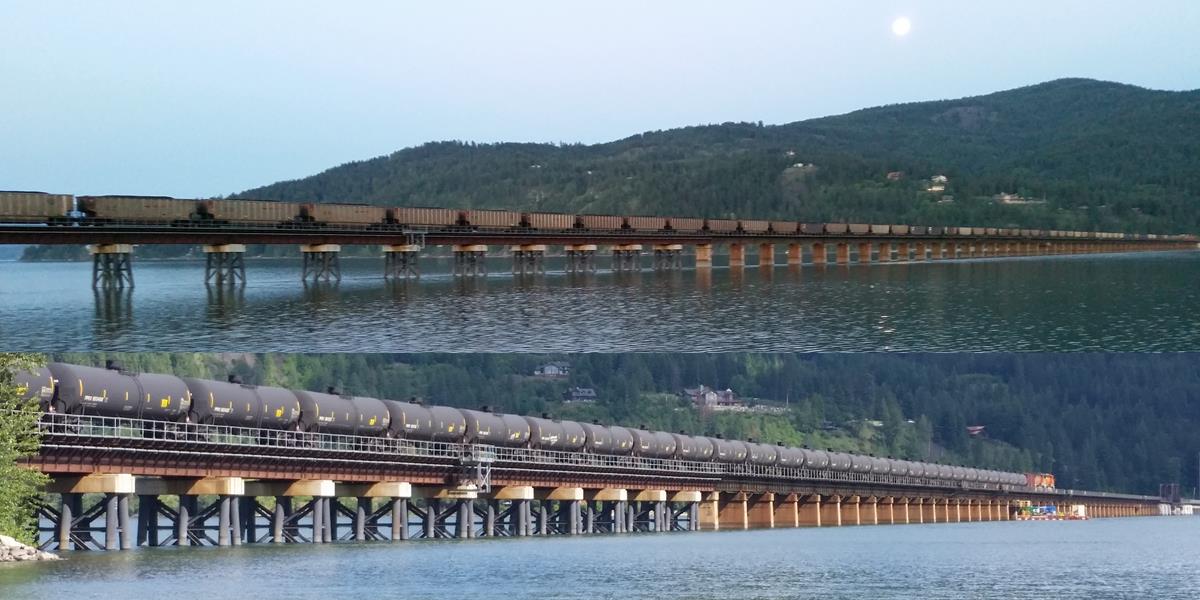
Opposing Burlington Northern Santa Fe Railway’s (BNSF) proposed, second rail bridge over Lake Pend Oreille and double downtown tracks, Sandpoint area activists are converging at 12 noon on Friday, June 2, at City Beach Park.  Before Sandpoint carpools to Spokane and Mosier depart at 2 pm that afternoon, and return on Saturday evening, June 3, participants are marching north with Mosier solidarity signs on Sandpoint Avenue, to the Lake Pend Oreille surface water treatment plant.  Completed in 2012 and operated by the City of Sandpoint, the facility treats and distributes 10 million gallons per day to two on-site, two-million-gallon reservoirs and over 4000 connections in Dover, Kootenai, Ponderay, Sandpoint, and surrounding Bonner County [6].  Only 65 feet from the BNSF tracks carrying full, explosive, Bakken shale and Alberta tar sands crude oil trains and dusty, Powder River Basin coal cars toward and over the lake rail bridge, this critical, community source of treated lake water is just as vulnerable to an oil train fire and spill as the Mosier wastewater treatment plant adjacent to the Union Pacific train derailment that inundated the facility with 13,000 gallons of the estimated 47,000 gallons of oil released from four derailed tanker cars in early June 2016 [7].

Occupy activists are meeting between 4 and 6 pm on Friday, June 2, for the weekly, public demonstrations of Free Speech Friday at the V, where Ruby and Division streets split north of the Spokane River bridge and North River Drive in downtown Spokane.  Organizers invite everyone to bring smiles and Mosier train wreck anniversary signs and banners, and address concerns about coal and oil train traffic through Spokane, while exercising rights to freedom of speech and assembly in public places.  Music, singing, and dancing may also emerge, before regional activists depart for Mosier at 6 pm. Continue reading

Second Lake Rail Bridge Protest #1 Report


Thanks to each of the 20 indigenous, community, and climate activists who participated in the Second Lake Rail Bridge Protest #1 between 9 and 11:30 am on Monday, May 8, on the Dog Beach Park path and site of pile drive tests in preparation for Burlington Northern Santa Fe’s (BNSF) proposed, second, 4800-foot, rail bridge across Lake Pend Oreille, near Sandpoint, Idaho! [1-3]

At 9:09 am, BNSF again attempted, but failed this time, to rush a westbound, unit oil train past a rail-line community, in advance of another demonstration. The train crossed over Sand Creek near its lake outlet, on the single-track bridge that BNSF plans to double-track along with construction of the parallel lake bridge.  Water protectors at the event stood with banners in the mid-morning light and close proximity to the train that WIRT activists documented with high-resolution photos clearly identifying its “1267” crude oil hazmat placards.  They later noticed several alarming components of these tanker cars illustrated in the photos: tangles of snaggable, undercarriage wires and tanker end valves facing each other on adjacent cars and protruding from rectangular, metal bar “shields.”  These purportedly safe rail cars looked like an end-to-end, heavy, oil car crash accident waiting to happen.

Marching with protest signs visibly close to U.S. Highway 95, the Bonner County residents and three Washington friends waved to the BNSF cops and contracted, Oregon workers, before reaching the lake shore and standing with banners in front of the pile drive crane and the Lake Pend Oreille rail bridge. As new participants arrived, they circled, smudged, prayed, drummed, and sang in ceremony, then reflected on and discussed second rail bridge concerns among themselves and on video.  They gradually dispersed and waved goodbye to the railroad crew and police, and gathered for lunch before three visiting Kalispel Nation and Spokane activists departed. Continue reading

Second Lake Rail Bridge Protest #1


THANKS to everyone who contributed practical and passionate insights to the Thursday evening, May 4, Second Rail Bridge Community Meeting. Resulting from this amazing, shared, grassroots organizing, Wild Idaho Rising Tide (WIRT) and allies have initiated three ongoing projects in resistance to Burlington Northern Santa Fe Railway’s (BNSF) proposed, second, rail bridge in Lake Pend Oreille.

First, we have opened conversations and continue to seek information from city, county, state, and federal regulatory agencies responsible for bridge testing and building permits. As further discussed in an upcoming report with issue background and recent developments, on Monday, May 8, BNSF will commence two preliminary pile load tests on land (not near water or in the lake, as assumed) below the railroad tracks north of Dog Beach Park just outside Sandpoint, Idaho, in its right-of-way property, requiring no permitting.

Second, we are composing a legally defensible, sign-on letter to include numerous, regional groups in opposition to initial pile load tests and proposed construction of a second lake rail bridge. Our coordinated outreach is asking for the support of elected officials, media, allies, and the regional community, as we build a strong case against this BNSF plan.

Third, as the first of many likely demonstrations, we are protesting BNSF pile drive work near Dog Beach Park. Please join WIRT and allied climate and community activists and Kalispel Nation members at 9 am on Monday, May 8, for the Second Lake Rail Bridge Protest #1.  Meet us in the parking lots near the Power House (120 East Lake Street) or visitor center/trailhead at the East Superior Street/Highway 95 intersection or on the bike path north of Dog Beach Park.  Bring your protest signs and banners, drums, voice, and, for protection from pile drive noise, ear plugs, to vote early and often with your body against this first and subsequent, second bridge invasions!

Power Up!  Resist, Insist, Persist!  Warriors Up!

Second Rail Bridge Community Meeting


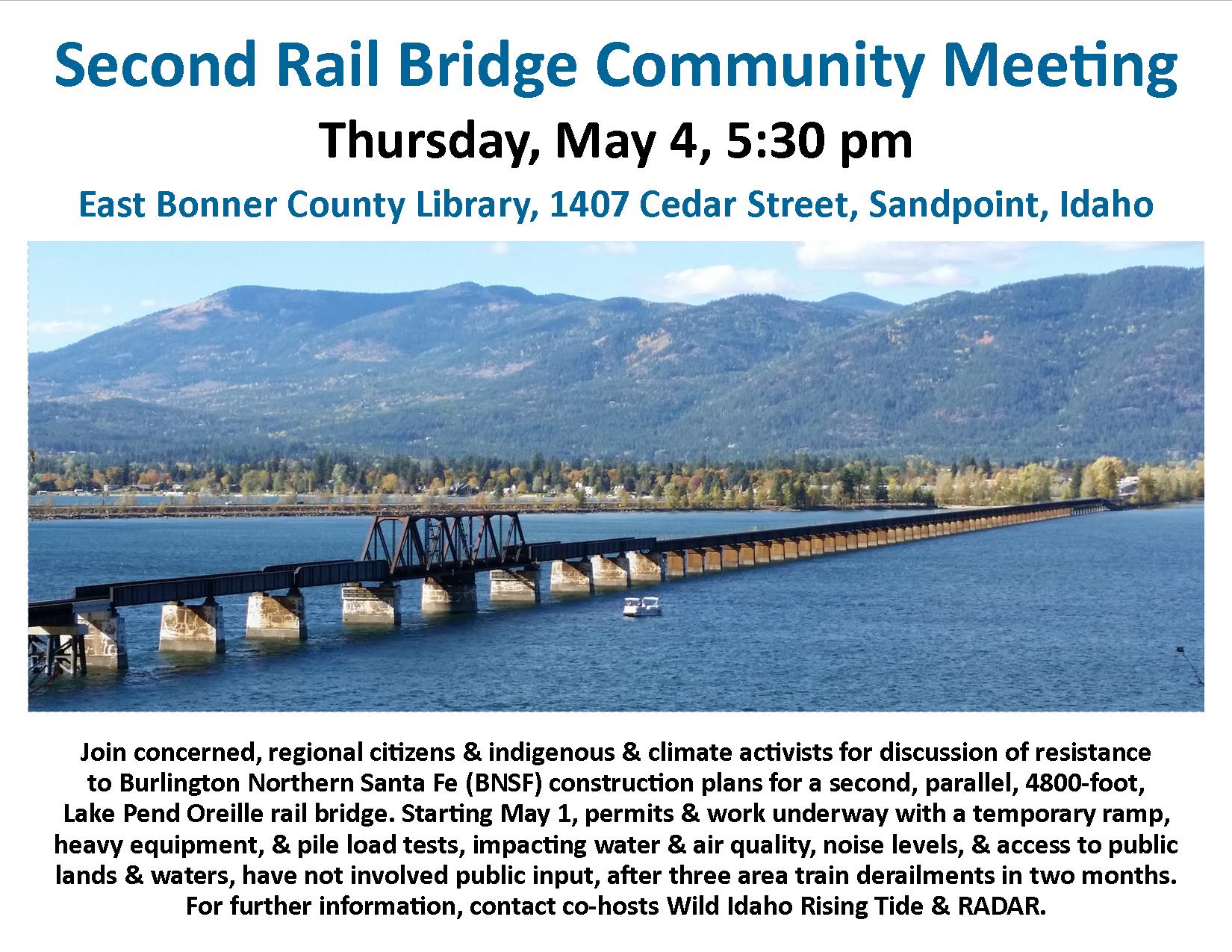
Wild Idaho Rising Tide (WIRT), RADAR, and allied, indigenous and climate activists are hosting a community meeting to discuss and design resistance to Burlington Northern Santa Fe (BNSF) plans for a second, parallel, rail bridge over Lake Pend Oreille and associated, potentially illegal, temporary ramps and heavy equipment on public lands and pile driven, load bearing tests in the lake, starting on Monday, May 1.  Concerned, regional citizens are welcome to participate from 5:30 to 7:30 pm on Thursday, May 4, in Rooms 103 and 104 of the East Bonner County Library, 1407 Cedar Street in Sandpoint, Idaho.

Predictably in conservative, small, Idaho towns, direct action seems our only recourse, without any public input opportunities, or even information, about the permitting processes for these railroad invasions impacting water and air quality and community noise levels and access to public lands and waters.  Photos of a BNSF ad in the Sunday, April 30, Bonner County Daily Bee bear logistical information about rail bridge work already underway [1].  WIRT website and facebook event pages will soon expand this announcement to provide further issue, meeting, and protest information.

Also on this May Day, the second, Sandpoint area, train derailment in one and a half months occurred around 6 am, on BNSF tracks paralleling U.S. Highway 95, less than 13 rail miles west of the current and proposed, 4800-foot, rail bridges over Lake Pend Oreille [2].  About 25 scattered, mangled cars of a presumably westbound, unit, corn train left the straight rail line in front of Valley Vista Ranch near Cocolalla, north of Highway 95 milepost 460.  On March 17, an eastbound, empty, unit, coal train derailed between Ponderay and Kootenai, only three rail miles east of the lake rail bridge.

[1] Second Rail Bridge Community Meeting, May 1, 2017 Wild Idaho Rising Tide facebook photo

[2] The Second, Sandpoint Area, Train Derailment…, May 1, 2017 Wild Idaho Rising Tide facebook photo

Oil & Gas Development & Resistance in Idaho Communities


Wild Idaho Rising Tide (WIRT), Citizens Allied for Integrity and Accountability (CAIA), and allied activists earnestly invite you to participate in a presentation and forum on fossil fuel extraction in Idaho, held at 7 pm on Saturday, April 29, in the 1912 Center Fiske Room, 412 East Third Street in Moscow, Idaho.  In the wake of the Lori Batina Memorial Climate March and the People’s Climate March in Sandpoint, we are grateful and honored to welcome Shelley Brock of CAIA in Eagle, Idaho, sharing with the Moscow-Pullman-Palouse community an evening talk about oil and gas development and resistance in Idaho communities and associated, practical solutions to the regional causes of the global climate crisis [1-3].

Through a brief presentation with photos, giving a descriptive overview of the current, Treasure Valley, oil and gas situation and offering a question-and-answer session and open forum afterward, Shelley will inform and show audience members the extent of Idaho oil and gas leasing, the effects of fossil fuels drilling and producing, and the efforts of citizen, legal challenges of integration (forced pooling) applications.  She will also bring and display a dozen posters and distribute printed material about these oil and gas industry invasions impacting landowners and taxpayers throughout the state.

This public education opportunity aims to empower and encourage Idahoans and their neighbors to gain and exchange knowledge and understanding of climate change sources in Idaho, to initiate and sustain effective, grassroots, resistance work, and to support concerned, fellow citizens on the southwest Idaho gasland frontlines.  The Union of Concerned Scientists states that, “In 2014, approximately 78 percent of U.S. global warming emissions were energy-related emissions of carbon dioxide.  Of this, approximately 42 percent was from oil and other liquids, 32 percent from coal, and 27 percent from natural gas.” [4]

During Earth Week outreach events at the University of Idaho and Washington State University, students expressed great interest in this talk.  With your friends and families, please attend this well researched, highly recommended presentation, to learn about new and expanding fossil fuel infrastructure, operations, rules and legislation, and organized opposition in Idaho and across the Northwest.  CAIA and WIRT appreciate your work on climate and fossil fuels issues and your potential participation in this forum with free admission and requested contributions toward discussions and event costs. Continue reading

Friday, April 14, Spokane Megaload Alert!


According to Spokane television media sources shared by a core Wild Idaho Rising Tide (WIRT) activist, one of at least three half-million-pound megaloads heading to an oil refinery near Blaine, northwest Washington, will move from the Idaho panhandle into Washington at 7 pm this evening, Friday, April 14 [1].  The Washington State Department of Transportation and the huge size of the boiler and truck/trailer combination, together weighing 480,000 pounds and measuring 213 feet long and almost 22 feet wide, require that this megaload only moves during overnight hours on a route avoiding low, interstate overpasses and bridges that may not withstand its weight.

The megaload will travel along Washington Highway 290 and Trent Avenue, south on Pines Road to the Interstate 90 westbound lanes, then exit onto Broadway Avenue in Spokane [2].  After turning south on Fancher, it will proceed west onto Third then Second Avenues past Altamont, before re-entering the westbound interstate.  Detouring through Cheney on Washington Highway 904, the megaload will take I-90 south to the Country Travel Plaza at Highways 395 and 26, where it will stop for the day.  Please see the following media coverage, megaload route map, and facebook posts, and join Spokane and north Idaho activists for multiple protests of this fossil fuel infrastructure, starting at the Trent and Pines intersection at 7:30 pm. Continue reading

MRL-BNSF Empty Coal Train Derailment in Ponderay, Idaho


Rain and snow melt washed-out, BNSF train tracks above the Black Rock, lead-contaminated, former smelter site on Lake Pend Oreille in Ponderay, Idaho (Joshua Voss photo)

At 6:05 am on a dark, rainy Saint Patrick’s Day, Friday, March 17, 50 to 60 empty cars and a rear locomotive of an eastbound, Montana Rail Link (MRL), unit coal train derailed, remained upright, caused no injuries, and released no obvious hazardous materials in Ponderay and Kootenai, Idaho [1-5].  The wreck occurred on MRL’s mainline, owned and operated in Idaho by Burlington Northern Santa Fe (BNSF) Railway, a route typically carrying mixed freight and Powder River Basin coal – rarely Bakken shale oil and Alberta tar sands crude – from the east, through Missoula, around Lake Pend Oreille, and over the 4800-foot rail bridge southeast of Sandpoint.  Railroad first responders assessed the situation, located approximately 450 feet uphill and separated from the lake shoreline by a stretch of trees, only 250 feet from modest homes and two blocks from the post office and police station in Ponderay.  They would not estimate the timing of the re-opening of their tracks, but determined that recently intense rains and rapid snow melt had washed out a section of collapsed tracks “east of the intersection of Third Street and Cedar Avenue.” [6]

One set of train tracks and a Jersey barrier were suspended over a 30-foot-tall void in the railroad’s embankment on Friday.  At the bottom of the void was a current of storm water.  Other culverts under the tracks on Ponder Point appeared to be running at or near capacity on Friday afternoon…The cause of the wash-out remained under investigation…”High water levels and ground saturation are contributing factors.” [6]

The BNSF and MRL railroad companies, respectively based in Fort Worth, Texas, and Missoula, Montana, brought dozens of crew members, semi-trucks and trailers, and large pieces of ground and track-mounted, heavy equipment to staging areas east and west of the derailment, at Kootenai Bay Road and Seven Sisters Drive on both sides of Idaho Highway 200 in Kootenai, and at Fourth Street and Elm Avenue, adjacent to the railroad right-of-way in Ponderay, all photographed by Wild Idaho Rising Tide (WIRT).  Despite overwhelming railroad presence and close proximity to Ponderay houses, businesses, and government facilities, media stories rarely mentioned Ponderay as the location of this historic mishap, instead stating a derailment “west of Kootenai Bay Road in Kootenai, Idaho,” in the vicinity of a wealthy, lakeside, residential neighborhood.

While media reporters and government officials easily accessed the MRL-BNSF derailment mitigation staging site in Ponderay, to obtain crucial information, photographs of the damaged track area, and footage of interviews, nearby, impacted, community members and fossil fuel train monitoring and opposing activists could only reach the accident scene by vehicle and on foot for miles on snowy, lakeside trails, on muddy residential streets, and through wet forests, evading railroad cops to find, observe, and ascertain the accident scene [7-9].  At about 3 pm, two black helicopters left the Sandpoint Airport, circled over Lake Pend Oreille, and flew over the incident site.  Not until the following day, March 18, the local newspaper provided comprehensive event coverage confirming additional details of the emerging story.  By 4:48 pm on that rainy Saturday afternoon, a Kansas City Southern engine trailed one of the first, westbound, mixed freight trains crossing tracks repaired over the 30-foot chasm likely filled by the multiple dump trucks seen in the area since Friday. Continue reading