Report on Three Actions: Northwest Communities Oppose Coal Exports


IMAG0089

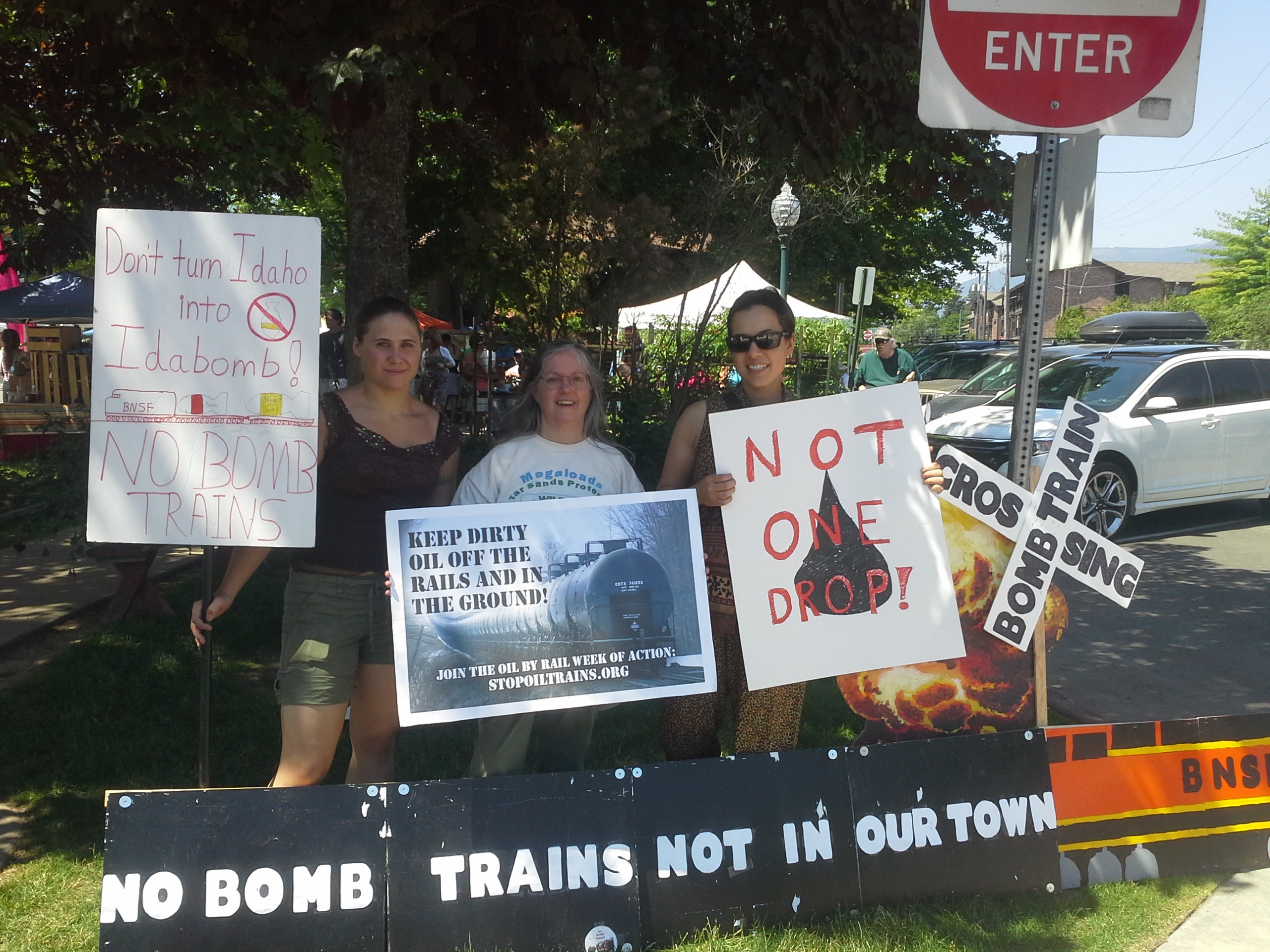
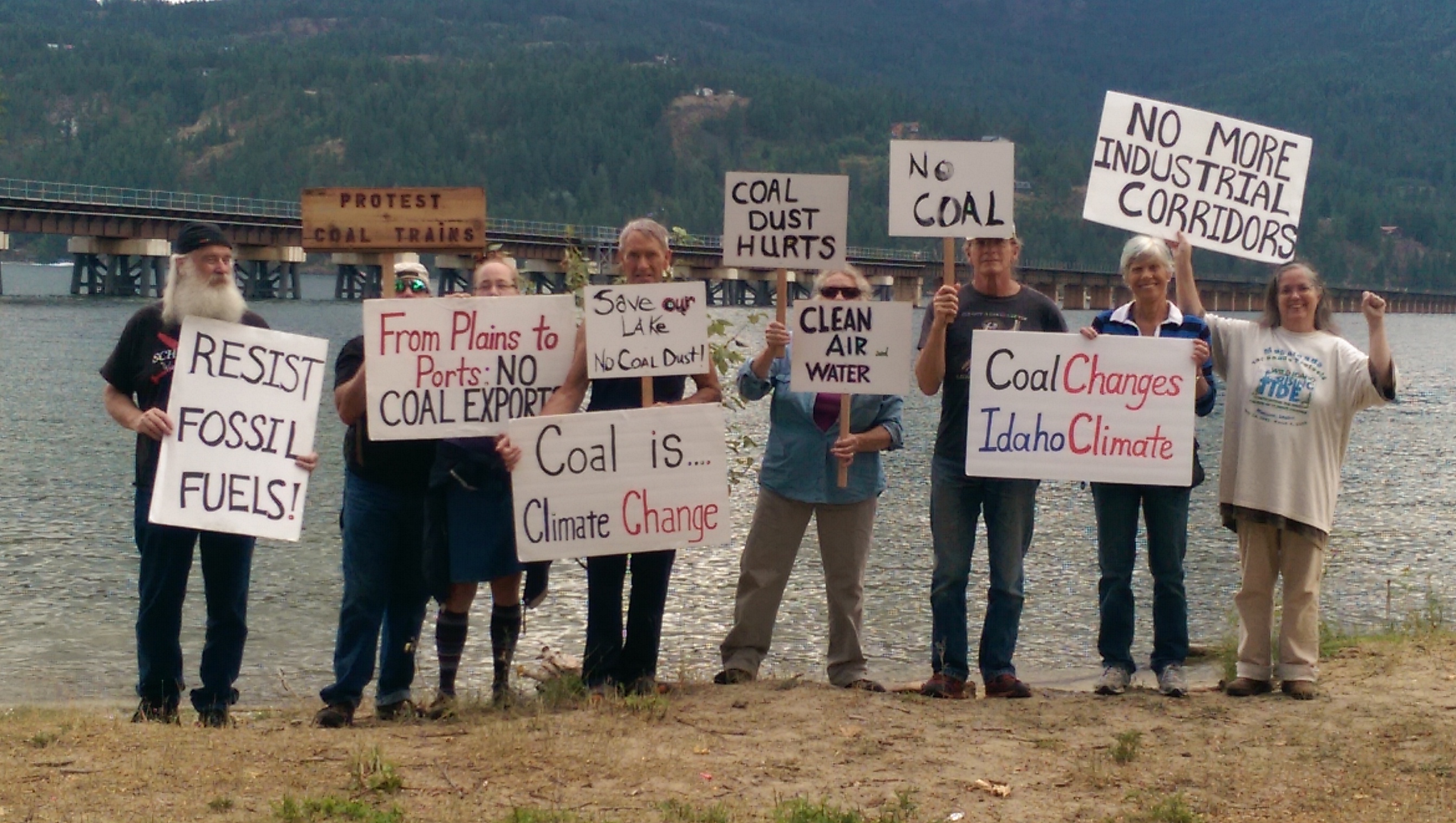
Northwest Communities Oppose Coal Exports 8-16-14 (August 16, 2014 Wild Idaho Rising Tide photos)

During the week of August 10, grassroots groups and peaceful protesters coordinated and staged regional actions against increased coal train traffic in interior Northwest communities and West Coast coal exports [1-3].  Sponsored by several climate and tribal organizations, including 350-Missoula, Blue Skies Campaign, the Confederated Tribes of the Umatilla Indian Reservation (CTUIR), Indian People’s Action, and Wild Idaho Rising Tide, activists held gatherings, speeches, rallies, marches, and train blockades in eastern Oregon, Idaho, and Montana.  Together, they catalyzed growing inland Northwest opposition largely dismissed by federal and state regulatory processes determining the fate of Powder River Basin coal mines and three proposed coal export facilities at Cherry Point and Longview, Washington, and Boardman, Oregon.

Boardman, Oregon

On Tuesday, August 12, over 40 dedicated people from western Oregon and about a dozen folks from eastern Oregon traveled up to 12 hours via bus and passenger vehicles, through summer storms with wind gusts, heavy rain, and lightning, to the Port of Morrow conference center in Boardman, Oregon [4].  At the Oregon Department of Environmental Quality (DEQ) public hearing on a 401 water quality certification for Ambre Energy’s Morrow Pacific coal train terminal, coal export opponents convened a lovely pre-hearing picnic, packed the room, and voiced resistance through about 75 percent of the amazing citizen testimony and inquiries during a DEQ question-and-(un)answer session.  Among health professionals, longshore and warehouse union workers, and eastern Oregon residents, Umatilla tribal representatives spoke powerfully against coal export impacts, offering many compelling reasons to deny state permit approval.  Chief Carl Sampson of the Wallulapum Tribe of the CTUIR welcomed coal export opponents and offered strong words, as did his daughter Cathy Sampson-Kruse, his granddaughter Mariah, and Umatilla Board of Trustees Chairman Gary Burke.

Missoula, Montana

Saturday, August 16, brought nonviolent civil disobedience to a Missoula, Montana, rail line for the second time this year, as Montana writer Rick Bass and three concerned Missoula community members stood on both sides of train tracks and temporarily delayed a coal train [5].  While 50 supporters cheered from the sidelines and forced an inbound coal train to crawl through Hellgate Canyon, police arrested and removed the four brave protesters from the path of the oncoming train in the railroad right-of-way, citing them for trespass and releasing them for appearances in court next week.  In April 2014, police similarly arrested seven people during civil disobedience that delayed an outbound train carrying coal.  Author of nonfiction novels and books, Rick Bass read from his current work to the gathering of coal export opponents and asserted that uncovered, dirty coal shipments by rail through Montana towns, moving all the time through all kinds of weather, violate the Montana constitution and contribute toward still correctable climate change.

Sandpoint, Idaho

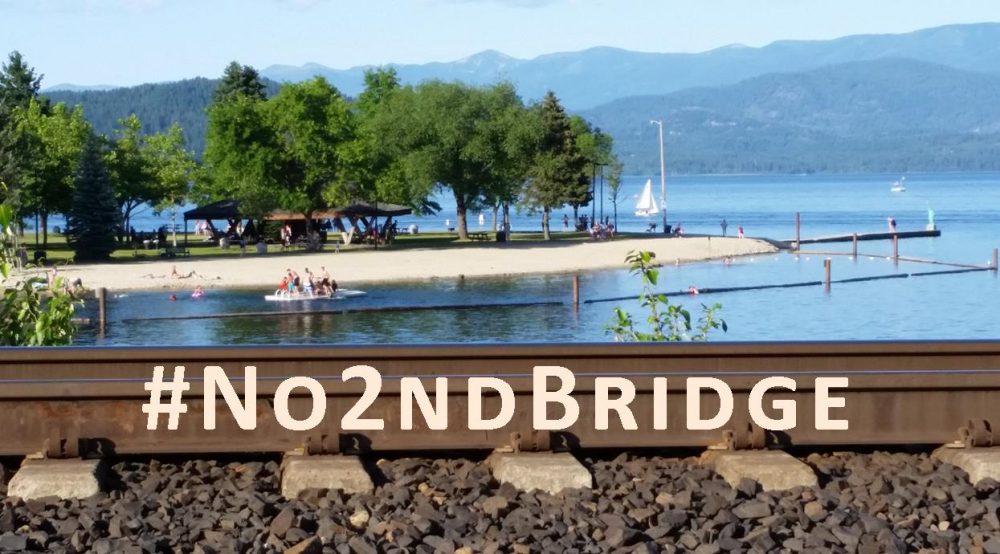
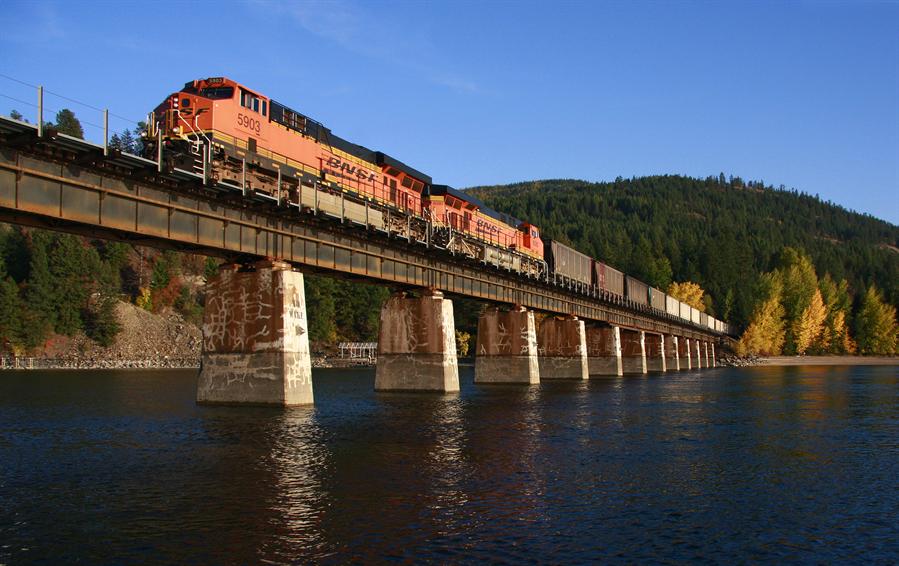
In the midst of an intensive week of tar sands refinery megaload protests in northern Idaho, Wild Idaho Rising Tide and allied activists gathered in Sandpoint, Idaho, on Saturday, August 16, for a rally, march, and protest of coal export trains traversing and polluting Lake Pend Oreille, the fifth deepest lake in the U.S. [6]  Meeting in Farmin Park, friends and family members brought their protest signs, voices, and chants, and walked through the various parts of the Farmers’ Market at Sandpoint, distributing WIRT brochures and urging convergence and participation in the upcoming march.  Activists walked and chanted “Save Our Lake, No Coal Trains!” for a mile on downtown sidewalks and along the paved, lakeside Sagle-to-Sandpoint community trail that merges into the pedestrian bridge paralleling the two-mile vehicular span of the U.S. Highway 95 Long Bridge.  Among human and canine visitors and swimmers at the sandy, public Dog Beach between the highway and the mile-long, railroad trestle bridge, on which dusty coal trains cross Lake Pend Oreille, participants stood in solidarity with regional action partners and 75 Northwest activists arrested during coal export protests over the last few years.  They supported and immediately shared news of Missoula rail line blockaders arrested concurrently and of the Confederated Umatilla Tribes’ honorable rejection of Morrow Pacific bribes to build and benefit from the Coyote Island Terminal in Boardman.  Local protesters noted that the nearby train tracks remained eerily but thankfully vacant during the hours-long Sandpoint action. Continue reading
Sunday Night Megaload Protest Around Idaho Highway 200


Multiple on-site and network sources confirmed at about 9:30 pm on Friday, August 15, that the Calumet tar sands refinery hydrocracker section hauled by Bigge Crane and Rigging would not move on Friday and Saturday nights, August 15 and 16.  Although the Montana Department of Transportation (MDT) has released the Bigge transportation plan for hauling this million-pound transport on the most convoluted route ever across Idaho and Montana to Great Falls, and several mainstream media sources have circulated information about its Montana route, it is unclear whether MDT has yet issued Bigge a Montana megaload permit [1].  The agency generally does not allow oversize rig travel during the day or on weekend (Friday and Saturday) nights.  As Wild Idaho Rising Tide (WIRT) compiles a comprehensive report about the last week of megaload protesting, monitoring, and formal petitioning in Idaho, as well as a description of upcoming Montana megaload transit plans and associated resistance, please provide an appropriate send-off to the Bigge/Calumet load and convoy that have so thoroughly degraded public resources and democracy in Idaho.

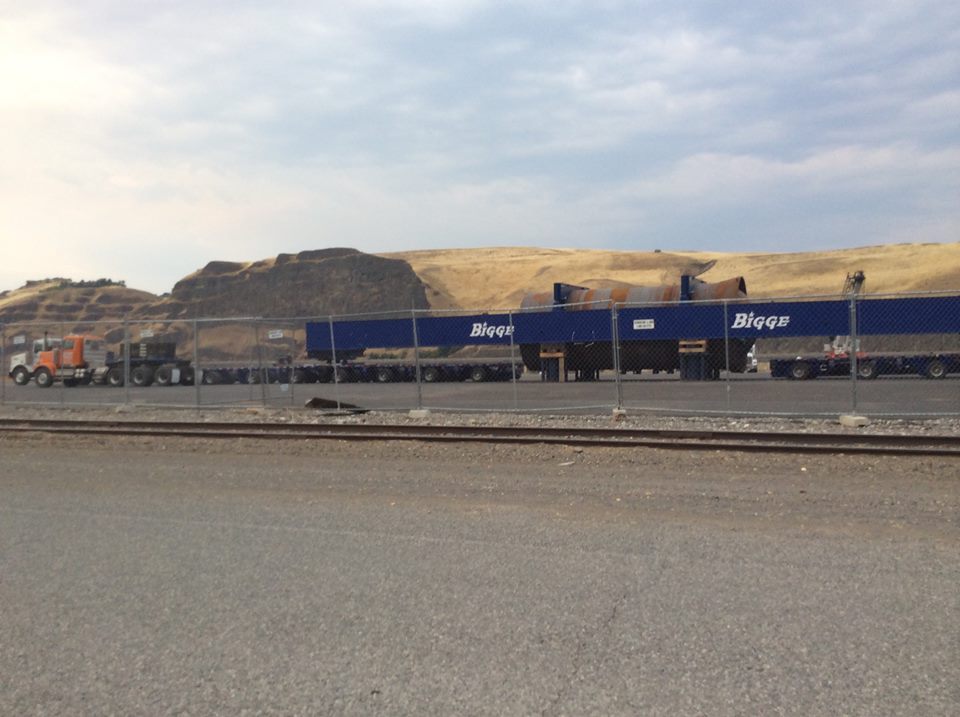
Wild Idaho Rising Tide is deeply grateful for the enthusiastic and experienced commitment and camaraderie of the progressive Idaho panhandle community, shared during respective Thursday and Saturday Sandpoint protests of this inbound refinery component and outbound coal export shipments.  We are depending on the strength and spirit of a great group of protestors converging in Hope and Clark Fork to oppose the passage of the Bigge/Calumet hydrocracker megaload on its last night in Idaho.  Early on Friday morning, Bigge parked its payload, trailers, and trucks at Idaho Highway 200 milepost 44.4, just west of Hope, Idaho, in anticipation of movement on Sunday night or later [2].  The convoy will travel on Business Highway 200 through Hope and East Hope, use jump bridges to traverse Strong and Riser Creeks, and risk sharp turns from Wellington Place to Centennial Boulevard and back onto Highway 200, not to mention the hazards of roadside cliffs and sloughing roadway along nearby Lake Pend Oreille wetlands and shorelines.  Please see Idaho and Montana Bigge transportation plans posted on the WIRT website and bring your friends, family, and protest signs to gather outside the Old Ice House Pizzeria, 140 West Main Street in Hope, at 9 pm on Sunday, August 17, and to monitor and protest the last 18 miles of this Alberta tar sands/Bakken shale oil infrastructure onslaught through Idaho [3-5].

[1] Million-Pound Megaload Will Roll through Bull, Swan Valleys (August 15, 2014 Ravalli Republic)

[2] Bigge-Hauled Calumet Hydrocracker Section at Idaho Highway 200 Milepost 44, Idaho 8-15-14 (August 15, 2014 Wild Idaho Rising Tide)

[3] ITD Highway 95 & 200 Megaload Public Records 7-31-14 (July 31, 2014 Wild Idaho Rising Tide)

[4] Old Ice House Pizzeria, 140 West Main Street in Hope, Idaho (August 17, 2014 Google Maps)

[5] Biggest Megaload Never! (August 10, 2014 Wild Idaho Rising Tide)

Northwest Communities Oppose Coal Exports


5576999

On Saturday, August 16, and during the previous week, grassroots groups are holding a coordinated day of peaceful actions, to protest the passage of coal trains through interior Northwest communities [1, 2].  From Montana and Wyoming to Oregon and Washington, proposals to bring more polluting coal trains through the region impact dozens of communities along rail lines, who are organizing to protect their towns from coal exports.  This summer, 350-Missoula, Blue Skies Campaign, Indian People’s Action, Wild Idaho Rising Tide, and other organizations are together catalyzing this movement against dirty energy in new and bolder ways, evident in this regional day of action.

As inland Northwest citizens largely dismissed by the federal and state regulatory processes that determine the fate of three proposed coal export facilities at Cherry Point and Longview, Washington, and Boardman, Oregon, we stand in solidarity with Northwest tribes and climate activists resisting these West Coast ports and Powder River Basin coal mines that despoil native lands and watersheds and ultimately global climate [3].  While Oregon agencies deliberate their possible issuance of key permits allowing financially risky, Australia-based Ambre Energy to begin construction on the controversial Morrow Pacific coal train terminal dock and warehouses at Boardman, we support friends among the Confederated Tribes of the Umatilla Indian Reservation, who rejected  the companies’ bribes of up to $800,000 per year to partner in and benefit from building this Coyote Island Terminal and shipping 8.8 million tons of coal per year down the Columbia River [4, 5]. Continue reading

Biggest Megaload Never!


10584055_1519796818254800_5233662663868064757_n

Protest Places & Tentative Times

Lewiston: Sunday, August 10, 9 pm: Arrive at the park/boat launch at Frontage Road and Steelhead Way, before the convoy closes Frontage Road, and expect to move to multiple locations as the megaload progresses.  Carpools depart from Third and Washington streets in Moscow at 8 pm (http://goo.gl/maps/BG4dt).

Moscow: Monday, August 11, 10 pm: Meet at Third and Washington streets outside Moscow City Hall.  Although this venue attracts too much police presence, it endures as the defacto megaload protest location.  The gargantuan load mounted the Lewiston grade and parked at Highway 95 milepost 320 at 2 am on Sunday night and will likely cross Moscow before midnight on Monday night (http://goo.gl/maps/4x0BQ).

Plummer: Wednesday, August 13, 10 pm: Converge outside the Warpath, before the Bigge megaload likely crosses Plummer at 11 pm or midnight.  Carpools from the Palouse region depart Third and Washington Streets in Moscow at 9 pm (http://goo.gl/maps/G5IV8).

Coeur d’Alene: Wednesday/Thursday, August 13-14: Come to the corner of West Linden Avenue and Lincoln Way at a time and date (early Thursday morning?) to be announced.  Carpools from the Palouse region depart Third and Washington Streets in Moscow at 9 pm on Wednesday (http://goo.gl/maps/0WWbv).

Sandpoint: Thursday, August 14, 5 pm & 10 pm: Assemble at 5 pm for a community meeting in Sandpoint Library rooms 103 and 104, and at 10 pm outside the Conoco gas station on East Superior Street, before the Calumet megaload crosses the Long Bridge at 11 pm, midnight, or later (http://goo.gl/maps/ryQLa).

Hope: Friday, August 15, 6 pm & Sunday, August 17, 9 pm: Bring your friends, family, and protest signs and gather at 6 pm on Friday for a community meeting in the upstairs room of the Old Ice House Pizzeria, 140 West Main Street in Hope, and at 9 pm on Sunday outside the Old Ice House Pizzeria, to monitor and protest the last 18 miles of this Alberta tar sands/Bakken shale oil infrastructure onslaught through Idaho (http://goo.gl/maps/EMz00).

Swan Lake: Sunday, August 24, 9:30 pm: Gather by 9:30 pm at the south end of the lakeside Swan Lake Day Use Area parking lot on the west side of Montana Highway 83, about one mile northwest of the town of Swan Lake (http://goo.gl/maps/zt3nf) [3].  Carpools depart from the east side of the Albertson’s parking lot, 1003 East Broadway Street in Missoula, after 7:30 pm (http://goo.gl/maps/XARbQ).  Expect to monitor the convoy and move to multiple protest locations, such as Condon and Seeley Lake, as the megaload progresses.

Clearwater Junction: Monday, August 25, 9:30 pm: Meet at 9:30 pm at the Clearwater Rest Area at the Clearwater Junction of Montana Highway 200 milepost 32 and Montana Highway 83 (http://goo.gl/maps/TKy7N) [4].  Carpools depart from the east side of the Albertson’s parking lot, 1003 East Broadway Street in Missoula, after 8:30 pm (http://goo.gl/maps/XARbQ).  Anticipate additional megaload monitoring along Highway 200 and protests in Lincoln and other places along the route.

Lincoln & Great Falls: Tuesday, August 26, 9 pm: Arrive by 9 pm at the Aspen Grove Campground about six miles east of Lincoln on a short access road off the south side of Montana Highway 200 (http://goo.gl/maps/8SqDf) [5].  Carpools depart from the east side of the Albertson’s parking lot, 1003 East Broadway Street in Missoula, after 7:30 pm (http://goo.gl/maps/XARbQ).  Monitors will follow the load and protest its arrival at the Great Falls Calumet refinery during the to-be-announced early morning hours of Wednesday, August 27 (http://goo.gl/maps/42HfG).

After eight anxious months and the usual last-minute fiasco to deter legal and physical resistance, the Idaho Transportation Department (ITD) issued a permit for Bigge Crane and Rigging Company early on Friday afternoon, August 8 [1].  The San Leandro, California-based company plans to haul an up to 1,086,000-pound piece of Great Falls, Montana, refinery equipment across northern Idaho over four to five nights, after departing the Port of Wilma near Clarkston, Washington, at 10 pm on Sunday, August 10.  The bottom, lightest, one-foot wider section of a hydrocracker, which would assist in tripling tar sands production at the Montana Refining Company owned by Calumet Specialty Products Partners, measures 311 feet long, 21 feet wide, and 16 feet, 8 inches high and weighs 926,000 pounds with interconnected trailers and trucks, when additional pull and push trucks are not powering the transport [2].  Accompanied by Idaho State Police, flaggers, and pilot vehicles every night between 10 pm and 5:30 am, the heaviest and longest shipment to (n)ever cross the region can move at speeds between 5 and 35 miles per hour.  It would enter Idaho from the eastern Washington port on Idaho Highway 128, and move north on U.S. Highway 95 up the Lewiston grade, avoiding the bridge over U.S. Highway 195 by briefly sidetracking under the bridge into Washington (with a permit?) and back into Idaho against off-ramp traffic.  After journeying through Moscow, Plummer, and Coeur d’Alene and crossing the two-mile Long Bridge to Sandpoint, the megaload would travel east to Montana on Idaho Highway 200, the federally designated Pend Oreille Scenic Byway with possible weight restrictions and load limits for the lake shore road partially built on fill material [3].  By Idaho law throughout the trip, the convoy must limit the traffic delays of two-lane blockage to 15 minutes, by notifying the transport driver of approaching and trailing vehicles and pulling off the roadway to let them pass.

In less than a Friday hour after ITD’s announcement, Wild Idaho Rising Tide (WIRT) responded to three ITD offices, the Federal Highway Administration (FHWA) in Boise, and the Idaho Attorney General, alerting them to a formal WIRT petition filed by the 5 pm MDT close of the business day.  The petition requests an immediate stay and reconsideration of ITD’s permit issuance to Bigge only days before it hauls its oversize shipment across northern Idaho [4-6].  By describing the many potential hazards to public safety, convenience, and road and bridge infrastructure that this megaload would impose, the petition outlines ITD’s subsequent violations of the U.S. Fourteenth Amendment and Idaho rules governing open public meetings, overlegal permits, and ITD operating objectives, as explained by Moscow community radio comprehensive coverage and a WIRT interview about the Calumet refinery megaload saga [7].  Wild Idaho Rising Tide did not receive explicitly requested acknowledgement of WIRT petition receipt from ITD, FHWA, and the attorney general on Friday, although the biggest ever megaload could roll before normal ITD business hours on Monday.  But a local reporter noted that, “ITD spokesman Adam Rush said his agency was prepared to receive a petition seeking to halt the shipment and that the matter would be considered over the weekend, before the shipment could legally leave the Port of Wilma…  If the WIRT petition isn’t granted, the megaload shipment could pass through Moscow late Sunday or early Monday” [8].  Whether any state officials bother to notify the petitioning group of their decision or just continue to dismiss it as collateral damage on the roadside to ruin remains uncertain.

Monitor & Protest! Continue reading

Bigge Stages the Last Calumet Megaload


20140724_191831

Bigge Stages the Last Calumet Megaload 7-24-14 (Wild Idaho Rising Tide photos)

On Thursday, July 24, two Wild Idaho Rising Tide (WIRT) activists scouted the Port of Wilma, across the Snake River from Clarkston, Washington, to document with photos and ascertain any changes at the fenced compound where Bigge Crane and Rigging stores the last of three rusty, cylindrical, hydrocracker sections stranded since mid-December 2013.  Participants in the Nez Perce Environmental Summit on Saturday, July 19, discovered the two other, larger, megaload parts vanished, with crews still in the port lot leased by Omega Morgan in late 2013, for its two massive evaporator cargoes [1].  Last observed on short, 12-axle trailers at the port on Tuesday, July 15, the two heavier, missing loads, 573,000 and 661,000 pounds each, likely departed by barge downriver or by train on the Watco Companies Great Northwest Railroad to the Tri-Cities, Washington [2].  According to late-May newspaper articles that suggested megaload rail travel, haulers could have transported the shipments on Schnabel train cars as oncoming traffic to potentially explosive, West Coast-bound, unit “bomb trains” of fracked Bakken shale oil.  The behemoths could currently be moving across eastern Washington and northern Idaho on either Union Pacific or Burlington Northern Santa Fe rail lines to Bonners Ferry, Idaho, then eastward on the BNSF railroad to a spur line heading south from Shelby to the Montana Refining Company in Great Falls.  The hydrocracker column formed by stacking the three purportedly irreducible components upright constitutes equipment essential to tripling Calumet Specialty Products Partners’ refinery production of Alberta tar sands, Bow River crude, and Bakken shale oil.

Activists noticed on July 19 that heavy hauler Bigge had left a white and red crane, a heavy-duty, white semi-truck, a small, orange truck, several flatbed trailers, and some white trailer pieces resembling the steel suspension systems seen around other, huge, fossil fuel contraptions in the region since February 2011.  The San Leandro, California-based company also abandoned the 504,000-pound, lightest, bottom part of the hydrocracker.  Its largest diameter of the three modules may have deterred its passage by train through tunnels, close, two-way tracks, or other rail line impediments, while its weight and length, when combined with interlocked trailers and trucks, could forebode the heaviest and longest megaload to ever traverse rural northern Idaho highway routes.  On Thursday evening, July 24, WIRT comrades saw additional Bigge gear that alerted them to imminent megaload movement, perhaps within a week.  A second, white semi-truck occupied the southwestern corner of the lot, while the orange truck, previously parked next to the hydrocracker piece, sat behind it, attached to the white trailer.  Absent during prior scouting forays, long, dark-blue, trailer sections loomed in front of the module, and a colossal, dark-blue, metal bar on a specialized semi-trailer, like the top of megaload lifts seen at the Ports of Pasco and Umatilla, crowded the eastern pavement outside the fence, along with a uniformed security guard in an older, white and red pickup truck. Continue reading

Support the Land Defenders Arrested on Monday at the Utah Tar Sands!


On Monday, July 21, about 80 climate justice land defenders peacefully expressed their First Amendment right to free speech, by staging a massive direct action at the site of U.S. Oil Sands’ tar sands strip mine at PR Springs in the Book Cliffs, Utah.  The protest that blocked mining facilities construction culminated a week-long direct action training camp held within two miles of the mine.  Participants of Climate Justice Summer Camp traveled from numerous organizations, states, and sovereign tribal nations to learn direct action skills and build networks.  These inspiring heroes left the comfort of their homes, the company of their families, and the security of their jobs to fight for the future of this beautiful, historical area.

Early in the morning, activists and supporters of Canyon Country Rising Tide, Peaceful Uprising, and Utah Tar Sands Resistance locked themselves to equipment, and a fenced storage cage around it, used to clear-cut and grade an area designated for the tar sands mining company’s processing plant.  Other protesters formed a physical blockade with their bodies, to halt construction work and to protect their locked-down comrades.  They hung and displayed banners off the cage that read: “You Are Trespassing on Ute Land” and “Respect Existence or Expect Resistance.” Continue reading

Oil and Gas Rulemaking Public Meeting on Tuesday, July 22


In April 2014, the Idaho Oil and Gas Conservation Commission voted to enter into negotiated rulemaking, to improve and clarify the existing Rules Pertaining to Conservation of Crude Oil and Natural Gas, IDAPA 20.07.02.  The commission published a notice of intent about this process in the Idaho Administrative Bulletin on June 4, 2014.  The Idaho Department of Lands (IDL) is holding four negotiated rulemaking public meetings in the Idaho Capitol at 8:30 am MDT on June 6 and 18 and on July 2 and 22 [1].  Purportedly state-initiated, but primarily industry-instigated, changes to the rules governing oil and gas development in Idaho are open to oral and written public comments and eventual hearings on the final draft of the proposed rules.  IDL oil and gas program manager Bobby Johnson has managed these rulemaking sessions that have drawn the attendance of agency staff, industry representatives, and stakeholders from Alta Mesa, the Idaho Association of Counties, Idaho Conservation League, IDL, Idaho Department of Water Resources, and Idaho Petroleum Council, and concerned county commissioners, Gem and Payette county residents and landowners, and Boise citizens.

Much that Idahoans cherish is at stake through this rulemaking and associated legislative approval of revised Idaho oil and gas rules and other related laws.  As Gem County activist Joe Morton asserts, the new IDAPA rules and prerogatives advanced by Governor Otter’s appointed Oil and Gas Conservation Commission are eroding, if not eliminating, Idaho private property rights [2].  The state legislature mandated legal clauses proclaiming that the Oil and Gas Conservation Commission shall have “authority over all persons and property, public and private” concerning oil and gas extraction.  Idaho lawmakers also removed local government control of oil and gas exploitation with passage of House Bill 464 in 2012, which states that “No ordinance, resolution, requirement, or standard of a city, county, or political subdivision, except a state agency with authority, shall actually or operationally prohibit the extraction of oil and gas.”  Besides many other troublesome rule changes favoring industry, state agency and commission members are currently displaying corporatism at its best: Writing new IDAPA rules that could force pool 45 percent of non-participating private property owners into relinquishing their rights to minerals taken from under their lands.  Like landowners who do not own their subsurface minerals and accompanying rights in “split estates,” the state of Idaho would allow extraction of oil and gas regardless of property owners wishes. Continue reading

Calumet Megaloads Depart the Port of Wilma


20140719_162950

Calumet Megaloads Depart the Port of Wilma 7-19-14 (July 19, 2014 Wild Idaho Rising Tide photos)

According to at least four Saturday, July 19, Wild Idaho Rising Tide (WIRT) eyewitnesses, two of the three Calumet tar sands refinery hydrocracker sections stranded at the Port of Wilma, Washington, since mid-December 2013 have vanished [1].  During the week of July 20, Bigge Crane and Rigging of San Leandro, California, is likely hauling these megaloads via river, rail, or road, from the port on the Snake River near Clarkston to the Montana Refining Company in Great Falls.  Last observed and described (but not documented with photos?) on short, heavy-duty, 12-axle trailers at the port on Tuesday, July 15, the loads were missing when a Saturday morning scout noticed crews still in the port lot previously leased for storage and staging of Omega Morgan “water filtration units.”  Questions about whether the hydrocracker parts departed by barge or rail downriver still linger, but after only a few days of travel, these megaloads may not have gone far.

In the fenced port compound, Bigge left white trailer pieces resembling the steel suspension systems seen around other huge fossil fuel extraction contraptions in the region since February 2011.  The company also abandoned the half-million-pound, lightest weight piece of the hydrocracker, the bottom part of the column formed by stacking the three components upright.  Its largest diameter, not weight, may have proved the critical factor restricting its passage by train through tunnels, close bi-directional tracks, or other rail line impediments [2].  Megaload owners and haulers cannot further downsize the three rusty, cylindrical sections and, as announced by late-May newspaper accounts, are probably shipping them to a trans-loading facility for transport on Schnabel train cars [3].  They could be moving the megaloads to the Port of Umatilla on the Oregon side of the Columbia River and attempting the previously permitted eastern Oregon, southern Idaho, and western Montana heavy-haul route pummeled by three almost-as-massive Omega Morgan loads last winter, especially while forest fires close eastern Oregon rural routes. Continue reading

Report & Further Work on the Idaho Week of Actions Against Bomb Trains


20140712_121334

No Idaho Bomb Trains! March & Protest 7-12-14 (July 12, 2014 Spokane and Wild Idaho Rising Tides photos)

Among over fifty coordinated, local, and continent-wide demonstrations against explosive oil trains, dozens of Spokane Rising Tide (SPORT) and Wild Idaho Rising Tide (WIRT) climate activists from eastern Washington and northern Idaho participated in five events during the Idaho Week of Actions Against Bomb Trains [1, 2].  In the spirit of Big Oil resistance and solidarity with the thousands of frontline communities who live along railroad sacrifice zones across the continent, citizens gathered to honor and commemorate the 47 residents of the still-recovering, devastated town of Lac-Mégantic, Quebec, who lost their lives when a unit train transporting fracked Bakken shale oil in outdated DOT-111 railcars derailed and exploded on July 6, 2013.  On the  solemn, one-year anniversary of this terrible tragedy, despite dozens of additional oil train disasters, oil-by-rail shipments continue to increase in the U.S. and Canada, and similarly risky tanker cars carry crude Alberta tar sands and Bakken shale oil around and over northern Idaho lakes, through flammable, forested, mountain valleys, and across the urban core of Spokane, Washington.

On Monday evening, July 7, a dozen people learned and discussed tactics and strategies for staging non-violent civil disobedience on railroad property during the Railroad Direct Action Skill-Share and presentation at the East Bonner County Library in Sandpoint, Idaho.  As part of a series of skill-shares in communities along Northwest coal- and oil-transporting rail lines, Blue Skies Campaign volunteers from Missoula, Montana, talked about their recent experiences and insights drawn from two direct actions on or near train tracks in Helena and Missoula.  Conversations in the library’s Rude Girls Room and later over pizza covered railroad security and law enforcement responses, coal train movements, protest logistical considerations, and opportunities for future, inter-group, regionally coordinated actions.  If you would like to engage in these mostly coal train protests and upcoming conference calls arranging them, please contact WIRT or Blue Skies Campaign.

WIRT participated in the Spokane Rising Tide action, Demand Safer Railcars, at the downtown Spokane office of Washington Republican Congressional Representative Cathy McMorris Rodgers (CMR), beginning at 12 noon on Tuesday, July 8 [3-5].  About a dozen protesters gathered on the North Post Street sidewalk below the fourth floor suite, with props representing an angry mob – cardboard and wooden pitchforks and torches provided by SPORT.  They delivered a great letter written by SPORT’s Terry Hill that sadly could serve as a template for letters to hundreds of other so-called elected officials installed by corrupt industries to ensure their ruthless regimes of continued destruction of the planet and countless lives.  The letter asked how the Congresswoman would protect the safety of her constituents and communities endangered by bomb trains, while she compromises her public interests by taking big campaign contributions from the oil and dirty energy industry and railroad companies.  It requested that she and Congress ensure the security of rail line residents by removing outdated DOT-111 train cars from service.

From within the potential Spokane blast zone of such trains, CMR’s staff members acted congenially, respectfully, and professionally towards the concerned citizens.  They stated that they would forward the letter to CMR, and, when asked by the protesters, promised everyone who left contact information a response specific to their addressed concerns, not the anticipated, vapid, form letter filled with conciliatory comments.  The visitors questioned CMR’s staff about the regularity and accessibility of the Congresswoman’s appearances in Spokane.  The staff members suggested that the group of voters request a “coffee with Cathy” meeting as early as August.  Returning to the street, the comrades energetically repeated five chants that Moscow and Spokane activists devised, hopefully audible in CMR’s office: “Rolling downhill, oil trains kill, 47 slain, no bomb trains!” “Pipelines spill, but bomb trains kill!” “While Cathy takes bribes, bomb trains take lives!” “Big oil bribes, railroad ties, Cathy’s corruption risks our lives!” and “Spokane oil trains, more every day, Cathy’s voters say no way!”  The climate activists then huddled, noticed police entering the building, talked for a while, and dispersed. Continue reading

Join the Transporta​tion Board Thursday Tour & Moscow Visit: Final Highway 95 EIS Chose Paradise Ridge Reroute


Palouse Prairie (Alison Meyer photo)

Palouse Prairie (Alison Meyer photo)

Final Highway 95 EIS Chose Paradise Ridge Reroute

After releasing its final environmental impact statement (FEIS) for U.S. Highway 95 expansion and rerouting between Thorn Creek Road and Moscow on Tuesday, July 8, “the [Idaho] Transportation Department (ITD) has maintained its preferred route as the eastern path along Paradise Ridge” [1].  The 1200-page FEIS reflects that recommendation, which does not ensure that the Federal Highway Administration (FHWA) will select the E-2 Paradise Ridge alternative for the reroute.  ITD plans to send copies of the FEIS to the FHWA district office and the environmental section of the ITD headquarters office, both in Boise.  Those agencies would review the statement and provide comments and feedback over about three weeks.  The FHWA would then submit the FEIS to its legal section in Washington D.C. for review.  The number of technical reports accompanying the statement – addressing citizen and agency concerns over wildlife, groundwater, weather, wind, weeds, and safety – could prolong FHWA legal section analysis to a couple of months, but ITD does not anticipate many questions.  The worst-case scenario for ITD – resubmitting the FEIS in response to this review – would take an estimated week.  When and if the national FHWA office finally approves the FEIS, it would place it in the Federal Register for 30 days, for other agencies to review and make comments.  Most pertinent federal and state environmental and wildlife agencies have previously advised against the E-2 route.  After this feedback, ITD would issue the record of decision (ROD), a separate document in response to federal agency comments, which would state FHWA’s route alignment selection, summarize the entire process, and undergo a FHWA review before it signs off on the ROD.  At that point, the final design phase and right-of-way plans for the new highway section would begin.  ITD has about $20 million in federal funding shifted to each of the fiscal years of 2016 and 2017 for construction.  ITD’s “very aggressive, but doable” plan foresees construction start-up by summer 2016.

​With characteristically disgraceful hubris rivaling that of Idaho’s highest elected officials, ITD has neither publicly responded as promised to the questions of 400 commenters on its draft environmental impact statement nor directly notified them of its FEIS release, as it files another likely inadequate, incomplete, and fraudulent impact statement.  It also has sidestepped citizen attempts to ascertain the project analysis schedule as well as requests for public hearings addressing legitimate citizen charges of blatant dishonesty.  ITD project manager Ken Helm asserts that “he and various consultants have spent the past year addressing each of those concerns and questions, revising technical reports, and creating new ones, in an effort to produce the final environmental impact statement” [1].  But with ITD’s obstinate insistence on the E2 route, the fix is apparently in.  According to a current schedule posted on ITD’s project website, “the FEIS will address public comments, make any corrections, and provide new information…The document will be sent to the FHWA office in Washington D.C. for a legal sufficiency review in August [and September 2014]” [2].  By mid-October 2014, the responsible (?) agencies intend to publish notice in the Federal Register of a 30-day period of FEIS “review by local resource agencies and the public.”  After the review process, ITD will prepare and issue a record of decision in late December 2014, which will require FHWA approval.

Transportation Board Will Visit Port, Highway 95, & Moscow on Thursday

In its typical last-minute manner, ITD distributed an announcement on Tuesday, July 8, that the Idaho Transportation Board will tour the Port of Lewiston, the Highway 95 section proposed for re-routing and expansion south of Moscow, the Intermodal Transit Center in Moscow, and other locations on Thursday, July 10, before holding its regular monthly meeting on Friday, July 11, at the ITD District 1 office at 600 West Prairie Avenue in Coeur d’Alene [3].  The Board will begin its tour of ITD Districts 1 and 2 highways on Thursday at the ITD District 2 office at 2600 Frontage Road in Lewiston.  Departing at 7:50 am, the Board will meet with officials at the Port of Lewiston until 8:30 am, when it will travel north on U.S. Highway 95 to a “vantage point” on Zietler and Cameron Roads, where observers can envision and discuss at 9 am the eastern and central re-routing paths of Highway 95 between Thorn Creek Road and Moscow.  After 15 minutes, the Board tour will travel north to arrive at the Intermodal Transit Center, at the corner of West Sweet Avenue and Railroad Street on the University of Idaho campus in Moscow, at 9:25 am and stay until 10:25 am.  Stops north of Moscow include Potlatch, Plummer, and Post Falls, along with overnight accommodations at the Holiday Inn Express in Coeur d’Alene and the Friday Board meeting of unknown schedule at the District 1 office. Continue reading