Wild Idaho Rising Tide (WIRT) confronts the root causes of climate change, water degradation, and air pollution, by asserting direct actions and promoting locally organized solutions, in solidarity with frontline communities of resistance and an international, volunteer, grassroots network of activists.
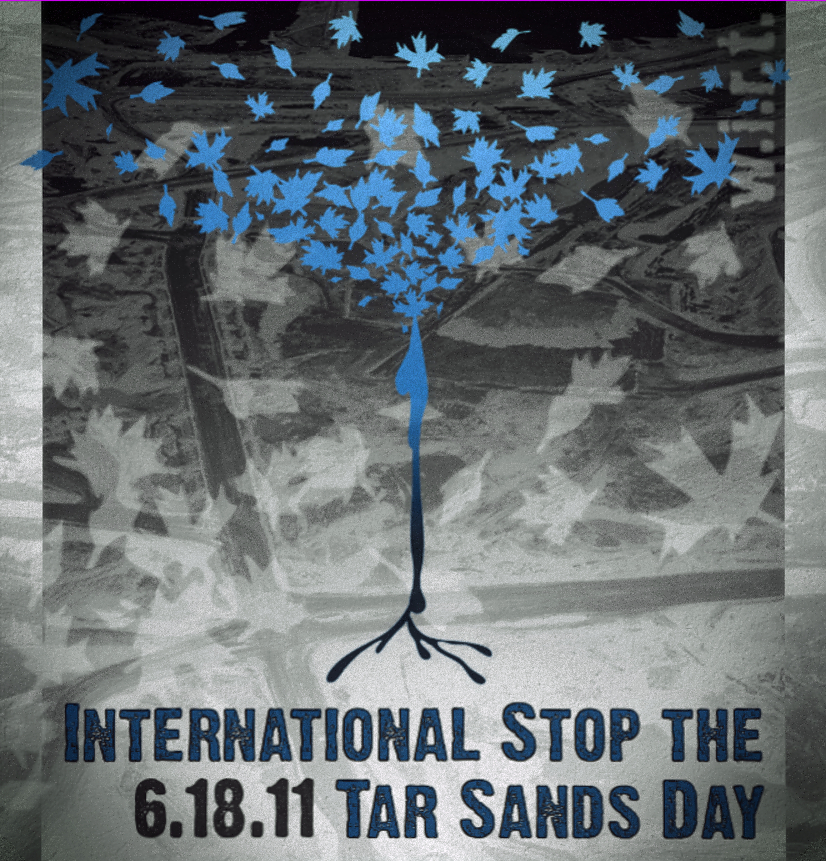
On June 18th people all over the globe will be taking to the streets as part of an International Day of Action Against the Tar Sands and I want you to join them.
For more info on upcoming local actions contact wild.idaho.rising.tide@gmail.com
BACKGROUND:
The Tar Sands are destroying forests, trampling indigenous rights, poisoning our atmosphere and river systems and threatening community health. On June 18th we will fight back globally. Demonstrations and protests are being organized around the world in the largest day of action against the Tar Sands ever.
Whether it’s forest destruction of areas that ultimately could equal the size of Scotland, toxic lakes that can be seen from space, the trampling of Indigenous rights or the poisoning of Canadian and US communities living near Tar Sands operations, turning Tar Sands into transportation fuel hurts our environment and communities every step of the way.
We need you to help draw a line in the sand and show companies and governments around the world that our future doesn’t contain this toxic resource. Take action with us on June 18!
University of Idaho students and regional activists with Wild Idaho Rising Tide marched across the UI campus in Moscow at midday on April 20th to display their opposition to the ExxonMobil transports planned for Idaho roads and bound for Alberta tar sands development. As part of the international Day of Action Against Extraction, north central Idahoans joined thousands of climate justice activists marking the anniversary of the BP oil disaster in the Gulf of Mexico with public demonstrations and direct actions.
In solidarity with communities and ecosystems devastated by corporate extraction of fossil fuels and public natural resources, the dozen protesters carried signs saying, “Stop the Megaloads” and “Big Oil Has the Right-of-Way.” Their banners were strung on ropes between them that illustrated the 208-foot length and 24-foot width of the colossal oil company megaloads that could travel Highways 12 and 95.
Student members of the UI Oxfam and Environmental clubs, Corrie Ellis and Danie Merriman, said, “We feel we are representing university and Moscow students, and we are not O.K. with big business running over our town and us not having a voice in this matter. We are ready to be heard.”
Lee Spencer, a fisherman against tar sands exploitation, noted that, “My family and I have fished and lived on the Lochsa River for generations. It is a sacred place. It is not a corridor to facilitate the destruction of Alberta and the entire biosphere.”
The rally participants also voiced their displeasure with multi-national, dirty energy industries that sacrifice clean air, water, and lands and human health for their tax-free profits. Lewis-Clark State College Business Division lecturer Leslie Rist emphasized that, “It’s not nice to rape Mother Nature. Big Oil isn’t good business.”
The newly formed group is planning another march and rally on May 11th, when the Idaho Transportation Department and Imperial Oil, a subsidiary of ExxonMobil, will hold an interactive public meeting in Moscow. Many citizens and city officials have expressed concerns about the dozens of oversized shipments the oil company has proposed to move on Highway 95 through Moscow.
About 1,300 homes and businesses in the Pierce and Weippe areas were without power for almost five hours this morning after an Imperial Oil test module hit a line supporting a transmission wire.
The outage started at about 1:45 a.m. following the incident on U.S. Highway 12, two miles east of Orofino, said Debbie Simock, a spokeswoman for Avista.
The megaload hit a supporting line triggering a pole holding it up to break and then the supporting line hit a transmission line that shorted, said Simock and a spokesman for the Idaho Transportation Department.
Traffic was delayed one hour instead of the 15 minutes that ITD is allowing, said Adam Rush, a spokesman for the transportation department.
The over-sized shipment is now parked at milepost 61, 13 miles short of Kooskia where it was supposed to arrive by 5:30 this morning, Rush said.
“No one was hurt,” said Pius Rolheiser, a spokesman for Imperial Oil.
No decision has been made about whether the test module will continue this evening on the next leg of its trip to Montana on U.S. 12, Rush said.
Rush’s employer is waiting for a report from Mammoet, Imperial Oil’s hired hauler, about what happened before it makes any decisions, Rush said.
Groups to mark Gulf Oil Spill anniversary with direct action against fossil fuel extraction.
On April 20th dozens of environmental, climate, and social justice groups will target government and corporate operations with aggressive protests and civil disobedience in an International Day of Direct Action Against Extraction being organized by Rising Tide North America. The protests will commemorate the 1 year anniversary of BP’s Gulf Oil Disaster by demanding an end to the environmental destruction and climate destabilization created by fossil fuel and other extractive industries.
“The Gulf Oil Disaster was the worst manifestation of the disasters that are created by extractive industries on a daily basis” said Matt Wilkerson of Rising Tide North America. “Communities around the world are terrorized by corporate and state ventures to extract fossil fuels. On top of poisoning our water and polluting our air, extractive industries are at the root of our climate crisis. If we have any hope of averting the worst affects of climate change we must leave fossil fuels in the ground.”
Megaloads Debate In Idaho Now Includes US 95 And I-90:
ExxonMobil needs to move the oversized loads from the Port of Lewiston to Montana. The company is proposing to move them up US-95 through Moscow and other communities to reach Coeur d’Alene, and then head east on I-90 to Montana. In its proposal, the company says the shipments would move between 10:00pm and 5:30am and says that each trip would take three nights. Crews are working at the Port of Lewiston to reduce the size of the megaloads stored there so that they can make the trip. The Idaho Transportation Department says the largest shipment being proposed is 24 feet wide, 15 feet- ten inches tall and 207 feet in length. ITD says its engineers have just begun analyzing the proposal and does not know when the shipments would start if the plan is approved.
Numerous stakeholders are involved in shaping oil sands policy
“The Alberta government, as owner of the province’s resources, has played the dominant role. Different divisions of the Albertan government are responsible for the various aspects of oil sands policy. The Energy Resources Conservation Board is responsible for regulating the oil and gas industry in Alberta, while Alberta Energy is responsible for granting rights to industry for exploration and development, collecting royalties, and administering the energy sector’s fiscal regime. Alberta Environment, through relevant legislation and guidelines, regulates the impact of oil sands development on air, land, and water in the province. Recently, the Oil Sands Secretariat was created within the Treasury Board to strengthen policy coordination.
To inform policy development the Government of Alberta has also turned to processes involving a multitude of stakeholders. To guide the direction of future growth in the oil sands, the Alberta government created the Oil Sands Multi-Stakeholder Committee to consult with all relevant stakeholders in the province, including the general public. The committee released its report in June 2007. As of the end of May 2008, the government has yet to respond. The Cumulative Environmental Management Association (CEMA) was created in 2000, with the charge to propose a framework for environmental management for the Athabasca oil sands region. For various reasons, its progress has been slow. In January 2008, CEMA did call for a halt to the issuance of new tenures in one area while it continued deliberating , but the provincial government rejected the request, saying it would consider the issue when CEMA delivered its complete report. CEMA released its Terrestrial Ecosystem Management Framework on June 5, 2008.
The federal government’s role in managing the oil sands has been minimal. While the Government of Canada has jurisdiction over waterways, fisheries, Indian lands, and environmental assessments, it has been hesitant to exercise this jurisdiction in a way that would threaten Alberta’s perceived right to develop its resources as it sees fit.
The oil and gas companies involved in oil sands production have been extremely powerful stakeholders in the province. As of the end of December 2006 there were 21 companies operating 74 projects in the Alberta oil sands. Some of the companies producing the largest amounts of oil included Imperial Oil, Suncor, Shell Canada Limited and Canadian Natural Resources. Of the 21 producing companies, the largest seven accounted for about 84 percent of production in 2006.
Today, environmental groups are increasingly asserting their concerns regarding oil sands development, and have gone so far as to challenge government policies in court. As the Alberta government remains relatively hostile to these groups’ demands, environmentalists find themselves largely removed from the formal political sphere in this arena.
Finally, the 23 Aboriginal groups that live in northern Alberta are increasingly asserting their right to shape the development of their ancestral lands. Many of their concerns are articulated in the recent First Nations’ consultative process.
All of these stakeholders are attempting to shift the pace, scale and direction of oil sands development in a particular direction that suits their respective needs or interests. To this end, some of the challenges with oil sands exploration – outlined further in this feature – are cited by many of these groups as they attempt to articulate their vision for the oil sands.
The absolute scale of current development in the oil sands, and the consequent environmental, social and economic implications of this development, are massive. Since the mid-1990s, production of oil from the region has increased exponentially. In 2006, oil sands production was at approximately 1.2 million barrels a day – a figure representing about 42 percent of Canada’s total crude output. Accordingly, the potential for future growth is enormous, as to date less than five percent of the established reserves have been produced. Alberta Energy estimates that production could reach five million barrels a day by 2030. As production continues to propel the Alberta economy forward, the policy problems that remain unresolved today will only increase.”
– Located at the University of Lethbridge, in Lethbridge, Alberta (Canada), Maple Leaf Web publishes original articles and features on Canadian political events and institutions and provides important links to a wide range of external resources.
Welcome to WordPress.com. This page is a work in progress. After you read this, you should contact me to get the password to be able to write your own posts.
Add PressThis to your browser. It creates a new blog post for you about any interesting page you read on the web.
Make some changes to this page, and then hit preview on the right side of the screen after logging in. You can always preview any post or edit you before you share it to the world.
Thank you for generously contributing to the Wild Idaho Rising Tide (WIRT) collective! Your donations support our direct action and outreach work, operational costs, travel and demonstration supplies, and legal and court fees arising from our non-violent, civilly disobedient protests.
Wild Idaho Rising Tide confronts the root causes of climate change by asserting direct actions and promoting locally organized solutions, in solidarity with frontline communities of resistance and an international, volunteer, grassroots network of activists.
With and for you, we will continue to foster formidable citizen resistance to dirty energy development schemes like tar sands transports, Northwest coal and shale oil exports, and oil and gas drilling/fracking in Idaho.
Please visit our facebook and website pages often for current information and opportunities to physically and/or fiscally participate in our shared climate activism.




 Wild Idaho Rising Tide