Lewiston Dock Expansion Work Could Begin in Summer of 2013


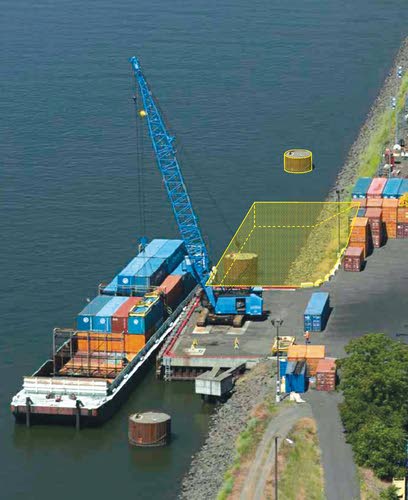
The yellow shaded area next to the existing cargo loading dock at the Port of Lewiston shows the downstream area where the dock would be expanded (Port of Lewiston photo).

Containers are loaded into barges at the Port of Lewiston cargo dock, where an expansion project would significantly increase shipping volume capacity (The Lewiston Tribune/Barry Kough photo).

Unknowns for port include decision by U.S. Army Corps of Engineers, grant money

The Port of Lewiston is getting a little closer to a $2.9 million expansion of its container dock, a project it initiated in 2007.

Plans are to begin the work in July 2013 and have it finished by September of that same year, said port Manager David Doeringsfeld.  “It’s not that big or difficult a project.”

That schedule, however, depends on a number of variables falling into place.

The U.S. Army Corps of Engineers received more than 50 public comments after it issued a draft finding of no significant impact, said Bruce Hendrickson, a spokesman for the Corps in Walla Walla.  That feedback will weigh into its final decision on the work. Continue reading

Spokane Democracy School


Please do not miss the Spokane Democracy School on Friday evening, April 6, and Saturday, April 7, described in the following message from Kai Huschke, who taught the Moscow Democracy School Workshop on March 23 and 24.  A video and website of its Community Environmental Legal Defense Fund instructors also reveal the crucial value of these sessions that empower citizens to institute their rights over corporate privilege.  Several Wild Idaho Rising Tide (WIRT) activists who participated in the Moscow workshop and are preparing to launch a Latah County community bill of rights will carpool to Spokane for the weekend training, departing Moscow on Friday, April 6, at 3 pm or earlier.  If you plan to attend the Spokane Democracy School, please contact Kai at kai@celdf.org, to reserve your spot, and WIRT at wild.idaho.rising.tide@gmail.com or 208-301-8039, to arrange Moscow carpools and Spokane lodging.  (Also listen to Kai on the March 29 and upcoming podcast of Democracy Matters. Continue reading

Port of Lewiston Expansion Comments due Friday Night


The U.S. Army Corps of Engineers (Corps) extended the deadline until March 30, 2012, for public comments about the environmental assessment (EA) and finding of no significant impact (FONSI) analyses of the proposed Port of Lewiston Dock Expansion and Storage Area Development.  This project specifically aims to accommodate larger cargo on a regular basis, like the Alberta tar sands megaloads that have invaded and damaged Highway 95, Moscow streets, and Highway 12 through the Wild and Scenic Lochsa-Clearwater river corridor.  Together, north central Idahoans have prevented and protested these transports on our roads; let’s flood the Walla Walla Corps offices with letters of continuing resistance and block megaloads in Idaho at their point of arrival.  Please write a few paragraphs to Corps officials, urging decision makers to choose the “No Action” Alternative 1 before midnight on Friday evening.  Ask your friends, co-workers, and family members to pen their opinions, too.  For suggestions of key points to include in your letter to the Corps, please peruse WIRT’s formal July 22 Port of Lewiston Permit Application Comments and consider the following arguments suggested by Fighting Goliath and Friends of the Clearwater.  Also see the Port of Lewiston category on the WIRT website for a recent project summary and government document links, additional talking points, and related news articles. Continue reading

Controversial Oil/Gas Drilling Bill, HB 464, Signed into Law


Here’s a news item from the Associated Press: BOISE, Idaho ― Governor C.L. “Butch” Otter signed the bill restricting local control over the natural gas industry, putting the finishing touches to a measure that launched the Senate’s ethics investigation into Senator Monty Pearce.  The law, HB 464, went into effect Friday, forbidding local governments from enacting ordinances to prohibit gas drilling.  From now on, Idaho cities and counties can’t require exploration companies to secure conditional use permits for their projects.  Though the bill cleared the House and Senate on wide margins, it created a sensation in the 2012 Legislature when Democrats accused Pearce of not disclosing a conflict of interest.  Pearce has leased land to Snake River Oil and Gas, the company behind the bill.  He didn’t disclose his leases publicly until the final vote.  Wednesday, the Senate Ethics Committee dismissed the complaint.

(By Betsy Russell, Eye on Boise, The Spokesman Review)

Gasland Rancher John Fenton in Idaho


On Monday, March 19, in Weiser, and on Tuesday, March 20, in Fruitland, the Idaho Organizing Project of the Western Organization of Resource Councils and Oregon Rural Action hosted guest speaker John Fenton of Pavillion, Wyoming, the rancher and chair of the Pavillion Area Concerned Citizens featured in the Gasland documentary.  Throughout two informative evenings of free, public presentations, John talked about his and his neighbors’ personal experiences and their direct struggles against the negative aspects of living in the middle of oil and gas fracking development on their ranches and in their community.  See a brief video of John explaining how his peers organized themselves and recruited the U.S. Environmental Protection Agency for a seminal study of their ground water.

(Link provided by Liz Amason)

Idaho Senate Democrats Decry ‘Unpleasant Ordeal’ of Pearce Ethics Process


The Senate ethics investigation into Senator Monty Pearce is over – as a bipartisan committee voted unanimously to drop a conflict-of-interest complaint.

But the hard feelings linger.

In a news release this morning, Senate Democrats complain that they were saddled with an unreasonable burden of proof. They say they were told to prove that Pearce, R-New Plymouth, would derive direct and unusual financial benefit from oil and gas leases from the process.

Committee Republicans and Democrats closed the process with an agreement that potential conflicts should be disclosed sooner in the legislative process – not on the Senate floor, before a final vote on legislation, as Pearce did last week.

Read more: Idaho Senate Democrats Decry ‘Unpleasant Ordeal’ of Pearce Ethics Process

(By Kevin Richert, The Idaho Statesman)

House Bill 464 in the Idaho Senate


Controversial legislation fast-tracked by the Idaho Petroleum Council through the Idaho Legislature, House Bill 464 faced a gridlock 17 to 17 vote on the Senate floor last Friday, March 9, about whether it should be sent to the Amending order for language changes.  This industry-sponsored law would allow state agencies and commissions to pre-empt city and county control of natural gas development and would exempt associated wells from state regulations governing Class II injection wells, thus permitting disposal of hazardous drilling waste such as hydraulic fracturing (“fracking”) fluids.  In an unexpected turn of events, Lieutenant Governor Brad Little cast the deciding vote in favor of revisions (see the Boise Weekly article also on the WIRT website, Senate Deadlocks on Amending Gas Drilling Measure, Lieutenent Governor Casts Tie-Breaker. Continue reading

Comment Period Extended for Port of Lewiston Expansion


The Walla Walla District of the U.S. Army Corps of Engineers (Corps) has extended the deadline for public input on the recently released 73-page Environmental Assessment (EA) and draft Finding of No Significant Impact (FONSI) for the Port of Lewiston Dock Expansion and Storage Area Development.  It lengthened the comment period to a more appropriate 30 days ending on Friday, March 30, rather than on Friday, March 16.  Both documents are available for your examination on the left side of the Corps’ Port of Lewiston Dock Expansion and Storage Area Development web page.  The project proposed by the Corps’ preferred Alternative 2 would expand the existing dock from its present 100 feet to 250 feet parallel with the north bank of the Clearwater River, along the Corps-owned flood protection levee and adjacent shoreline land.  It would also move a mooring pillar downstream in the river and develop two acres as a graveled storage area at current port facilities, among a half dozen other associated modifications. Continue reading

Moscow Democracy School Workshop


Without public consent, how can officials “permit” industrial processes and pollution that destroy pristine land, clean water, and shared infrastructure?  Democracy Schools offered by the Community Environmental Legal Defense Fund (CELDF) examine how the American constitution has been reinterpreted and laws enacted to shift power from real people to “corporate persons.”  Learn why large businesses have gained and seemingly possess more civil rights than the communities they overrule and impact, which often lack the authority to reject unfavorable development projects.  Discover how people from Maine to Washington are working through their municipal governments to legally enforce economic and environmental sustainability.  Explore next steps for passing city or county laws to expand protections for people and places, lives and livelihoods.

Organizer Kai Huschke of CELDF in Spokane will lead the Moscow Democracy School Workshop discussing remedies to state and federal government enforcement of corporate rights to extract natural and financial resources from citizens and communities in Idaho and across the country.  Please RSVP and register to participate in this timely, pro-active seminar held in the 1912 Center Fiske Room at 412 East Third Street in Moscow between 6:00 and 8:30 pm on Friday, March 23, and from 9 am until noon on Saturday, March 24.  To cover presenter work, travel, venue, and materials costs, we are requesting a $15 registration donation upon arrival for the entire two-day-minimum session.  Similar to workshops provided in Bellingham, Washington, where an anti-coal export train initiative has emerged, and in Washington County, Idaho, where strong natural gas facility regulations have developed, further descriptions and the Two-Day Democracy School Agenda for the Moscow Democracy School Workshop are available on the Wild Idaho Rising Tide and CELDF websites.  Kai encourages participants who would like to further lead the campaigns that arise from the Moscow workshop to attend the more comprehensive Democracy School in Spokane on Friday and Saturday, April 6 and 7.

Imperial Gets Last of Kearl on Road


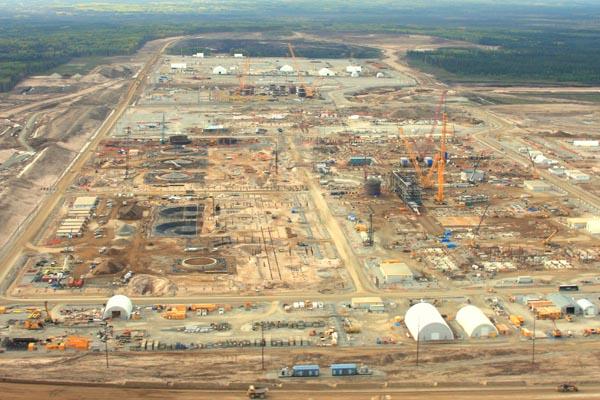
The foundation and underground services are in place at the first phase of the $8-billion Kearl Oil Sands project, seen in a recent aerial photo of the site north of Fort McMurray (Imperial Oil photo).

$11-billion plant on schedule to start up at year’s end

After months of delays, route changes, and extra work to disassemble huge oil sands modules sent from South Korea, the last loads are on the road to Imperial’s $10.9-billion Kearl project.

The final shipment of 33 modules left the Port of Lewiston, Idaho, last week on the way to Edmonton, where they will be reassembled and sent to Fort McMurray.

Meanwhile, about half of the 205 imported modules remain at the Port of Pasco, midway between Lewiston and the Port of Vancouver, Washington.  The Korean units represent about 20 percent of the modules needed for the vast Kearl project.  Almost all of the remainder were constructed in Edmonton-area yards, primarily in Nisku.

The Pasco modules are being disassembled and sent off in batches of two or three shipments twice a week, following a four-lane highway to Spokane, Washington, and Butte, Montana, then north to Alberta on a route that will take them east of Calgary.

“We’ve been moving multiple loads but on fewer nights,” said spokesman Pius Rolheiser.  Imperial has day park locations along the route.

Kearl is scheduled to start up at the end of this year with work now about 90 percent complete.

…Depending on weather and permits, all Pasco modules will be at Kearl by the summer.

…Imperial won’t be building an upgrader at Kearl but is using a patented paraffinic froth treatment system to produce a solids-free bitumen that will be blended with diluent and shipped by pipeline to North American refineries.

…A key feature of Imperial’s plan is to ship the Kearl diluted bitumen on the proposed 500,000 barrels-per-day TransCanada Keystone XL pipeline, which has become a hot political issue in the U.S.

Read more: Imperial Gets Last of Kearl on Road

(By Dave Cooper, Edmonton Journal)