WIRT Response to Idaho Department of Lands Media Counter-Release


Wild Idaho Rising Tide (WIRT) organized several upcoming statewide protests and commented against Alta Mesa Services’ (AMS) plans to drill the Smoke Ranch natural gas well on private land in Birding Island, Payette County.  In response to nationwide WIRT publicity of this gas extraction scheme, the Idaho Department of Lands (IDL), the administrative arm of the Idaho Land Board and Oil and Gas Conservation Commission authorized to both lease lands and consider and permit such drilling on them (conflicting roles?), released a Fact Sheet for Media with information that counters WIRT assertions and displays alarming duplicity.

No Fracking?

Even though IDL states that “oil and gas resources in Idaho generally do not have the [fracking?] issues with extraction that have been reported over the last few years in other states,” they likely will experience these problems, considering the mercenary objectives of oil and gas companies and the state’s conflict of public interest as the major holder of subsurface mineral rights in the target region.  State rules “include the requirement that an operator must disclose all materials used for well treatments and fracking [if they are not proprietary brews], and to inform the state of where it will dispose of fracking fluid.  Disposal could include the recycle and reuse of the fluid for the fracking process.”  If Idaho resources do not require fracking, why has the state established rules about it?

“Small Frac Jobs”?

“The IDL has received no applications to date for hydraulic fracturing.  However, approximately half of the currently completed [eleven] wells in Idaho will need a SMALL FRAC JOB to clear the drilling mud from the POROUS reservoir rocks.  This frac job is estimated to be only about three percent of the size of frac jobs performed to extract oil or gas from shale, as is currently being done in North Dakota, Pennsylvania, and other places outside Idaho.  This means they would only be using thousands of gallons of water and not millions…”  This IDL statement represents written proof that Idaho is about to be fracked in a similar although smaller way as the places most poisoned by this risky extraction method. Continue reading
WIRT Comments to the Idaho Department of Lands on Alta Mesa Services’ Permit Application for Drilling Well 1-21


The 1500+ members of Wild Idaho Rising Tide (WIRT) oppose Idaho Department of Lands (IDL) permitting of the Alta Mesa Resources (AMS) application to drill well number 1-21 of the Smoke Ranch lease on Birding Island in Payette County, Idaho.  We are concerned that AMS drilling through subsurface shale would require utilization of hydraulic fracturing (“fracking”) in close proximity to the Payette River, Big Willow Creek, and their confluence and surrounding floodplains and wetlands.  Even without fracking, the majority of drinking water contamination problems across the United States have arisen from natural gas and oil drilling and improper well casing construction: Approximately half of all oil and gas well casings fail within twenty years.  Surface water contamination can carelessly occur from the fluids that result as a byproduct of this kind of drilling: the deeper the well, the more radioactive the returning material.

Furthermore, if the Smoke Ranch 1-21 well proves productive during this first foray into the deeper Willow gas field, Alta Mesa Services, Snake River Oil and Gas (SROG), and their peers, backed only by questionable financial resources, could drill in the state lands (leased by IDL at ridiculously low rates) along the Payette River.  With only expensive, exploratory progress in the southwestern Idaho target area that geologists have stated holds very little oil and gas resources, AMS and SROG drilling in riverine places most vulnerable to water contamination is not in the best interests of the health and safety of Idahoans and the environment upon which we rely for our economic activities.  Moreover, oil and natural gas resources in Idaho can only be developed and moved to market with great difficulty and cost, due to lack of existing infrastructure. Continue reading

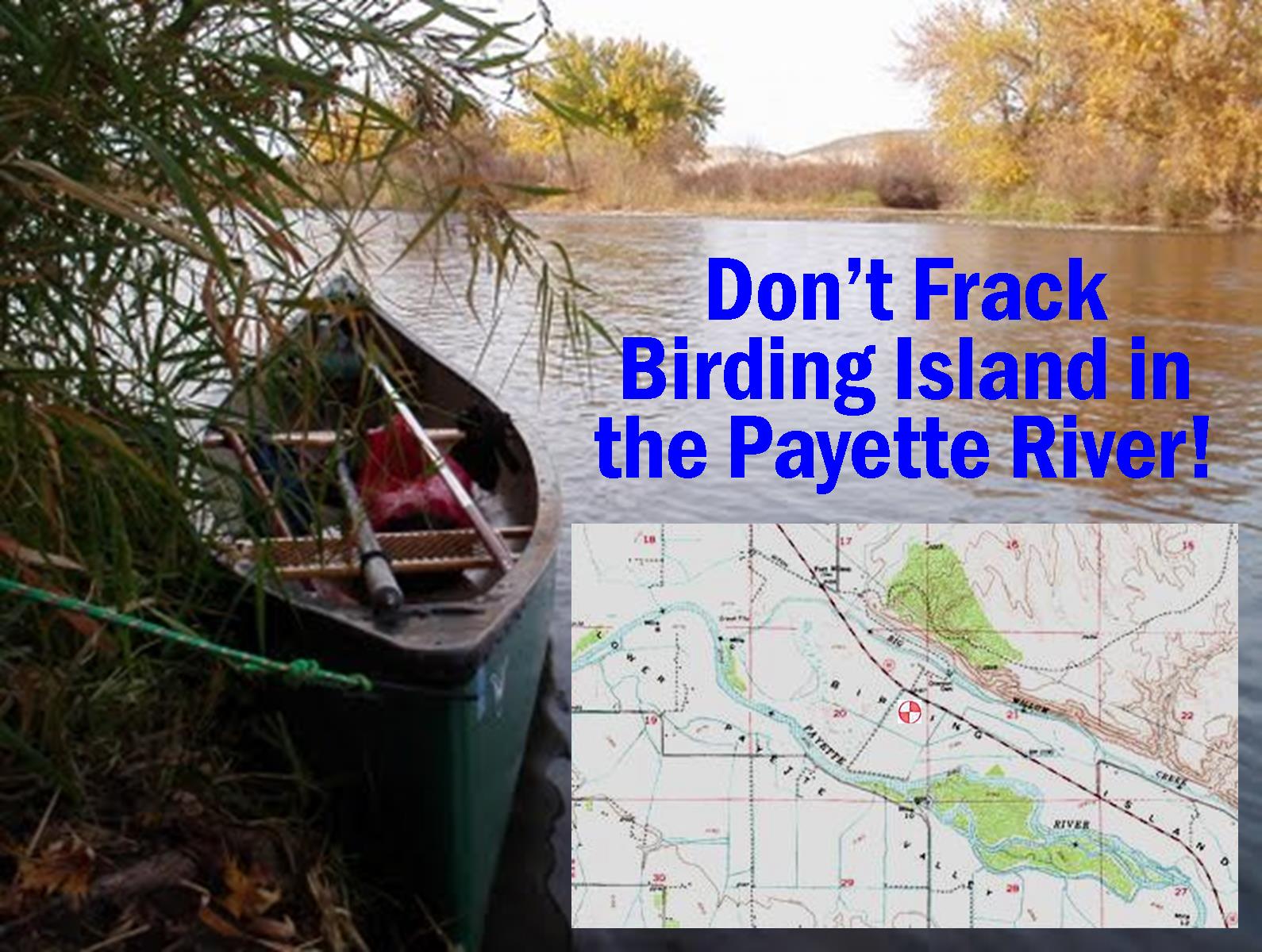
Don’t Frack Birding Island in Idaho’s Payette River


The Idaho Legislature’s changes to the state’s ballot initiative process will make it harder to change laws from the grassroots up and have stymied efforts to launch a statewide hydraulic fracturing and waste injection ballot initiative.

This year, Gem State lawmakers passed SB 1108, making it more difficult to gather enough signatures to push successful petition campaigns.

Currently, petitioners are required to collect six percent of registered voters’ signatures statewide.  Under the new law taking effect July 1, petitioners must collect six percent of registered voters’ signatures from a minimum of 18 of the state’s 35 legislative districts.

Read more: Don’t Frack Birding Island in Idaho’s Payette River

(By Blair Koch, Earthworks Earthblog)

Stop the Frack Attack, Idaho


Idaho activists are concerned that Alta Mesa Services (AMS) of Houston, Texas, could hydraulically fracture rocks almost a mile underground to obtain natural gas and oil.  AMS submitted an application to the Idaho Department of Lands (IDL) on April 30, for a permit to directionally drill a natural gas well under Highway 52 in Payette County, Idaho, using a lease to the mineral rights under Smoke Ranch.

Like the 11 wells sunk by Bridge Resources in 2010 and 2011 through the “tight” gas sandstone formation of the Hamilton field under Payette River bottomlands (at about 1,400 to 1,750 feet), this well represents another incursion into the Willow gas field.  This deeper of two potential plays in southwestern Idaho lies beneath the lowlands, hills, and buttes surrounding the agricultural communities of New Plymouth and Fruitland, below the Hamilton sandstone and underlying shale, at depths between 4,500 and 5,800 feet in sands over basalt.

Read more: Stop the Frack Attack, Idaho

(By EcoWatch, from a Wild Idaho Rising Tide media release)

Stop the Frack Attack, Idaho!


Don’t Frack Birding Island

Alta Mesa Services (AMS) of Houston, Texas, submitted an application to the Idaho Department of Lands (IDL) on April 30, 2013, for a permit to directionally drill a natural gas well under Highway 52 in Payette County, Idaho (1).  Unlike the eleven wells sunk by Bridge Resources in 2010 and 2011 in the shallower (1400 to 1750 feet), “tight” gas sandstone formation of the Hamilton field under Payette River bottomlands, this well represents the first incursion into the Willow gas field.  This deeper of two potential plays in southwestern Idaho lies beneath the hills and buttes surrounding the agricultural communities of New Plymouth and Fruitland, below the Hamilton sandstone and underlying shale, at depths between 4500 and 5800 feet in sands over basalt.  Idaho activists are concerned that the company could hydraulically fracture (“frack”) rocks almost a mile underground, like drilling practices used to extract hydrocarbon deposits from shale formations, to obtain natural gas and/or oil from this Smoke Ranch lease of mineral rights.

A dangerous method of oil and gas well stimulation, fracking forces millions of gallons of pressurized water and toxic substances down wells to crack subsurface rocks and release small, substandard pockets of oil and natural gas.  In dozens of states across the country, this process has produced hazardous, radioactive wastewater, contaminated air and water, generated cancer-causing pollution, compromised human and environmental health and safety, and released greenhouses gases causing climate change.  Earthquakes triggered by fracking’s explosive charges and wastewater well injections could exacerbate Idaho’s fifth greatest amount of seismic activity in the nation and consequently shatter the mechanical integrity of such inherently toxic oil and gas wells.

The proposed Smoke Ranch well would drill and potentially frack Birding Island, within the extensive wetlands and floodplain confluence of the Payette River and Big Willow Creek, only a few miles upriver from the City of Fruitland drinking water intake and the Payette/Snake River convergence (2).  Under the surrounding landscape full of farms, ranches, livestock, and wildlife dependent on clean surface streams and irrigation canals, aquifers only 660 feet deep perch, without much distance or barriers, over gas-bearing zones in porous layers punctured by drilling activities. Continue reading

Paradise Ridge Field Tour


Paradise Ridge Field Tour Flyer

The Paradise Ridge Defense Coalition (PRDC), Palouse Prairie Foundation, and Idaho Native Plant Society encourage everyone to join a field tour of sites along and near the proposed U.S. Highway 95 E-2 realignment on the west flank of Paradise Ridge.  On Sunday, May 19, starting at 2:00 pm, participants will meet at the parking lot of the University of Idaho Arboretum, 1200 West Palouse River Drive in Moscow, and carpool to Zeitler Road east of Highway 95.  People attending the field tour will view sites with ungulate/big game habitat, spring wildflowers, and native Palouse Prairie.  Regional botanists and wildlife biologists who know the area well will help guide the tour.  The co-sponsors are inviting the public as well as the Moscow mayor and city council, Latah County commissioners, Idaho state legislators, and the press.  After the planned field tour, hosts will also lead a hike to the top of Paradise Ridge, for participants who wish to enjoy the natural areas and vast views of the ridge. Continue reading

Flashpoints Interview of Helen Yost


Helen Yost of Wild Idaho Rising Tide (WIRT) talked with nationally broadcast Flashpoints radio program host Dennis Bernstein during a recorded interview, aired between 21:52 and 33:07 of the Monday evening, April 1, 2013, Flashpoints show.  Helen discussed megaload and tar sands operations and their impacts on the places and people of Canada and Idaho, expressing gratitude for KRFP Radio Free Moscow and promoting WIRT’s radio program, the Climate Justice Forum, website and facebook pages, and upcoming events.

Alternative Highway 95 Forum and Field Trip


C-3 E-2 & Current 95

The Paradise Ridge Defense Coalition (PRDC), its organizational partners (including Wild Idaho Rising Tide), and concerned Moscow area citizens invite regional public involvement at an informational meeting followed by site visits on Saturday, March 16.  Everyone is welcome to consider and discuss Idaho Transportation Department (ITD) plans to reroute U.S. Highway 95 between Thorn Creek Road and Moscow, at the Alternative Highway 95 Forum and Field Trip starting at the 1912 Center Great Room, 412 East Third Street in Moscow.

From noon to 2 pm in the Great Room, community members will talk about ITD’s draft environmental impact statement (DEIS) and technical reports on three alternatives for proposed highway realignment.  While presenting arguments supporting the central C-3 alternative and opposing the ITD-preferred eastern E-2 alternative, the knowledge-sharing session will encourage participant questions and insights.  Between 2 and 5 pm, event organizers and participants will carpool to locations along and near the proposed C-3 and E-2 routes.  Several area residents will host pertinent site visits and talks off Eid, Paradise Ridge, and Zeitler roads and Highway 95.  Travelers should dress warmly and bring beverages and snacks if desired. Continue reading

U.S. Highway 95 DEIS Misinformation


Lahde Forbes, Moscow

The Moscow-Pullman Daily News 2/21/13

At the Idaho Transportation Department Hearing on January 23, I talked with Tim Long, district right of way supervisor, and Carmen Reese, senior right of way agent. We looked at which eight businesses would be displaced on alternative C-3. They informed me in fact no businesses will be displaced, and the widening of current U.S. Highway 95 would have no effect beyond a potential noise increase.

I was surprised ITD had the displacement of eight businesses as one of its main four reasons for not choosing C-3 as its preferred alternative since this information is inaccurate. Long wanted me to stress in my comment letter that “there will be no definitive displacement of businesses (on C-3) and that this is misleading to the public.” I expect to see this information corrected in the subsequent IDT hearing information boards and in the DEIS/FEIS. Continue reading

Consider All the Facts


Joann Muneta, Moscow

The Moscow-Pullman Daily News 2/20/13

It is not true all of those objecting to the proposed E-2 alignment for U.S. Highway 95 to go over the western shoulder of Paradise Ridge are residents of that area. People from throughout the city and county are writing letters and signing petitions to the Idaho Transportation Department asking that the central alignment (C-3) be chosen. I myself live near East City Park, yet I want to preserve and protect the Paradise Ridge area that is one of our area’s significant and treasured natural landmarks.

A highway is forever. Once paved, we cannot reclaim the Palouse Prairie or any other part of this area. Therefore it is important all the facts be carefully considered. Why choose E-2? It is only .09 mile shorter. The ITD safety data are not thorough enough to conclude any one alternative is safer than another. Continue reading