Last, Largest Coal Port DEIS Hearings


On Thursday, April 29, 2016, as required by the Washington State Environmental Policy Act (SEPA), the Washington Department of Ecology and Cowlitz County, Washington released a draft environmental impact statement (EIS) on the huge Millennium Bulk Terminals coal export terminal proposed for Longview, Washington [1, 2]. Along with the U.S. Army Corps of Engineers, which is preparing a separate federal draft EIS, the agencies are studying the potential environmental and social impacts and evaluating the risks of this project [3].  They will review and consider all concerned citizen input after the 45-day comment period ends on June 13, while performing further analyses for the final EIS.  Once this document emerges, terminal owners would begin application processes for local, state, and federal permits.

Millennium proponent Lighthouse Resources (formerly Ambre Energy) owns 62 percent of the project; 38 percent owner Arch Coal has filed for bankruptcy. Their potentially largest such facility in North America, built and operated on the site of the former Reynolds Aluminum smelter, could annually transfer and stockpile 44 million metric tons of Powder River Basin coal, strip-mined in Montana and Wyoming, between unit coal trains and ships bound for Asia.  Besides eight empty, returning trains daily, the terminal would impose on trackside communities eight fully loaded, additional coal trains per day.

This last remaining Northwest coal export project of an original six proposals should concern Idahoans, who live among relatively clean air and water, abundant wildlife, and scenic beauty, just as much as Washington citizens [4]. Coal transport through Sandpoint and surrounding north Idaho communities, 400-plus miles away, directly pollutes, threatens, and impacts regional public and environmental health and safety and economic vitality, all for private profit.  Each coal train engine spews carcinogenic diesel fumes, and its 110 open rail cars together shed 55,000 pounds of coal dust from mine to port, laden with arsenic, lead, mercury, nickel, tin, and other heavy metals.  Health experts link exposure to diesel exhaust and coal dust with decreased lung capacity and exacerbated asthma, bronchitis, emphysema, pneumonia, lung cancer, and heart disease.  Increased, slow-moving coal traffic can also obstruct and delay vehicles at rail crossings, extend the travel times of emergency responders, and block access to hospitals, schools, businesses, and neighborhoods.  Heavy coal trains damage rails with their pressure and clog the pores of gravel under tracks, reducing wet ballast permeability and stability and thus risking derailment of other hazardous and explosive freight.

Why support the significantly faltering coal industry and world markets [5, 6]? In recent months, owners of a dozen of the most productive coal mines in the Powder River Basin and country, Peabody, Arch, and Alpha Natural Resources, have filed for bankruptcy [7].  With the downturn in Wyoming coal, oil, and gas production, 2,400 dirty energy sector employees have lost jobs since January 1, most from the two largest coal companies [8].  Burlington Northern Santa Fe Railway has furloughed 4,600 workers nationwide over the last several months, and Union Pacific Railroad has laid off 4,100 employees.  After 30-plus years of endlessly fighting coal projects, tribal and Montana activists have stopped the Otter Creek coal mine in the Powder River Basin, and the federal Surface Transportation Board has dismissed the permit for the Tongue River Railroad [9].  Agencies temporarily suspended EIS preparation for the Gateway Pacific Terminal at Cherry Point near Bellingham, before the Lummi Nation and supportive Northwest tribes convinced the U.S. Army Corps of Engineers to reject permits for the once biggest proposed coal port in North America, in defense of their Constitutionally-protected treaty rights to fishing grounds and practices [10].  And these developments represent only the most salient of recent, historic Northwest victories over extreme energy projects.

But the Washington Department of Ecology has announced three informational open houses and public hearings on the proposed Longview coal terminal draft EIS in three cities across the state. Various organizers with the Power Past Coal and Stand Up To Oil coalitions are hosting 4 pm rallies at each location, before oral testimony restarts after 5 pm agency presentations (also at 1 pm).  Please read the draft EIS on the Department of Ecology’s website, wear red, and come prepared to speak for only two minutes and/or provide comments to a court reporter and/or in written form during the meeting.

* Tuesday, May 24, 1 to 9 pm at the Cowlitz Regional Conference Center, 1900 Seventh Avenue in Longview, Washington [11]

* Thursday, May 26, 1 to 9 pm at the Spokane Convention Center, 334 West Spokane Falls Boulevard in Spokane, Washington [12]

* Thursday, June 2, 1 to 9 pm at the TRAC Center, 6600 Burden Boulevard in Pasco, Washington [13] Continue reading
Inland NW Break Free Planning & Training Workshops


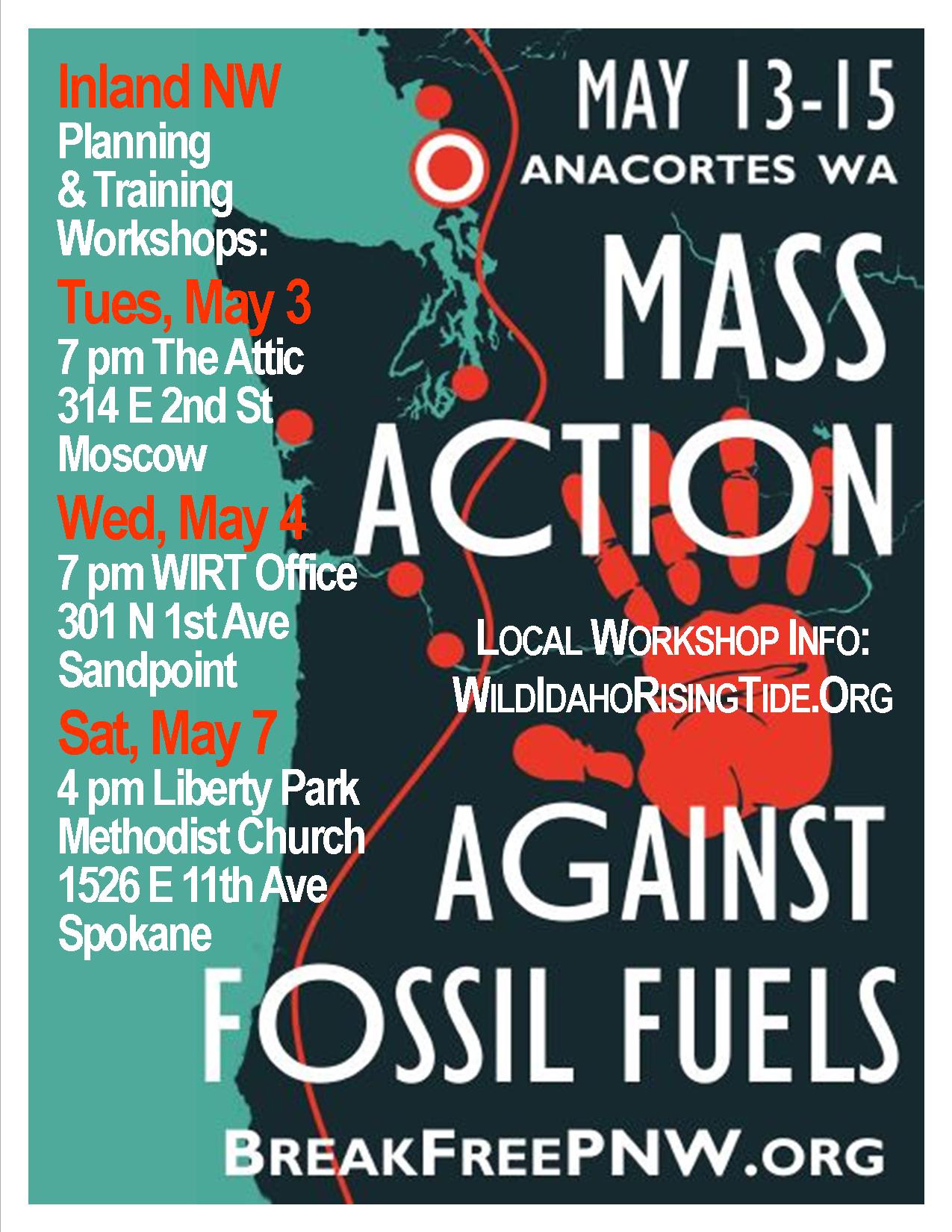
Inland NW Break Free Workshops Flyer

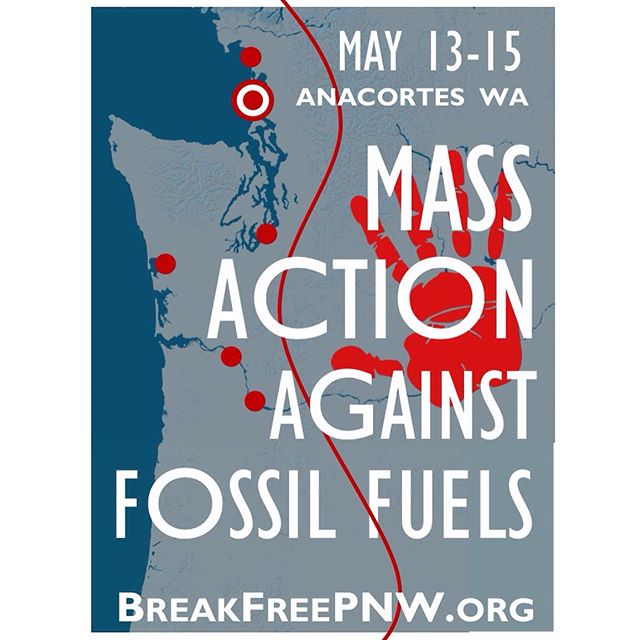
Through the ongoing participation of Northwest fossil fuels resisters in public events, hearings, marches, and media stories, we have clearly registered our opposition to the expansion of coal, oil, and gas infrastructure projects across the region. Accelerating impacts of climate change call for ever stronger messages and unified, non-violent, civilly disobedient, direct actions.  For months, Pacific Northwest organizers have been planning a Break Free from Fossil Fuels action, a mass 350.org and allied protest of two crude oil refineries at March Point near Anacortes, Washington, on May 13 to 15, 2016 (http://breakfreepnw.org/).  Please join us in risking arrest or supporting others as part of ongoing Northwest resistance to fossil fuels.

In late March 2016, Wild Idaho Rising Tide (WIRT) and allies promised hundreds of participants in well-attended screenings and panel discussions of the global climate activism documentary This Changes Everything in Moscow and Sandpoint, Idaho, and at WIRT’s Fifth Annual Celebration in Moscow, that we intend to stage regional direct action and kayaktivist trainings before the Anacortes uprising.  Over the last month, we have incessantly requested that our western Oregon and Washington colleagues send trainers to the inland Northwest, to further recruit, mobilize, and prepare activists for the mid-May Break Free Pacific Northwest action.  After pouring years of energy into supporting opposition to Washington state fossil fuel infrastructure projects, we are understandably eager for some West Coast input toward receptive inland Northwest frontlines.

A small team of Oregon comrades generously proposed to travel to northern Idaho and eastern Washington and present several trainings on consecutive days, among a dozen similar workshops scheduled across the region. But considering the time and expense involved in providing guidance to predictably low Idaho turnouts, they decided to cancel their plans.

Unwilling to sacrifice our networks to the strong tendency to discount interior Northwest activism, due to low participation numbers, unnecessary competition and targeted suppression from larger groups, and the limited capacity of a few climate activism organizers dismissed by their communities as too radical or criminal, WIRT is now hosting three Break Free logistics planning and direct action training convergences. Although we would prefer to concentrate our efforts on local empowerment and resulting strong, relatively urgent actions like those against tar sands megaloads and Shell Arctic drilling armadas, not to mention volatile bomb trains and explosive gas facilities, please expand our work supporting this historic protest by attending these workshops:

* Tuesday, May 3, 7 pm at The Attic, up the back stairs of 314 East Second Street in Moscow, Idaho

* Wednesday, May 4, 7 pm at the WIRT office, 301 North First Avenue in Sandpoint, Idaho

* Saturday, May 7, 4 pm at the Liberty Park United Methodist Church, 1526 East Eleventh Avenue in Spokane, Washington Continue reading

April 13-14: Bill McKibben at WSU, May 13-15: Anacortes Break Free Action!


Anacortes Mass Action BreakFreePNW

April 13-14: Bill McKibben at WSU

Climate movement leader, educator, and author Bill McKibben is speaking twice for Humanities Week at Washington State University (WSU) in Pullman [1]. In the wake of well-attended screenings and panel discussions of the global climate activism documentary This Changes Everything in Moscow and Sandpoint in late March, Wild Idaho Rising Tide (WIRT) and regional allies anticipate that McKibben can further mobilize inland Northwest residents to participate in the 350.org-initiated Break Free from Fossil Fuels mass action in Anacortes, Washington, in mid-May [2]. WIRT is calling on you and all volunteers to assist with distributing the attached quarter-sheet flyers outside both WSU events, to recruit more involvement in the already hundreds-strong Break Free Pacific Northwest demonstration of fossil fuel resistance: Please contact WIRT if you can help.

April 13: Humanities Week keynote address: ‘The Human Element in Nature: From Harm to Hope’ at 5:30 pm on Wednesday in the CUB senior ballroom

April 14: Foley Institute Coffee and Politics talk: ‘Report from the Front Lines of Climate Change’ at noon on Thursday in Bryan Hall 308

May 13-15: Anacortes Break Free Action

“We are in a kind of climate emergency now,” struggling to stay below 1.5°C of warming, to avoid radical climate destabilization [3]. No current policies keep us anywhere near this goal: We are barreling towards double that temperature, leaving us with a broken world. This has to change, and we have to lead: We have to Break Free from Fossil Fuels! [4] This global climate movement initiative aims to shut down the world’s most dangerous fossil fuel projects and support the most ambitious climate solutions.

In the Northwest, we are breaking free by taking on the region’s biggest carbon bomb: the Shell and Tesoro refineries at March Point in northern Washington. Combined, these facilities refine 47 percent of all the gasoline and diesel consumed in the region, and produce the largest, unaddressed point source of carbon pollution in the Northwest. They are an integral part of the system that we must change – within years, not decades.

Join us for regional mobilization and a mass action outside these refineries on May 13, 14, and 15, to demand that we Break Free from Big Oil and speed up a just transition to 100 percent renewable energy. By land and by sea, we will stage creative and inspirational sit-ins, blockades, and kayaktivism. For people who prefer to not engage in civil disobedience, support roles and general opportunities for participation are essential to this action. WIRT and allied carpoolers, caravaners, and protesters risking arrest or not are traveling from Missoula, Moscow/Pullman, Sandpoint, and Spokane to Anacortes for this Break Free Pacific Northwest mass action. Continue reading

End the Tesoro Savage Oil Terminal Lease!


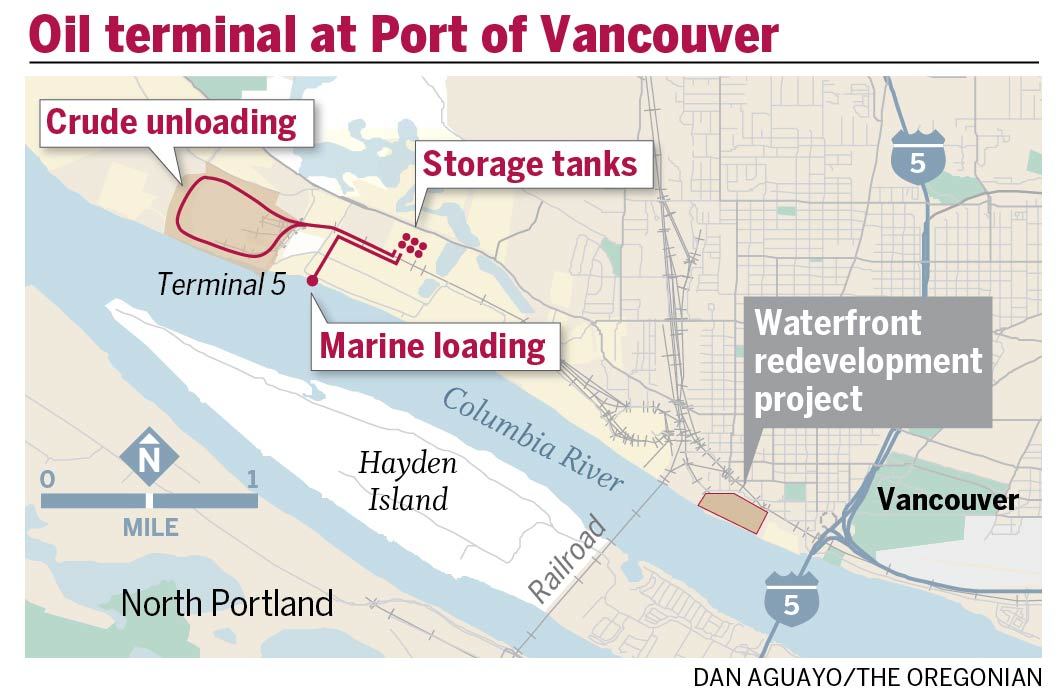
Tesoro Savage Terminal Map 2

On Tuesday, April 12, 2016, Port of Vancouver Commissioners are conducting another public hearing [1].  The lease for the largest crude oil-by-rail transfer, storage, and shipping terminal in North America – Vancouver Energy proposed by Tesoro Corporation and Savage Companies for Vancouver, Washington – expires on August 1.  But Vancouver Energy proponents are requesting, Burlington Northern Santa Fe (BNSF) Railway is supporting (and attending the hearing), and the Port Commissioners are considering a lease amendment extending the government approval contingency period of the lease by two years and providing an additional 30 months to resolve any approval appeals, decreasing higher monthly rent after August 1, foregoing operation of a second Tesoro Savage oil facility at the port, and allowing port use of Vancouver Energy premises during the extended contingency period [2].

Initially approving the Vancouver Energy lease in 2013, the Commissioners assumed that the Washington Energy Facility Site Evaluation Council (EFSEC) would complete its project review within 12 months per state law. In its third year of this arduous process, complicated and prolonged by widespread public resistance, Vancouver Energy has not obtained the government approvals necessary to build the terminal, as required by its Port of Vancouver lease.  The terms of the original lease, which the Commissioners wisely negotiated and Vancouver Energy accepted, include the option for both parties to terminate the lease on or before August 1 “without further cost or obligation.”  The Port Commissioners must decide by August whether they will use this critical opportunity to end the Tesoro Savage lease and thus lead the Northwest and the nation towards a clean, independent, and secure energy future.  Otherwise, they lose this option.

Last Wednesday, April 6, Port of Vancouver staff significantly recommended against extending the Vancouver Energy lease; they will present their objections at the April 12 Port Commission meeting.  Reconvening its April 12 regular meeting at 1 pm on Friday, April 15, at the Port’s administrative office, the Board of Commissioners will consider and likely take action on the lease amendment, without further on-site public comments.

Meanwhile, the Vancouver Port Commissioners need to know and understand that the region supports their positive, strong action to terminate the lease for the dangerous, dead-end Tesoro Savage project. Such encouragement must come from local and up-track community residents, tribal members, labor representatives, health professionals, firefighting and emergency personnel, business people, elected officials, faith leaders, and climate activists.  Vancouver Energy oil terminal opponents of every perspective have packed each hearing to date and must again assert their concerns before Friday.

Please comment in-person or online about the proposed Port of Vancouver lease amendment requested by Tesoro and Savage for their Vancouver Energy oil-by-rail terminal!  Ask the Port Commissioners to end the lease by August 1, as terminal proponents will not have acquired all of the necessary approvals by then to continue their joint venture.  Explain how crude oil trains increasingly expose you and your family, friends, community, and environment to unnecessary risks and climate change that the Commissioners can help us all to avert. Continue reading

Feds Choose Easternmost Route for U.S. Highway 95 Realignment


In spite of years-long efforts to persuade transportation officials not to realign U.S. Highway 95 from Moscow to Thorncreek Road over Paradise Ridge and through an untouched area of the Palouse Prairie, the federal Record of Decision was signed this week verifying the choice to do just that.

“It’s a great day for the public,” said Ken Helm, project manager for the Idaho Transportation Department.

“It’s kind of what we expected,” Steve Flint, one of the board members of the Palouse Ridge Defense Coalition, said about what the group considers a disappointing choice.

In 2003, the coalition and other groups successfully argued the ITD failed to adequately examine the environmental effects of its plans for U.S. Highway 95, and a judge ordered a full environmental impact statement process be completed.

Last year, the group announced it was willing to take legal action based on the latest project documents, specifically the FEIS, if they appeared inadequate.

Continue reading

Monday Oil & Gas Talk & Idaho House Vote


Calvin Tillman in Boise

On Monday, March 7, at 6:30 pm, Citizens Allied for Integrity and Accountability (CAIA) is hosting a talk/presentation by the former mayor of Dish, Texas, Calvin Tillman, entitled How Will Oil and Gas Activity Change Your Community?, at the Lincoln Auditorium in the Idaho State Capitol, 700 West Jefferson Street in Boise, Idaho [1, 2]. Currently an Aubrey, Texas, city council member, Mr. Tillman will share his years of direct experience with oil and gas development, as an elected official and impacted father and homeowner.  Please see the attached flyer for further information about this event that Idaho Public Television will livestream at this link, for Idahoans and friends to watch it on their computers [3].

Stop S1339 in the Idaho House

The full Idaho House of Representatives has delayed voting on Senate Bill 1339 (S1339), the industry-promoted law that would expedite oil and gas development permits, reduce opportunities for public input and appeals, further advance forced pooling and leasing of unwilling mineral interests owners, and thus compromise private property rights, not to mention more essential human rights to healthful air, water, and soil [4]. Please comment to your legislators and all House members before their probable full chamber vote on S1339 on Monday, March 7.  See the last two Wild Idaho Rising Tide alerts on this issue, for further information and talking points [5, 6], and call 208-332-1000 or 800-626-0471 and/or email lawmakers at these listed addresses [7].  S1339 will affect all the citizens of Idaho and their rights to defend themselves from oil and gas development invasions. Continue reading

Friday: Tell Idaho Representatives to Vote No on Senate Bill 1339!


On Friday, March 4, at an unknown time, the full Idaho House of Representatives will hold the final vote on Senate Bill 1339 (S1339) [1, 2]. The Senate Resources and Environment Committee passed S1339 to the Senate floor on Friday, February 19, after an Alta Mesa oil and gas company attorney pushed for bill hearing closure, before all of the subsequently angry citizens present could testify.  Only Democrat committee member Michelle Stennett voted against this bill that, if passed by the Idaho Legislature and codified as an emergency law by Governor Otter’s signature, would expedite Idaho oil and gas development permitting procedures and further severely limit due process, associated public input and appeals, and information available to citizens, some forced to develop their mineral interests and most concerned about fossil fuel project impacts to private and public lands, water, air, and property rights [3-5].

According to Betsy Russell’s Eye on Boise, “after a two-hour debate, the Idaho Senate voted 31-4 in favor of SB 1339, a controversial proposal to streamline the process for issuing permits for oil and gas wells. The bill drew close to 100 people to an earlier hearing, most of them opposed…The bill now moves to the House side.  The Senate vote came just after 6:30 p.m. Boise time, half an hour after the Senate had been scheduled to conclude its late-afternoon session, which started at 4:30.  It was the only bill taken up.” [6]  On Tuesday, March 1, the Idaho House Resources and Conservation Committee held a hearing on this industry-promoted bill and passed S1339 on a two-to-one ratio [7].  Wild Idaho Rising Tide (WIRT) emailed letters of opposition to both Senate and House committees.

Meanwhile, on Monday, February 22, over 150 citizens participated in a rally on the Capitol steps in Boise, protesting the bill and oil and gas industry and infrastructure abuses of Idaho citizen health, private property rights, and essential air, water, and soil quality, at the Don’t Frack Idaho Statehouse Rally, hosted by Citizens Allied for Integrity and Accountability [8-12]. Organizing protests and rallies against oil and gas development around the state since 2012, WIRT activists are grateful that more than a few dozen Idahoans are finally displaying widespread resistance.

If the Idaho legislature could possibly defend your interests, please contact all of the state representatives, to oppose full Idaho House floor passage of S1339. See the comprehensive list of representative email addresses at citation 7 and talking point suggestions at the following links [13, 14].  NOW is your last chance to write to or call them on this issue, urging them to vote against this legislation that forces oil and gas development on unwilling land and mineral rights owners and that dismisses the public’s best interests and participation in permitting decisions.  Thank you! Continue reading

Friday Oil & Gas Bill Hearing & Monday Boise Protest/Carpools


Please take urgent action on these two significant Idaho oil and gas resistance events.  Thanks to Citizens Allied for Integrity and Accountability (CAIA) of Fruitland, Idaho, for organizing and sharing news about them!  Contact CAIA with your questions and suggestions at info@integrityandaccountability.org, IntegrityAndAccountability.org, or 208-963-5707.

Friday: Oppose Idaho Senate Bill 1339

The first oil and gas bill of the 2016 session is printed and scheduled to be heard on Friday, February 19, at 1:30 pm MST, first on the day’s agenda of the Idaho Senate Resources and Environment Committee [1, 2].  Attorney Kate Haas of the law firm Kestrel West, representing the primary Idaho oil and gas development company, Alta Mesa, will present Senate Bill 1339 (S1339) in Room WW55 of the Idaho Capitol in Boise [3].  Please participate in this hearing by attending in support of bill opponents, submitting your written comments in advance or in person, and/or speaking against S1339 for up to three minutes.  Contact Committee members by phone or email before the hearing.

Call 208-332-1323 and/or email sres@senate.idaho.gov, to extend your comments to all of the committee members together, or write to each and all of them at their individual addresses: Steve Bair <sbair@senate.idaho.gov>, Clifford Bayer <cbayer@senate.idaho.gov>, Marv Hagedorn <mhagedorn@senate.idaho.gov>, Lee Heider <lheider@senate.idaho.gov>, Roy Lacey <rlacey@senate.idaho.gov>, Sherry Nuxoll <snuxoll@senate.idaho.gov>, Jeff Siddoway <jsiddoway@senate.idaho.gov>, Michelle Stennett <mstennett@senate.idaho.gov>, Steve Vick <sjvick@senate.idaho.gov>.

S1339 would expedite all Idaho oil and gas development applications and further exclude Idahoans from crucial public input, as described in the following and attached, useful, talking points.  As an emergency bill, effective with Governor Otter’s signature, S1339 would essentially and immediately strip all due public process from oil and gas permitting in Idaho, risking the integrity of Idaho law and private and public property rights.  Compounding ongoing oil and gas industry degradation of the health and safety of Idahoans and their environment, this legislation, if passed over strong citizen objections, would: Continue reading

WIRT Comments on Tesoro Savage Vancouver Energy Project Draft Environmental Impact Statement


January 22, 2016

Sonia Bumpus, EFS Specialist, & EFSEC Members

Energy Facility Site Evaluation Council (EFSEC)

State of Washington

1300 S. Evergreen Park Drive SW

P.O. Box 43172

Olympia, Washington 98504-3172

sbumpus@utc.wa.gov

Sent via email and attachment

WIRT Comments on Tesoro Savage Vancouver Energy Project Draft Environmental Impact Statement

Members of the Energy Facility Site Evaluation Council,

On behalf of over 3200 members, friends, and allies of Wild Idaho Rising Tide (WIRT), including potentially impacted, concerned north Idaho residents near the proposed and existing rail routes affected by this proposal, I respectfully offer and request inclusion in the public record of these comments regarding the Tesoro Savage Vancouver Energy Project draft environmental impact statement (DEIS), during the public agency and citizen review period from November 24, 2015, until January 22, 2016 [1]. WIRT and associates collectively object to state permitting of the Tesoro Savage oil train terminal planned for the Port of Vancouver, Washington, which would impart myriad, significant risks and only marginal rewards for communities along the rail tracks and bridges, rivers, and lakes of Tesoro’s and Savage’s profitable thoroughfare to crude oil export.  In support of this official letter of resistance to Washington state Energy Facility Site Evaluation Council (EFSEC) approval of this application and resulting, destructive, implementation activities, we thoroughly concur with, contribute toward, and incorporate the concerns, oral testimony, and comments of all project opponents.

The Tesoro and Savage corporations intend to build the biggest crude-oil-by-rail terminal in the U.S. at the Port of Vancouver, potentially transferring an estimated 360,000 barrels per day of explosive Bakken shale oil and volatile Alberta diluted bitumen (tar sands) to tank farms across the Columbia River from Portland, Oregon, and to huge, ocean-going oil tankers shipping it to West Coast refineries and the world market [2]. Inevitable, disastrous, consequent oil spills into river, lake, or sea waters along rail and ocean routes, especially releases of thick tar sands oil that sinks to the bottom of waterways, would devastate local and regional waters and environments, fisheries, tribal lifeways, communities, and economies.

While moving enormous volumes of oil that ultimately impact our shared global climate, the Tesoro Savage facility would also increase the risk of fiery oil train accidents in countless communities along Northwest rail lines, from the Hi-Line around U.S. Highway 2 in Montana, to U.S. Highway 95 corridor towns from Bonners Ferry to Rathdrum in northern Idaho, to the dangerously elevated bridge and track funnels through the Sandpoint, Idaho area and downtown Spokane, Washington, to the Columbia River Gorge between eastern Oregon and Washington, to Vancouver [3, 4]. Every day, the huge oil terminal would bring four or more 100-car, mile-long trains toward the West Coast, hauling flammable cargo through climate-change-drying forests, increasingly dense cities, and ever more precious water bodies.  Public officials and emergency responders across the Northwest have raised concerns about the severe threats of oil train derailments, explosions, and pollution, as such incidents continually proliferate [5-7].

Many WIRT and allied group members who carpooled from Moscow and Sandpoint, Idaho, and Pullman, Washington, participated in the regional community rally of terminal opponents and orally testified at the public hearing on the project’s DEIS, hosted by EFSEC on Thursday evening, January 14, 2016, in Spokane Valley, Washington [8-10]. These activists spoke against the Tesoro Savage proposal, the deficiencies of its DEIS findings, greater hazards imposed by this massive project of significant oil spills, air pollution, loaded train derailments, explosions, fires, and accidents causing numerous injuries and deaths, increased rail and waterway traffic of oil tankers, harm to federally protected salmonids and aquatic species, detrimental effects on tribal treaties, cultures, and resources, susceptibility of the facility to earthquakes, more and longer vehicle delays at railroad crossings, and overall exacerbation of climate change [11].  These myriad, significant, environmental, social, and human health harms cannot be fully mitigated by the project proponents or local, state, and federal agencies.  Moreover, the project DEIS does not even consider the predictable potential impacts of this oil terminal beyond Washington state. Continue reading

Inland NW Oil Train Terminal Rally & Hearing


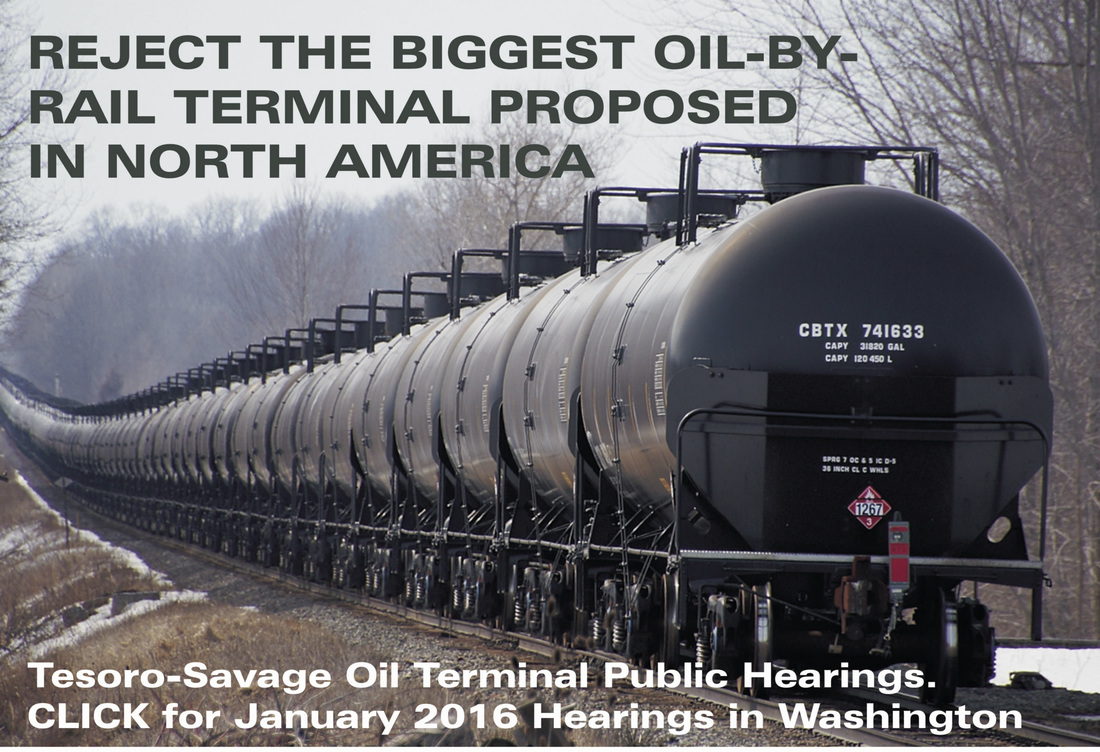
Tesoro Savage Hearing Train

On Thursday, January 14, 2016, please join Wild Idaho Rising Tide (WIRT) and allied groups carpooling from Moscow and Sandpoint, Idaho, and Pullman, Washington, to participate in the 4:30 pm regional community rally against the Tesoro-Savage Vancouver Energy Project, an oil train terminal proposed for the Port of Vancouver, Washington. At the same location – Centerplace Regional Event Center at 2426 North Discovery Place in Spokane Valley, Washington – the Washington state Energy Facility Site Evaluation Council (EFSEC) is hosting a public hearing on the project’s draft environmental impact statement (DEIS), from 5 to 11 pm or until the last testifier, hopefully late at night after many opposing speakers [1, 2].

Big Oil plans to build the largest crude-by-rail terminal in North America, potentially transferring an estimated 360,000 barrels per day of explosive Bakken shale oil and volatile Alberta diluted bitumen (tar sands) to tank farms across the Columbia River from Portland, Oregon, and to huge, ocean-going oil tankers shipping it to West Coast refineries and the world market [3]. Inevitable, resulting oil spills into river, lake, or sea waters along rail and ocean routes, especially releases of thick tar sands oil that sinks to the bottom of waterways, would disastrously affect local and regional environments, communities, and economies.

While moving enormous volumes of oil that ultimately impact our shared global climate, the Tesoro-Savage facility would also increase the risk of fiery oil train accidents in countless communities along Northwest rail lines, from the Hi-Line around U.S. Highway 2 in Montana, to U.S. Highway 95 corridor towns from Bonners Ferry to Rathdrum in northern Idaho, to the dangerously elevated bridge and track funnels through the Sandpoint, Idaho area and downtown Spokane, Washington, and down the Columbia River Gorge between eastern Oregon and Washington to Vancouver [4, 5]. The huge oil export terminal would bring four more 100-car trains hauling flammable cargo through climate-change-drying forests, increasingly dense cities, and ever more precious water bodies every day.  Public officials and emergency responders across the Northwest have raised concerns about the severe threats of train derailments, explosions, and pollution, as such incidents continually proliferate [6-8].

Northwesterners have successfully delayed, re-routed, and/or stopped similar fossil fuel infrastructure plans over the last five years, most notably tar sands mining and refining megaloads, coal export terminals, and just this week, a Grays Harbor oil terminal [9]. Faced with a flood of proposed coal, oil, and liquefied natural gas terminals in the Pacific Northwest, hundreds of concerned citizens like you have attended hearings to tell decision-makers no.  Altogether, people power has delayed nine fossil fuel terminals and stopped nine others in Oregon and Washington.

In Spokane Valley on January 14, your help is essential to protecting the safety, health, and environment of the Idaho panhandle and inland Northwest, by halting this oil terminal and its additional trains crossing the region [10]. Although jumping through government/industry-imposed hearing hoops held up to placate the public is not radical climate activism – wherein citizens, not their oppressors, define the terms of engagement – we encourage you to speak out and show the advising Washington EFSEC and decision-maker Governor Jay Inslee that the dirty and dangerous Tesoro-Savage proposal is all risk and no reward for our communities.  Hundreds of terminal opponents are already making history at these three important public meetings [11].  Native nations, civic groups, environmental organizations, firefighters, health and emergency professionals, and other individuals will similarly attend the Spokane Valley hearing. Continue reading