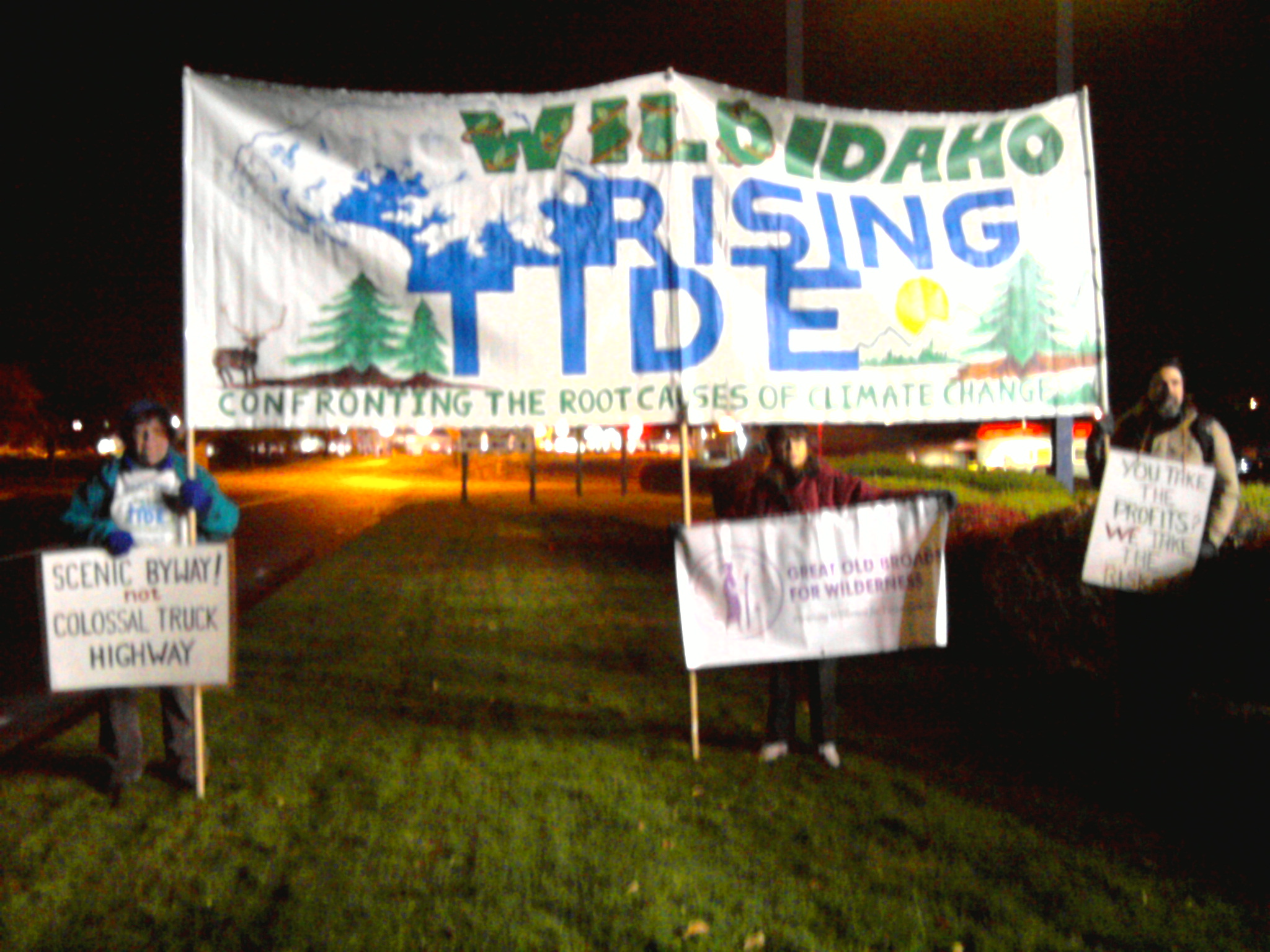
In conjunction with grassroots climate justice and tar sands co-activists from Canada, the Northeast, Texas, and Utah, near ruptured pipelines and oil spills, and across the continent, regional Wild Idaho Rising Tide members gathered at 5 pm on Monday, November 19, near the Moscow, Idaho, City Hall, for a Climate Change Resistance Solidarity Action. To recognize and support Tar Sands Blockade’s Mass Action in East Texas on Monday, blocking TransCanada construction of the Keystone XL pipeline, 350.org’s march around the White House and rally in Washington DC on Sunday, again denouncing Obama administration backing of the Keystone XL, and over 40 worldwide climate solidarity actions, a handful of stalwart tar sands megaload protesters wore WIRT T-shirts and hoisted the organizational banner and protest signs to compose solidarity photos posted and shared with courageous comrades in the Texas trees and numerous anti-tar sands allies. The rapid reunion demonstrated the participants’ ongoing resistance of tar sands and fossil fuel exploitation by oil companies like ExxonMobil, Shell, and TransCanada that are expanding Alberta tar sands mining operations on indigenous lands and associated production and transportation facilities throughout the U.S. Compelled by the aftershock of Hurricane Sandy, Midwestern crop failures, Western wildfires, the hottest year on record, aggressive corporate development of dirty energy, and presidential campaign silence on urgent climate change issues, American citizens and disproportionately impacted victims of extreme weather disasters and pollution are collectively and increasingly demanding climate crisis resolutions through unconventional methods.
Category Archives: Actions
Four-State Coal Export Protests & Hearings 11-17
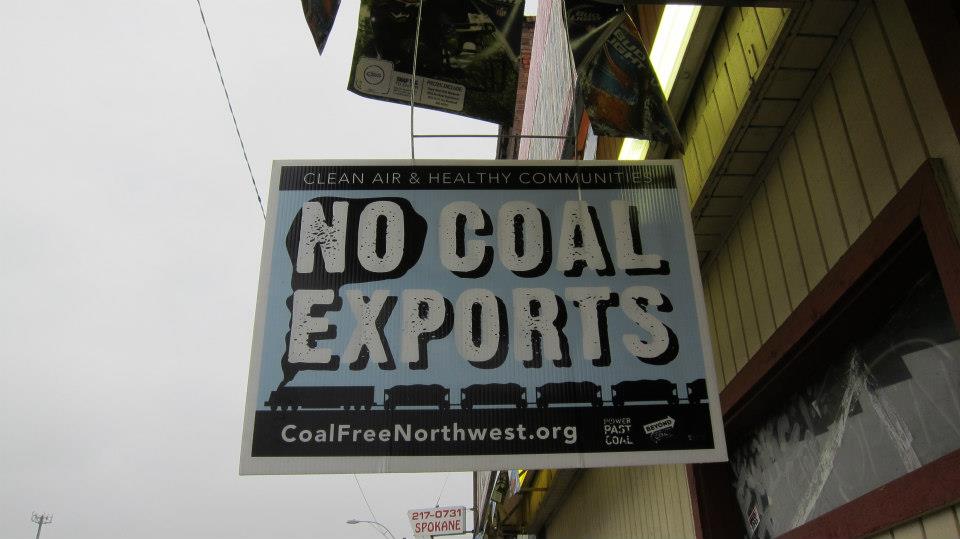
On Saturday, November 17, between noon and 4 pm, two dozen activists from Occupy Spokane and Wild Idaho Rising Tide (WIRT) converged in several high vehicle and pedestrian traffic areas in Sandpoint, Idaho, with a people’s train of “rail car” protest signs, sidewalk parades, and chants. Rebuking schemes for five coal export facilities on the Columbia River and Washington and Oregon coasts and increased toxic coal train traffic from Montana and Wyoming across the Northwest, demonstrators distributed coal issue flyers and door hangers, encouraged northern Idaho participation in December 4 scoping hearings in Boardman, Oregon, and Spokane, Washington, on proposed Coyote Island and Cherry Point coal terminals, and mobilized a network of activists for direct actions at the hearings and in the field before respective December 12 and January 21 public comment deadlines. As federal, state, and county decision makers and industry perpetrators of pollution and climate change discount the concerns of communities most adversely affected by potential coal export train traffic through eastern Washington, Idaho, and Montana, by staging distant opportunities for purported public input, anti-coal organizers are demanding rescheduling of the overlapping hearings, a mine-to-port programmatic environmental impact study and statement for all coal export proposals, and hearings in Idaho and Montana to expand the current exclusionary scoping process.
Climate Change Resistance Solidarity Action
Since spring 2010, frontline Northwest activists have been resisting tar sands transportation projects and associated police states in our communities and on our roads, through six court cases, a dozen arrests, and over 50 direct actions. Residents of Moscow and Lewiston, Idaho, Spokane, Washington, Missoula, Montana, and regional rural enclaves have defended our wild places, home towns, and public roadways from the climate-wrecking, industrial ravages of “megaload” equipment transported for ExxonMobil, Weyerhaeuser, and other undisclosed corporations to Alberta destinations and tar sands operations. Our monitoring, protesting, and litigating activities have challenged, stalled, diverted, blockaded, frustrated, cost millions, and forced some of the biggest, wealthiest, most powerful dirty energy purveyors on Earth to boost their security, pay our state, county, and city police officers as escorts, guard their unoccupied stopover and port spaces, dismantle their supposedly irreducible loads, and sneak around us on alternative routes. Strategically considering and creatively implementing group trainings, rallies, testimonies, demonstrations, concerts, presentations, sit-ins, videos, photos, critical mass walks and bike rides, marches, street theater, fundraisers, and banner drops, we will not stop resisting until corporate interlopers stop rampaging our planet.
Tar sands module convoys encountered monitors and protests with every passage up Highway 95 through Moscow, Idaho, between July 2011 and March 2012, and similar pushback in Spokane, Washington, in May and June 2012. During the last week of October 2012, a 236-foot-long, 520,000-pound wastewater evaporator accomplished the first successful transit to the Alberta tar sands, through our narrow, sinuous, and steep Highway 12 wild and scenic river corridor across the largest wildlands complex in the lower 48 states. As first fracking in Idaho looms to the south and coal export trains impend in the north, two smaller tar sands transports – with potentially thousands on the outsourced Asian production horizon – will attempt the same rugged route in early December, but not without our vigilant confrontations and their predictable accidents, injuries, and anguish imposed on people and property, collisions with vehicles, power lines, cliffs, and trees, delays of heart attack victims, emergency services, and holiday traffic, and degradation of our shared infrastructure and civil liberties, indigenous rights and northern boreal ecosystems, and atmospheric integrity. Continue reading
Stand Up! Fight Back! Against Big Coal in the Northwest 11-3-12
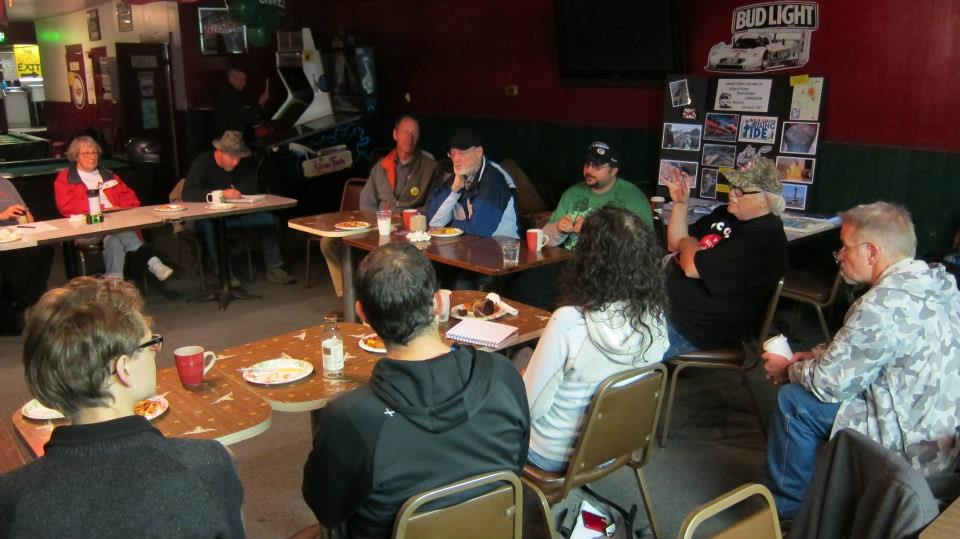
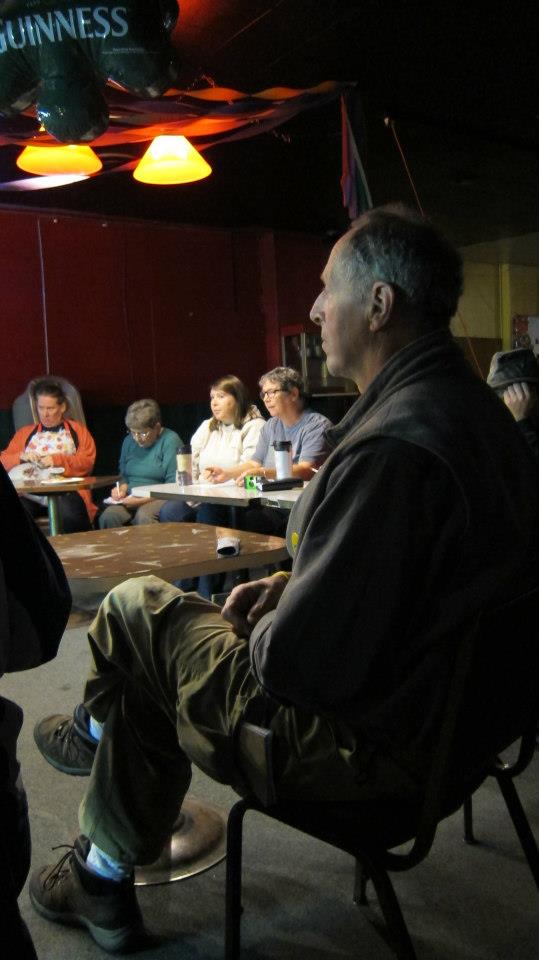
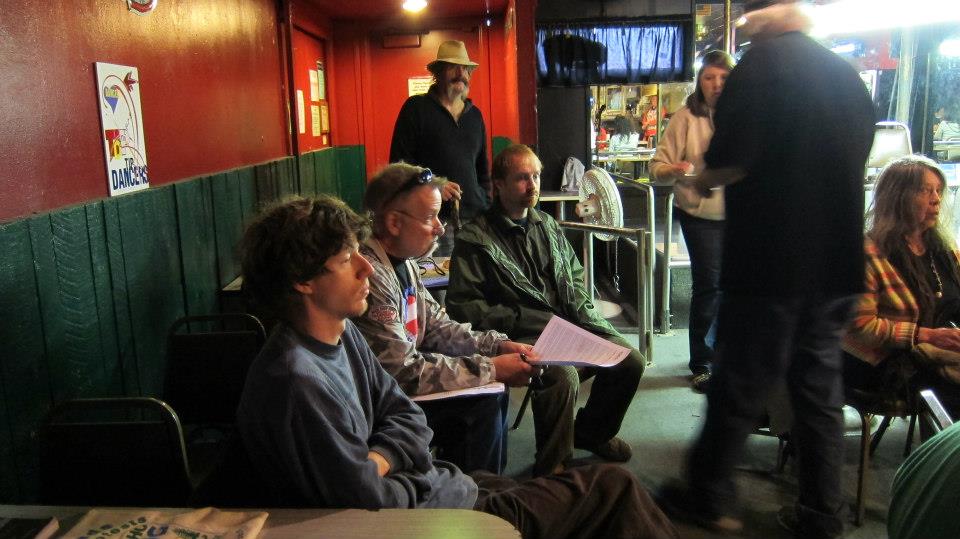
Thanks to our amazing Occupy Spokane and Wild Idaho Rising Tide comrades, two dozen activists contributed to a great seven-hour November 3 brainstorming/strategizing convergence, full of enthusiastic and insightful conversations, alliances, and upcoming actions! Following through on the successes of the Northwest Extraction Resistance Workshop in June, we networked with activists from the Spokane area, northern Idaho, British Columbia, Montana, and Oregon. Among a whirlwind of creative ideas, we designed a coal export train demonstration in Sandpoint on Saturday afternoon, November 17, to instigate more public participation in the December 4 Spokane scoping hearing on proposed West Coast coal port facilities. As we learned local hearing logistics from Crystal Gartner, who has diligently worked with numerous Coal-Free Spokane volunteers over the last year to secure and populate the event, we also planned tactics and props to augment the rally and citizen involvement in the hearing and to stage an on-the-ground action before the January 21 comment deadline. Heartfelt thanks to Terry for initiating this gathering and inviting western Washington allies’ input, to Val for workshop food provision, Nick for round-trip alternative fuel transportation between Moscow and Spokane, and to Andy, Peter, Cheryl, and Kerry for traveling so far to participate. As we left this last event ever held in the former Rainbow Tavern of the International District in Spokane, Peter of Oregon said, “You know, 100 years from now, people will point to that building and say ‘That is where a small group of people met and made the plans that stopped the coal trains.’” To join in discussions about coal export train direct actions, please join the facebook group Stand Up Fight Back Against Big Coal in the Northwest and/or our Spokane workshop email list shared among about 30 activists.
(All photos provided by Aaron Kathman of OUTSIDEmedia.)
Four-State Coal Export Protests & Hearings

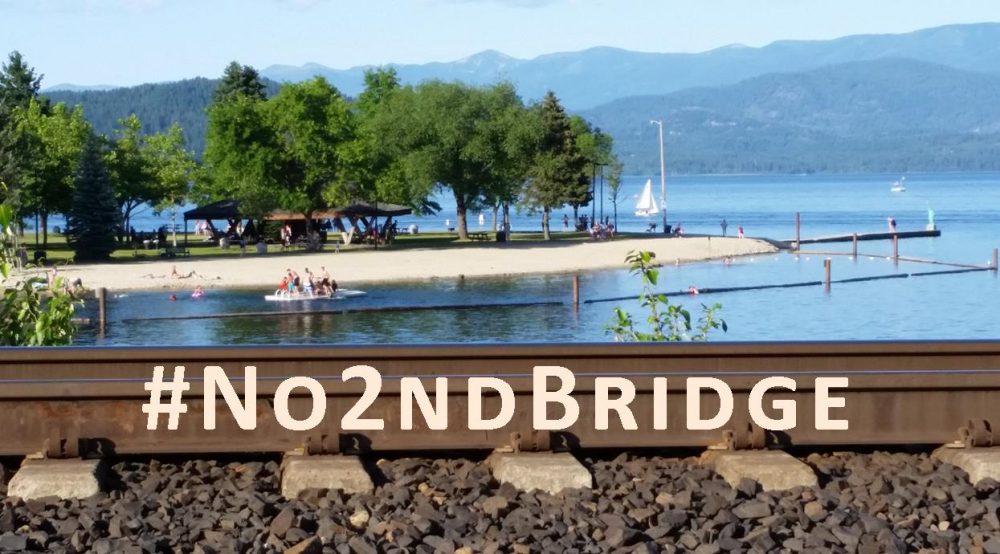
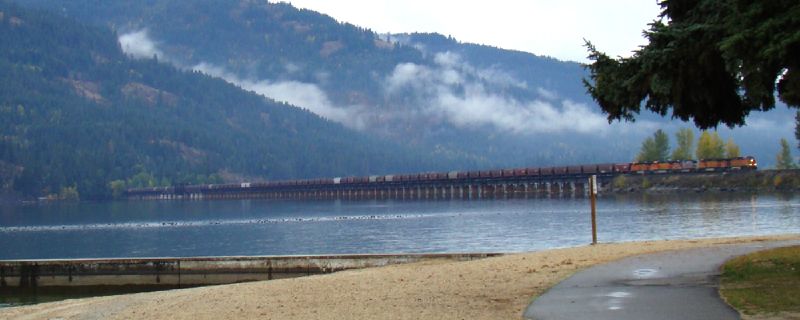
Just Do It: A Tale of Modern-Day OutlawsAn empty eastbound coal train crosses over Lake Pend Oreille, where the bridge is over one mile long at Sandpoint, Idaho (Terry Grey photo).
FIRST UPDATE: On Friday and Saturday, January 4 and 5, Wild Idaho Rising Tide and Occupy Spokane are hosting coal export direct action training, brainstorming, and planning sessions in Moscow and Spokane, with a preview screening of the British climate activism film Just Do It: A Tale of Modern-Day Outlaws, to organize a multi-state, concurrent action on Saturday, January 12. We anticipate train track/roadside coal protests in Missoula, Moscow, Sandpoint, Spokane, and perhaps other Montana cities, against the proposed Gateway Pacific Terminal coal port at Cherry Point near Bellingham, associated coal mining and railroad transport and subsequent devastation of land, water, air, and human and wildlife health, and an environmental impact scoping process that blatantly excludes Idaho, Montana, and eastern Washington concerns. Join us at 7 pm on Friday evening, January 4, at The Attic, up the back stairs of 314 East Second Street in Moscow, and/or at noon on Saturday, June 5, in Room 1A of the Spokane Public Library, 906 West Main Street in Spokane. We welcome all concerned activists at this discussion of demonstration strategies and legal protest rights followed by the movie screening. Expect another update about protest logistics on Sunday, January 6, and please comment by Thursday, January 3, on Morrow Pacific project proponent Ambre Energy’s removal-fill permit application to the Oregon Department of State Lands, to build coal transfer facilities at Boardman, Oregon. For more information, see WIRT member Nick Gier’s essay, Coal Trains Threaten Environment and Public Health, this WIRT website post, and the December 19 WIRT Newsletter: Solstice Party, Coal Export Comments, Hearings, & Other News. Continue reading
Omega Morgan Megaload 10-22&23-12
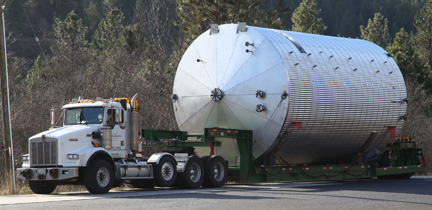
On Monday, October 22, at about 11 pm, Omega Morgan moved a cylindrical water treatment module bound for Sunshine Oilsands bitumen extraction/production operations near Fort McMurray, Alberta, through Lewiston, Idaho. Manufactured in the Portland, Oregon, area, the 236-foot-long, half-million-pound piece of equipment was barged up the Columbia and Snake Rivers to the Port of Wilma near Clarkston, Washington. Dedicated Wild Idaho Rising Tide (WIRT) activists confronted this first and longest tar sands megaload to cross Idaho and Montana via the Highway 12 wild and scenic river corridor, through the largest wildlands complex in the lower 48 states, and up the Blackfoot River valley and Rocky Mountain Front. Just a few miles into its historic 1000-mile-plus journey to its Canadian destination, WIRT demonstrated resistance near the Lewiston, Idaho, intersection of Idaho Highway 128 and U.S. Highways 12/95. There Omega Morgan workers dwarfed by the overlegal-size shipment adjusted transport trailer wheels that separate into independent sections to guide the load between front and rear trucks through road curves. In the third video segment, megaload monitors captured the behemoth squeezing past a Highway 12/95 sign in north Lewiston, followed by its convoy of pilot trucks, flagging teams, portable signs, and an ambulance, the latter included to assuage citizen concerns over megaload blockage of emergency services on narrow and sinuous upriver Highway 12. For the second part of this film, see the YouTube video Omega Morgan Megaload 10-22&23-12.
More footage of the Monday, October 22, passage of an Alberta tar sands water treatment vessel and accompanying convoy in Lewiston, Idaho, as it heads eastward along Highway 12/95. From the Port of Wilma, Washington, gateway through one of America’s greatest wilderness waterways, the Lochsa/Clearwater river corridor coveted by oil companies as a potential industrial route to the Canadian tar sands region, Wild Idaho Rising Tide (WIRT) monitors followed, videotaped, and documented Omega Morgan transport movements over two nights. Traveling only 45 miles on its first, easiest night, the megaload encountered WIRT protesters near the Port of Lewiston (see the YouTube video Omega Morgan Megaload 10-22-12), before sliding past the former Flying J gas station on the Highway 12/95 frontage road. WIRT activists walked along the nearby Clearwater River pedestrian/bike path to witness another megaload pinch point where the frontage road joins the highway. In the third video segment filmed at the junction of Highways 12 and 95, the convoy traveled east in the westbound lanes to avoid a low underpass. Monitors documented its wrong-way incursion while conversing with an Idaho state trooper, who revised the 15-minute traffic clearance requirement of the transport to disqualify the watchful monitors. The fourth video segment illustrates dangerously rapid megaload travel over the Arrow Bridge spanning the Clearwater River, with both the front and rear trucks attached and escort vehicles awaiting its precariously heavy crossing. Finally, on Tuesday night, October 23, Omega Morgan personnel invited WIRT monitors to accompany the convoy within the river canyon between Orofino and Kamiah, Idaho, to avert the confusion of trailing vehicle drivers not passing when directed, like constantly shadowing rear monitors. WIRT scrutinized 22 miles of convoy movements over three hours, noting half-paved highway sections, durations of convoy stops, highway traffic volumes, and the speeds between 5 and 25 miles per hour and locations of the megaload traversing the Nez Perce Reservation. The transport permitted by the Idaho Transportation Department temporarily stopped mid-street in downtown Kamiah, before resuming its road- and climate-wrecking assault and falling short of its second parking destination near Kooskia later that night.
Omega Morgan Megaload Observation & Objection 10-22&23-12

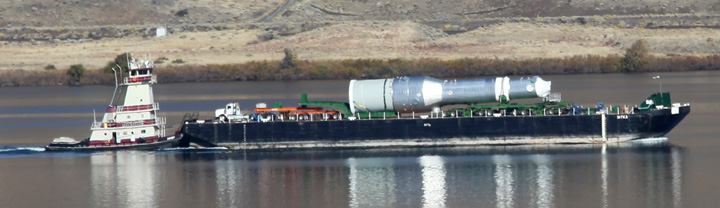
A barge pushes Alberta tar sands water treatment equipment manufactured in the Portland, Oregon, area up the Columbia and Snake Rivers to the Port of Wilma near Lewiston, Idaho.

A water treatment module of unknown ownership awaits transport by Omega Morgan from the Port of Wilma, Washington, to Fort McMurray, Alberta (Barry Kough photo).
Omega Morgan Megaload Observation and Objection
On Wednesday, October 17, the Idaho Transportation Department issued a permit to Omega Morgan Inc. to haul a water treatment vessel of unknown ownership up U.S. Highway 12 between 10 pm and 5:30 am on Monday night, October 22, through Saturday night, October 27. At 300 feet, this longest overlegal load to ever traverse the wild and scenic river corridor and largest wildlands complex in the contiguous U.S. states weighs 520,000 pounds and measures 20 feet wide and 22 feet high. Like the four 226-foot-long ConocoPhillips megaloads and one since dismantled ExxonMobil test validation module that Idahoans monitored last year, it will probably encounter difficult passage frustrated by impending snow and tight curves between roadside rock cliffs and guard-railed precipices over the Lochsa and Middle Fork Clearwater rivers.
The region, if not the nation, is watching this incursion, as apparent in a recent Boise Weekly article, Idaho Transportation Department Greenlights Mega-Load for U.S. Highway 12, and an Oregonian piece, Water-Purification Equipment Will Be Transported on Disputed Idaho-Montana Mountain Highway. Your involvement in monitoring and protesting this likely tar sands equipment as it grinds up highways from the Port of Wilma, Washington, to northern Alberta is more essential than ever. Wild Idaho Rising Tide (WIRT) and our regional allies have coordinated two protests and four nights of monitoring activities to confront this industrial invasion. Continue reading
Dana Lyons’ Great Coal Train Tour in Moscow 10-19-12
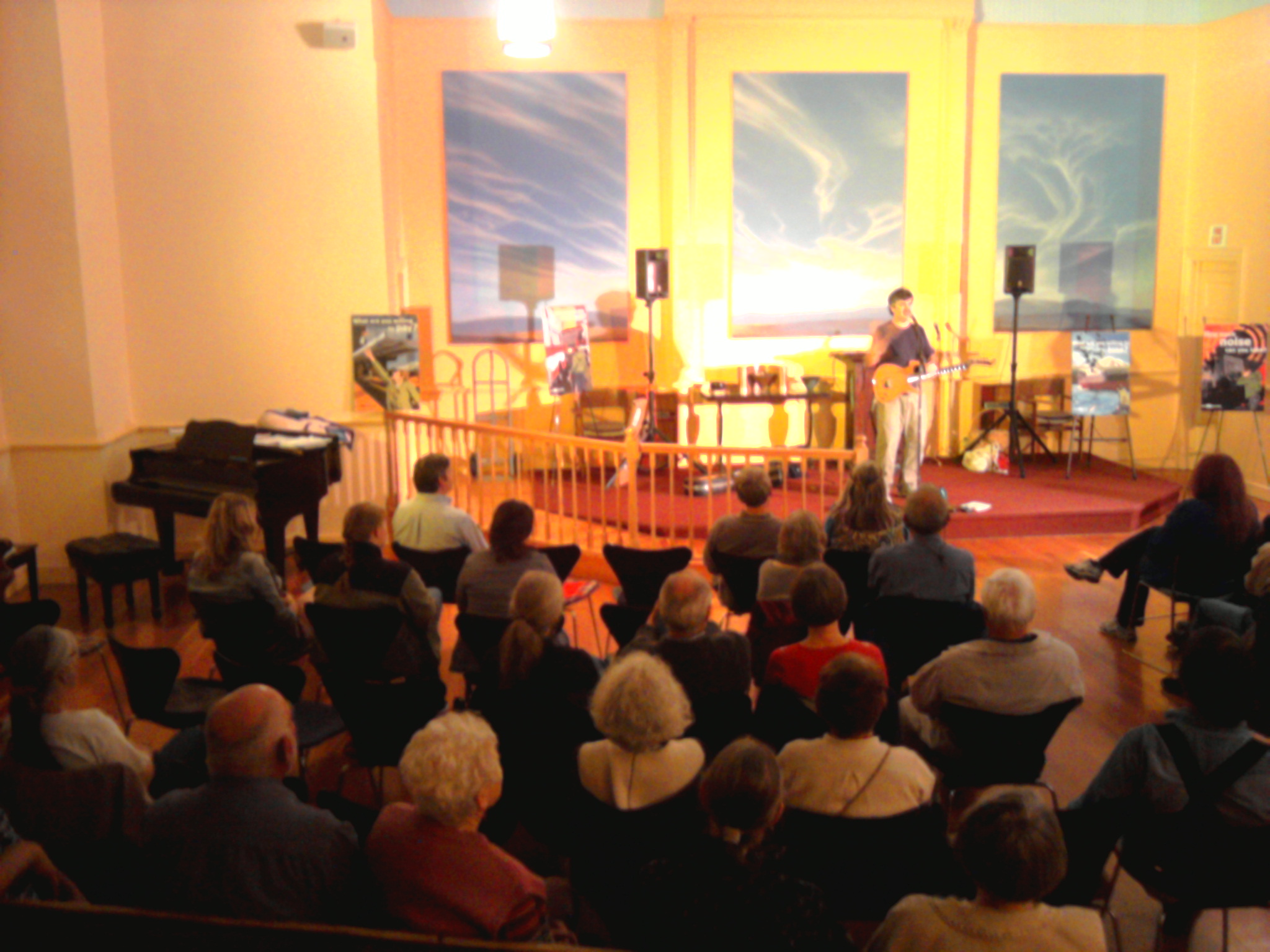
On Friday evening, October 19, performer and environmental educator Dana Lyons of Bellingham, Washington, brought his Great Coal Train Tour to Moscow. Best known for his comedy hit song Cows with Guns, Dana has recorded eight albums during his lifetime artistic career, working around the world to raise awareness, activism, and funds for environmental and social justice causes. Visiting communities from Billings to Bellingham and from Portland to Coos Bay along the route of proposed coal export trains through four Northwestern states, Dana’s fun and inspiring concert intermingled stories of resistance to associated mines, trains, and ports, gathered from potentially impacted groups like eastern Montana ranchers, Lummi Indians, and Puget Sound residents. While federal, state, and county agencies accept public scoping comments on the largest prospective coal export facility in North America, five local conservation organizations hosted this benefit event to bolster knowledge and participation in this significant regional and global issue. Wild Idaho Rising Tide, the Palouse Group of the Sierra Club, Friends of the Clearwater, Palouse Environmental Sustainability Coalition, and the Palouse Broadband of Great Old Broads for Wilderness offered appetizers and no-host beer and wine for almost 100 attendees at the Unitarian Universalist Church of the Palouse. After the show, visiting Occupy Spokane activists and Wild Idaho Rising Tide members staged a light projection action near the Sixth and Jackson street intersection in Moscow. Illuminating some recently repainted crop silos with messages denouncing Northwest coal exports and proclaiming various group affiliations, Ziggy and his comrades huddled under an awning in the rain, as passing motorists and pedestrians marveled at huge spotlighted campaign slogans and logos.
Flashpoints Interview of Alma Hasse & Helen Yost
Alma Hasse of Idaho Residents Against Gas Extraction and Helen Yost of Wild Idaho Rising Tide talked with nationally broadcast radio program host Dennis Bernstein between 0:56 and 20:38 of the Wednesday, October 17, edition of Flashpoints. Alma and Helen discussed citizen resistance to looming first fracking in Idaho, to tar sands equipment transports in eastern Montana and north central Idaho, and to national energy policies and debates.