
Stop the Frack Attack, Idaho! Month of Action


Stop the Frack Attack Idaho

During the Stop the Frack Attack Week of Action on June 3 to 9, activists of Wild Idaho Rising Tide (WIRT), Idaho Residents Against Gas Extraction (IRAGE), and United Vision for Idaho coordinated protests at six Idaho Department of Lands (IDL) offices throughout Idaho [1, 2].  Staging Stop the Frack Attack, Idaho! demonstrations and a strategy meeting, citizens expressed their concerns about oil and gas drilling near water bodies, on state lands, and via hydraulic fracturing (“fracking”) in Payette and surrounding counties [3, 4].  On Tuesday, June 4, Idaho and Washington participants brought their friends, family, and neighbors and fracking/drilling protest signs to IDL offices in Coeur d’Alene and Saint Maries in northern Idaho.  Fellow concerned citizens demonstrated outside IDL offices in Deary, Kamiah, and Orofino in north-central Idaho on Wednesday, June 5, and took plenty of photos and videos at all six locations to share with IDL and the regional and national media [5].  On Thursday evening, June 6, a dozen highly motivated and energized Idaho activists and attorneys converged for a third strategizing session, to shape our ongoing resistance to oil and gas drilling and fracking over the next year.  At the culminating action outside the main IDL office and minerals division near the state capitol in downtown Boise on Friday, June 7, at least 20 southwestern Idaho fractivists briefly talked with IDL director Tom Schultz, waved signs and banners during afternoon rush-hour traffic, and chalked notes on the adjacent sidewalks [6-9].

With a May 28 press release and event announcements, WIRT and its allies initially instigated these successful protests at IDL offices to rally public comments and opposition to the proposed Smoke Ranch natural gas well on Birding Island [10].  On April 30, Alta Mesa Services (AMS) submitted an application for an IDL permit to drill a gas well among the extensive floodplain and wetlands confluence of the Payette River and Big Willow Creek [11].  Between two nearby units of the Payette River Wildlife Management Area and the traditional lands of the Lenni-Lenape tribe, the AMS well would drill under Highway 52 near New Plymouth, only a few miles upriver from the City of Fruitland water supply intake and the Payette/Snake River convergence [12, 13].  On behalf of our nearly 2000 members, IRAGE and WIRT raised numerous objections to IDL permitting of the poorly-placed Smoke Ranch well that could set a precedent for risky, mercenary, industrial use of state lands and waters along and under the Payette River, leased by AMS and Snake River Oil and Gas [14-18].  The Smoke Ranch well pad on private property, constructed before the public comment period closed, recently flooded and required surface water pumping before drilling with toxic chemicals that has not yet commenced [19].

In response to nationwide WIRT publicity of this gas extraction scheme, the Idaho Department of Lands provoked the escalating urgency and significance of citizen protests of private exploitation of public resources with its May 30 Fact Sheet for Media countering WIRT’s May 28 press release [20, 21].  It disclosed the first written proof of impending fracking in Idaho: “Approximately half of the currently completed [eleven] wells in Idaho will need a small frac job to clear the drilling mud from the porous reservoir rocks.”  Similar to, but purportedly smaller than, the risky hydraulic fracturing of shale that has poisoned places like North Dakota and Pennsylvania, dangerous, earthquake-inducing fracking in the fifth most seismically active state could permanently withdraw and pollute millions of gallons of water in the Payette River basin.  As described in WIRT’s rebuttal of IDL’s media release, these deep explosions could induce methane and drilling chemical migration in the punctured, shallower layer of sandstone and gas underlying vulnerable area aquifers and surface waters including irrigation canals [22, 23].  IDL also confirmed the state’s conflict of public interest, as the major holder of subsurface mineral rights in the target region, with its fact sheet revelation that the two profiteering companies had leased tracts from IDL and the Idaho Department of Fish and Game in the Payette River WMA, within one half mile of the Smoke Ranch well.  This drill site could provide multiple, underground entry points for directional drilling and fracking of gas fields beneath the wildlife refuge, where the lease prohibits surface disruption from drilling [24]. Continue reading
Stop the Frack Attack, Idaho! Updates


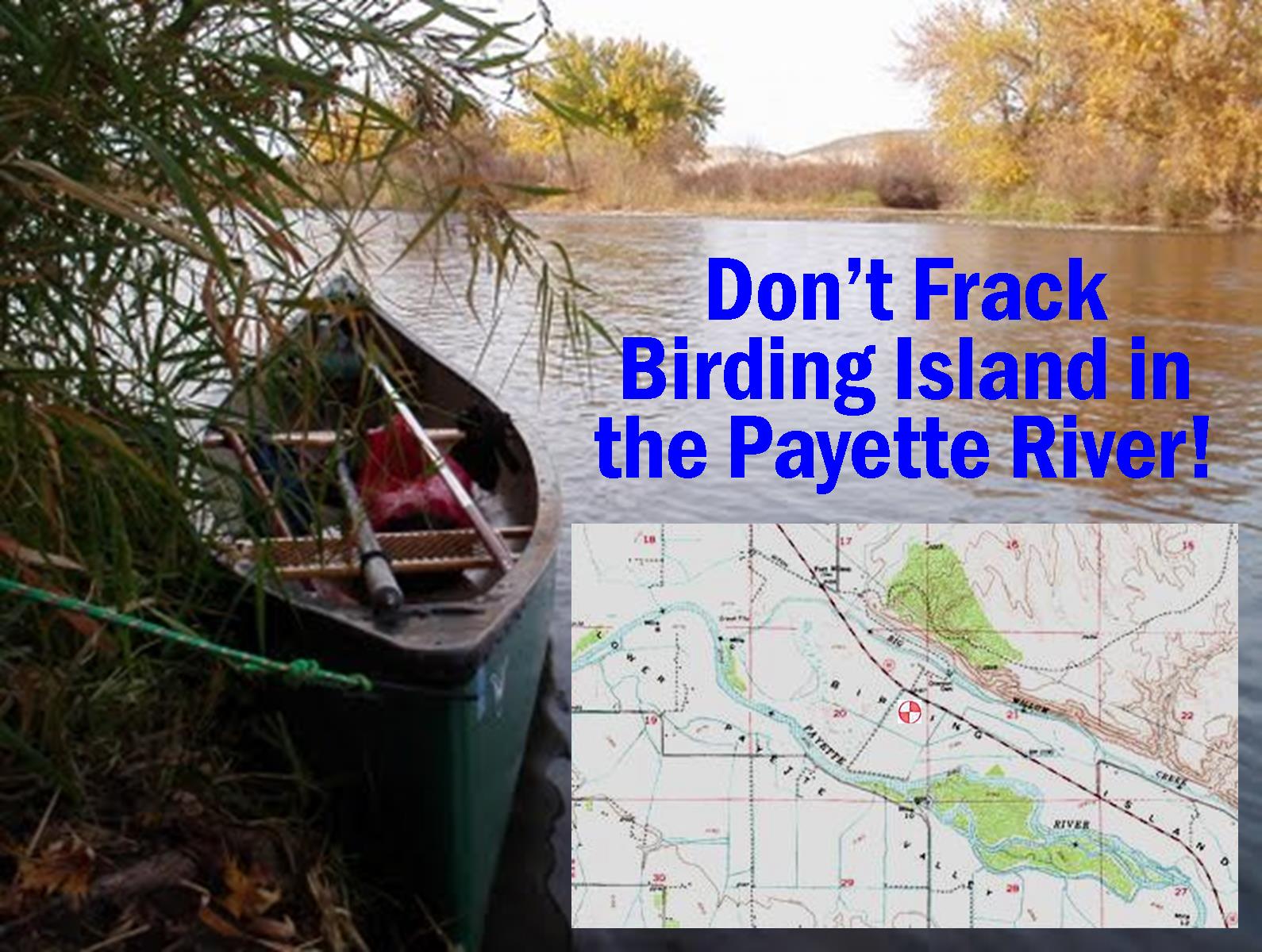
Alta Mesa Services plans to drill/frack for natural gas in Birding Island, near the Payette River Wildlife Management Area in Payette County, Idaho (Alma Hasse photo).

Alta Mesa Services plans to drill/frack for natural gas in Birding Island, near the Payette River Wildlife Management Area in Payette County, Idaho (Alma Hasse photo).

On Friday, June 7, at 3 pm, southwestern Idaho fractivists are meeting at the Idaho Department of Lands unit that houses the director and the lands, minerals, and range division, at 300 North Sixth Street near the state capitol in downtown Boise.

With the Thursday, May 30, disclosure by the Idaho Department of Lands (IDL) that Snake River Oil and Gas and Alta Mesa Services could implement “small frac jobs” on half of the eleven already drilled gas wells in Idaho, our protesting and organizing this week carries more urgency and significance [1].  Similar but smaller-scale than the risky hydraulic fracturing (“fracking”) of shale that has poisoned places like North Dakota and Pennsylvania, this dangerous blasting of porous gas reservoir rocks would permanently withdraw and pollute thousands of gallons of water from the Payette River basin.  IDL’s press release countering our media release that rallied public comments and protests also revealed that the two profiteering companies have leased tracts from IDL in the Payette River Wildlife Management Area (WMA), near the original target of our resistance, the proposed Smoke Ranch gas well on Birding Island, within the Big Willow Creek/Payette River confluence, floodplain, and wetlands.  Its well pad on private land, constructed before the public comment period closed, could provide an entry point for directional drilling into gas fields beneath the wildlife refuge, where the WMA lease prohibits surface disruption from drilling, and set a precedent for exploitation of other leased state lands along the river.

If you think that impending – and now verified – fracking in Idaho should only concern residents of Payette and surrounding counties, consider that oil and gas drilling could also soon be invading the Grangeville area and the 7,356 Bureau of Land Management acres leased near Bear Lake and Grays Lake in southeastern Idaho [2, 3].  Along with commenting against IDL permitting of the poorly-placed Smoke Ranch well, on behalf of our nearly 2000 members, Wild Idaho Rising Tide (WIRT) and our allies are coordinating protests at IDL offices throughout the state, during the Stop the Frack Attack Week of Action on June 3 to 9 [4, 5, 6, 7].  We are staging Stop the Frack Attack, Idaho! demonstrations and a strategy meeting on Tuesday through Friday, June 4 to 7, in northern, north-central, and southwestern Idaho [8].  Please bring your friends, family, and neighbors and fracking/drilling protest signs, banners, and chants, join fellow concerned citizens at these statewide demonstrations, and take plenty of photos and videos to later share with IDL!  If participating from Moscow, meet at the WIRT Activist House.  Please contact WIRT for further information about the following schedule. Continue reading

Stop the Frack Attack, Idaho!


Don’t Frack Birding Island

Alta Mesa Services (AMS) of Houston, Texas, submitted an application to the Idaho Department of Lands (IDL) on April 30, 2013, for a permit to directionally drill a natural gas well under Highway 52 in Payette County, Idaho (1).  Unlike the eleven wells sunk by Bridge Resources in 2010 and 2011 in the shallower (1400 to 1750 feet), “tight” gas sandstone formation of the Hamilton field under Payette River bottomlands, this well represents the first incursion into the Willow gas field.  This deeper of two potential plays in southwestern Idaho lies beneath the hills and buttes surrounding the agricultural communities of New Plymouth and Fruitland, below the Hamilton sandstone and underlying shale, at depths between 4500 and 5800 feet in sands over basalt.  Idaho activists are concerned that the company could hydraulically fracture (“frack”) rocks almost a mile underground, like drilling practices used to extract hydrocarbon deposits from shale formations, to obtain natural gas and/or oil from this Smoke Ranch lease of mineral rights.

A dangerous method of oil and gas well stimulation, fracking forces millions of gallons of pressurized water and toxic substances down wells to crack subsurface rocks and release small, substandard pockets of oil and natural gas.  In dozens of states across the country, this process has produced hazardous, radioactive wastewater, contaminated air and water, generated cancer-causing pollution, compromised human and environmental health and safety, and released greenhouses gases causing climate change.  Earthquakes triggered by fracking’s explosive charges and wastewater well injections could exacerbate Idaho’s fifth greatest amount of seismic activity in the nation and consequently shatter the mechanical integrity of such inherently toxic oil and gas wells.

The proposed Smoke Ranch well would drill and potentially frack Birding Island, within the extensive wetlands and floodplain confluence of the Payette River and Big Willow Creek, only a few miles upriver from the City of Fruitland drinking water intake and the Payette/Snake River convergence (2).  Under the surrounding landscape full of farms, ranches, livestock, and wildlife dependent on clean surface streams and irrigation canals, aquifers only 660 feet deep perch, without much distance or barriers, over gas-bearing zones in porous layers punctured by drilling activities. Continue reading

Second Tar Sands Solidarity Journey


57

Wild Idaho Rising Tide and Palouse Environmental Sustainability Coalition are coordinating a carpool/caravan to Fort McMurray in northeastern Alberta, Canada, to join with First Nations elders, indigenous residents, grassroots allies, and anti-tar sands activists from across the continent and world in the Fourth Annual Tar Sands Healing Walk on Friday and Saturday, July 5 and 6.  The Second Tar Sands Solidarity Journey will tentatively depart Moscow, Idaho, and Spokane, Washington, just before the Fourth of July weekend, on Wednesday morning, July 3, and return on Tuesday afternoon, July 9.  This life-changing, week-long adventure offers opportunities to inexpensively provide and share food, fuel, equipment, and fees for a summer camping trip to and from the largest industrial project on Earth.

Event coordinators enthusiastically invite regional community involvement in the solidarity journey, healing walk, and local planning meetings at 7 pm on Tuesday, May 28, and at 5:30 pm on Tuesday, June 11, at The Attic, up the back stairs of 314 East Second Street in Moscow.  Organizers also welcome ideas for and co-leadership of actions in the interior Northwest concurrent with the healing walk, such as Native drum circles or other demonstrations of solidarity.  For further information, please visit the enclosed websites and contact Wild Idaho Rising Tide at wild.idaho.rising.tide@gmail.com or 208-301-8039 and Palouse Environmental Sustainability Coalition at epfuerst@frontier.com or 509-339-5213, with your questions, suggestions, comments, and RSVP. Continue reading

Second Annual Celebration of Wild Idaho Rising Tide


Second Annual Celebration of WIRT Flyer 1

The courageous and vigilant activists of Wild Idaho Rising Tide (WIRT) invite everyone to our Second Annual Celebration of WIRT, commemorating our second anniversary as a direct action collective and reinvigorating for another year of confronting climate change perpetrators.  Between 7 pm and midnight on Friday, March 29, revel in a benefit concert provided by two solo musicians and a band, along with a home-cooked, potluck dinner and desert, beer and wine for purchase, and dozens of raffle prizes donated by community members and businesses.  Please join dirty energy resisters at the 1912 Center Great Room (412 East Third Street in Moscow), for a well-deserved wild time full of spirited conversation and danceable, singable music played by these remarkable artists:

6:30 pm: Moscow Volunteer Peace Band

Depending on weather conditions, this year’s festivities will again begin with a parade converging at Friendship Square and circling through downtown Moscow to the 1912 Center.  Peace is more fun than fossil fuel wars, so bring your protest signs, chants, and instruments to gather up rebellious party-goers.  Check out When the Saints Go Marching In performed by the Peace Band for the 2013 Moscow Mardi Gras.

8 pm: Kelly Emo with Fiddlin’ Big Al

Playing a revitalizing mixture of American folk and socio-politically aware songs, songwriter, singer, and guitarist Kelly Emo offers listeners an enlightening, relaxing experience.  Accompanied by musical guest Al Chidester, Kelly draws from his recently released first album, All in the Name of Freedom, that reflects his unique perspective on 21st century dilemmas like war and fracking.  Hear Kelly’s Change the World and more.

9 pm: Dan Maher

Renowned musician Dan Maher started his folk music career as a Spokane teenager and Washington State University student.  Dan shares his tremendous knowledge of this genre on his weekly, three-hour Public Radio program, Inland Folk, regionally broadcast for more than thirty decades.  His rousing repertoire of traditional and contemporary, local and international folk songs performed throughout the Northwest always incites enthusiastic audience participation.  Consider Dan’s story and music.

10 pm: Henry C. and the Willards

Originally formed to play for a September 2012 birthday party, this regional blues/rock band features musicians Henry Willard on guitar, dobro, and harmonica, Jeanne McHale on piano and vocals, Doug Park on bass and mandolin, Nels Peterson on drums, Terri Grzebielski on acoustic guitar and vocals, and Donna Holmes on percussion and vocals.  Band members have played with Kelley Riley, Charlie Sutton, The Hot Flashes, and several other performers.  View their videos.

Sharon Cousins and Josh Yeidel

Core WIRT eco-activists Sharon and Josh will make a special musical appearance, like at our First Annual Celebration, when they provided the musical interlude of Everybody’s Mama’s Got the Blues.

With hearty thanks to Kelly Emo for coordinating the multiple entertainment aspects of this March 29 benefit concert/anniversary party, Wild Idaho Rising Tide eagerly anticipates another lively evening gathering of more than fifty people enjoying shared camaraderie, live music and dancing, and plenty of rowdy fun.  To savor our successes, hundreds of selected photos and videos of our demonstrations and initiatives will cycle through a background slide show, and WIRT will offer the last of our limited-edition, collectors-item, tar sands megaload protest T-shirts.  Do not miss this upcoming opportunity to support Idaho’s relentless frontline challengers of Big Oil, King Coal, and Gashole Frackers for only $5 or greater voluntary admission contributions.  Please visit the WIRT website for further information and print and post these flyers, Second Annual Celebration of WIRT Flyer 1 and Second Annual Celebration of WIRT Flyer 2.  Contact wild.idaho.rising.tide@gmail.com or 208-301-8039 to assist with preparations for the big night.

March Forth to Monitor Megaloads!


On Friday, March 1, the Idaho Transportation Department (ITD) allowed a 129-foot long, 16-foot wide, 177,500-pound transport hauled by Mullen Trucking to travel west on U.S. Highway 12 from Montana between 10 pm and 5 am.  ITD inexplicably permitted this load without full advance public disclosure, as requested by our allies, by sending the associated announcement to area media outlets after 5 pm on Friday.  The state agency obviously compromised the safety and convenience of the traveling public, which it is mandated to uphold, by releasing this information to the press so late and thus facilitating probable traffic delays and confusion caused by the megaload.

If road and weather conditions favor travel tonight, March 4, MAK Transportation of British Columbia (http://www.maktransportation.com/) will move another mammoth shipment east on U.S. Highway 12, from the Port of Lewiston toward Montana, between 10 pm and 5:30 am.  Of unknown weight, ownership, and destination, the transport measures 85 feet long and 17 feet wide and tall.  Three flagging teams and escort vehicles will accompany the shipment to alert other drivers of the over-width load and to limit delays of other Highway 12 traffic to under 15 minutes, as the convoy uses identified turnouts. Continue reading

Idle No More World Day of Action Idaho Solidarity


Idle No More Bear Blockade

Urgent Alert and Update:

[The contracted hauler Mammoet is transporting two ConocoPhillips wastewater evaporators manufactured in Newburg, Oregon, to northern Alberta tar sands operations via Highway 12 in Idaho starting Wednesday night, January 30.  Each megaload weighing 255,600 pounds and measuring 20 feet tall, 16 feet wide, and 141 feet long will depart the Port of Wilma, across the river from Clarkston, Washington, on separate nights and travel as far as possible toward the Montana border between 10 pm and 5:30 am, depending on road and weather conditions.  The Idaho Transportation has not announced when the second load will similarly ravage Nez Perce lands, the Middle Fork Clearwater/Lochsa wild and scenic river corridor, area highways, and traveler safety.  Two pilot vehicles and flagging teams will accompany both shipments and limit traffic delays to less than 15 minutes.

On Wednesday and successive evenings, January 30 and beyond, Wild Idaho Rising Tide (WIRT) monitoring and protesting carpools provisioned with video and still cameras, audio recorders, and notebooks will converge at 9 pm at the corner of Second and Washington Streets in Moscow, to demonstrate our megaload opposition at 10 pm along Idaho Highway 128 near Lewiston.  Citizen monitors will then follow each shipment to their stop-over point, likely near Kooskia, where they will park during the day.  Because Mammoet’s transportation plan prohibits these transports from delaying other highway vehicles for more than 15 minutes before pulling over to let traffic pass, we intend to also scrutinize their every move on their second nights traveling toward milepost 139 east of Lowell, and on their third nights in Idaho, struggling over the Bitterroot crest and the Idaho/Montana state line, toward the Lolo scale in Montana.  All of our plans are subject to the constantly changing dynamics of weather and terrain.  For more information and to RSVP as a megaload monitor and protester, contact Wild Idaho Rising Tide at wild.idaho.rising.tide@gmail.com, through facebook, at the WIRT Activist House between noon and 8 pm daily, and/or at 208-301-8039.] Continue reading

Highway 95 Forum and Field Trip


Don't Pave Paradise

On November 26, the Idaho Transportation Department (ITD) approved a draft environmental impact statement (DEIS) and technical reports on three alternatives for proposed realignment of U.S. Highway 95 between Thorn Creek Road and Moscow.  It published the DEIS in early January 2013 and scheduled a public information/comment hearing between 2 and 8:30 pm on Wednesday, January 23, at the Best Western University Inn, 1516 Pullman Road in Moscow, and a public comment period ending on February 23.  Of the three DEIS alternatives of 11 options considered by ITD – an eastern route climbing the western shoulder of scenic Paradise Ridge (E2), a central corridor realigning the middle section of the present 6.5-mile stretch of road (C3), and a western, longer route veering close to Washington (W4) – the ITD-preferred eastern alternative shifts the highway up 400 to 500 feet in elevation and 2,000 feet east, between the Primeland Cooperative grain elevators south of Moscow and the top of Reisenauer Hill.

This E2 route in the recently released DEIS mirrors alternative 10A in a previous environmental assessment (EA) of Highway 95 re-construction plans.  That 2002 version provoked regional citizen concerns for climate-related highway traveler safety, urban sprawl, area aesthetics, wetland preservation, and protection of rare remnants of native Palouse Prairie habitat and wildlife.  The Paradise Ridge Defense Coalition (PRDC) emerged and, along with the Palouse Group of the Sierra Club and the Idaho Conservation League, successfully challenged the EA, secured a 2003 injunction from U.S. District Judge B. Lynn Winmill, and forced ITD to complete the current DEIS review process mandated for all federal highway redesign projects that widen or re-route roadbeds.

A reactivated group of prior and new PRDC members have identified many potential environmental, economic, and social consequences of the purportedly shorter, faster, and safer eastern realignment of Highway 95.  Besides the same ongoing objections, they note that the DEIS E2 alternative would impose the greatest detrimental effects on pine stands, ungulate (deer, moose) conservation and collisions, endangered species, and ecosystem restoration.  It would also create more stream tributary crossings, impervious surfaces, and pollution runoff and challenge flood control.  The U.S. Environmental Protection Agency and Fish and Wildlife Service as well as the Idaho Department of Fish and Game have strongly recommended against this eastern Highway 95 corridor, likely advanced by ITD to accommodate international industrial traffic like tar sands megaloads. Continue reading

Coal Export Resistance Solidarity Actions


BC Train Blockade

In early May 2012, police arrested 13 concerned British Colombia residents along with scientists, when they blocked four Wyoming coal export trains (350.org photo).

As the environmental impact statement (EIS) scoping period for the proposed Gateway Pacific Terminal at Cherry Point, Washington, draws to a close on January 21, and public comments on the Coyote Island Terminal in Boardman, Oregon, are long past due, federal, state, and county decision makers never provided public hearings in Idaho and Montana or a mine-to-port regional programmatic environmental analysis.  Nonetheless, residents of the comparatively rural inland Northwest, especially near Powder River Basin coal strip mines and train routes through Montana population centers and along the railroad funnel between Sandpoint, Idaho, and Spokane, Washington, will bear most of the adverse risks and consequences of domestic coal export to Asia, while Ambre Energy, Arch Coal, Peabody Energy, SSA Marine, and other giant coal companies reap billions of dollars in profit on up to 160 million tons of coal per year, at taxpayers’ expense.

Pillaged public investments would support the required infrastructure and mitigate the predictable damages of this corporate onslaught.  Each of the 40 to 60 additional coal trains per day, 1.5 miles long with their 125 cars, would spew toxic coal dust, diesel fumes, occasionally derailed loads, and incessant noise, disrupt local transportation, businesses, emergency responses, and economies, and degrade air and water quality, human and wildlife health, property values, and regional identity.  Five proposed West Coast and Columbia River terminals with huge, open-air coal heaps, river barges through endangered species critical habitat, and over 950 immense, ocean-going, coal ships per year, crowding oil tankers through the tangled Salish Sea to Asian markets for combustion, would further compromise aquatic ecosystems and inhabitants and significantly exacerbate pollution and global climate change.

Between January 11 and 20, 2013, Blue Skies Campaign, Occupy Spokane, and Wild Idaho Rising Tide are staging four or more coal export solidarity actions at train track/roadside intersections in Moscow and Sandpoint, Idaho, Missoula and other cities across Montana, and Spokane, Washington.  But we need your help to powerfully demonstrate our collective regional resistance to coal export schemes perpetrated by industry and government.  Tell the U.S. Army Corps of Engineers and Surface Transportation Board, state and county regulatory agencies, and the Burlington Northern Santa Fe Railroad, not to mention the world’s largest private coal companies, that Northwesterners will not tolerate their dismissal of community concerns and environmental wellbeing so apparent in their purported public participation processes and mercenary ventures. Continue reading

Megaload End of the (Industrial) World


Rural Megaload Route Map - Large

URGENT ALERT: We just received notice (at 6:30 pm!) from the Idaho Transportation Department that Mullen Trucking is moving a megaload on Highway 12 tonight (Thursday, January 3).  Please see the following, previous description and meet at 9 pm at the corner of Second and Washington Streets in Moscow to monitor and protest this likely Alberta-bound shipment!  Call 208-301-8039 for carpool arrangements to Lewiston…

Displaying its usual disregard for traveler safety over a holiday weekend and dangerous winter weather conditions, the Idaho Transportation Department has issued yet another permit for an oversized shipment on U.S. Highway 12 on Thursday night, January 3.  A 163-foot-long truck will transport a generator skid from the Port of Lewiston across Idaho to the Montana border and likely to Alberta between 10 pm on Thursday and 5:30 am on Friday.  The almost 17-foot tall, 243,000-pound shipment will crowd tight road curves and narrow two lanes with its 15 foot width, and will delay traffic on U.S. Highway 95 as it travels in the wrong direction near the Spalding bridge. Continue reading