The Monday, January 28, Climate Justice Forum radio program hosted by Wild Idaho Rising Tide (WIRT) features Kai Huschke, the Spokane-based Northwest organizer for the Community Environmental Legal Defense Fund and an Envision Spokane activist who will lead a Friday evening presentation and Saturday morning workshop at the 1912 Center in Moscow. Kai explains how the corporate-shaped/state-supported regulatory system and legal doctrines favor corporations over communities and why activists must transition from reactive, defensive struggles toward pro-active, offensive strategies that enact legally defensible bills of rights and succeed in protecting ecosystems and communities. His experience and perspective on rights-based initiatives are especially germane to the Idaho Transportation Department (ITD) scheme to expand and reroute U.S. Highway 95 south of Moscow through native Palouse Prairie remnants on weather-exposed Paradise Ridge, likely to accommodate international industrial traffic like tar sands megaloads. WIRT invites listeners to share their insights during the show broadcast on KRFP Radio Free Moscow between 7:30 and 9:30 pm PST live at 92.5 FM and online, by calling the station studio at 208-892-9200. Thanks to the generous, anonymous listener who adopted program host Helen Yost as his KRFP DJ, the show also covers regional and continent-wide dirty energy developments and climate activism news.
Author Archives: WIRT
Corporate Domination and Community Rights
On February 1 and 2, the Palouse Environmental Sustainability Coalition, Wild Idaho Rising Tide, and several local conservation and human rights organizations again gratefully welcome to Moscow Kai Huschke, the Spokane-based Northwest organizer for the Community Environmental Legal Defense Fund and an Envision Spokane activist. Everyone is invited to participate in his public presentation and meeting in the 1912 Center Fiske Room, 412 East Third Street in Moscow. On Friday evening, February 1, at 7 pm, Kai will talk about When the Law is on Their Side: What Communities are Doing Differently to Change the Game Against Corporate Domination, describing the legal background and necessity of the 150 community bills of rights codified by cities, counties, and townships as local “declarations of independence” from harmful corporate activities and their government facilitation.
Over the last 150 years, the few people who own and run corporations have perfectly constructed and patented a structure of law seldom understood in its practical applications. These legal doctrines insulate corporations from community control, grant them greater legal and constitutional rights than community majorities, and routinely preempt and nullify resistance in targeted communities, who almost never win against corporations. Communities predictably respond by focusing solely on the state-sanctioned destruction wrought by a corporate activity and by trying to convince other people of the need to ban, rather than merely regulate or allow, corporate actions and harms. But by instead structurally changing the ground rules, people across the country have successfully joined together to organize and use their collective lawmaking powers and non-violent civil disobedience, directly challenging and ultimately liberating themselves from centuries-old corporate domination in everything from factory farms to water privatization to dirty energy, while protecting the health, safety, and welfare of communities and ecosystems. Moscow and Latah County citizens could similarly offer important leadership and linkage in attaining more critical mass of this authentic democracy. Continue reading
Community Bill of Rights Information
Why Community Bills of Rights?
Help! I’ve Been Colonized – Jane Anne Morris
Regulatory Triangle (Factory Farms)
Box of Allowable Remedies (Factory Farms)
Model Community Bills of Rights
Pittsburgh’s Community Protection from Natural Gas Extraction Ordinance
Bellingham Community Bill of Rights
Envision Spokane Community Bill of Rights Initiative 2012-13
Benton County, Oregon, Food Bill of Rights
Fair Elections and Clean Government Model Ordinance
Communities Asserting Their Rights
Reflections on ITD U.S. Highway 95 Realignment Hearing
Mary Ullrich, Moscow
The Moscow-Pullman Daily News 1/25/13
In reflecting on testimony at Wednesday’s Idaho Transportation Department (ITD) hearing in Moscow, I would like to say a few things. First, I do need to express great compassion for all those who stand to be affected adversely. I sincerely hope that you will be compensated fairly and well by ITD.
For those who told stories of accidents and dangers on Reisenauer Hill, I hope that section of the highway will be redone to state and federal standards. This would be accomplished by going with Alignment C-3. Keep in mind if E-2 is built, the current highway will remain as it is (only as a county road) and many, especially local people, will be using that old highway.
For those who pleaded that ITD lower speed limits, add some center-line “rumble strips” and some carefully placed signage, I hope ITD will hear this loud and clear and take immediate action.
Let’s work together to make this happen now.
U.S. Highway 95 Reroute Opinions Differ

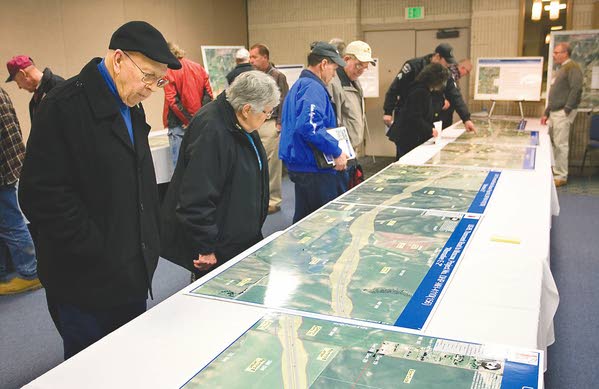
Bruce and Colleen Bumgarner, left, look at maps of proposed routes for the U.S. Highway 95 Thorncreek Road to Moscow Project during an Idaho Transportation Department hearing at the Best Western Plus University Inn in Moscow on Wednesday (Moscow-Pullman Daily News/Geoff Crimmins photo).

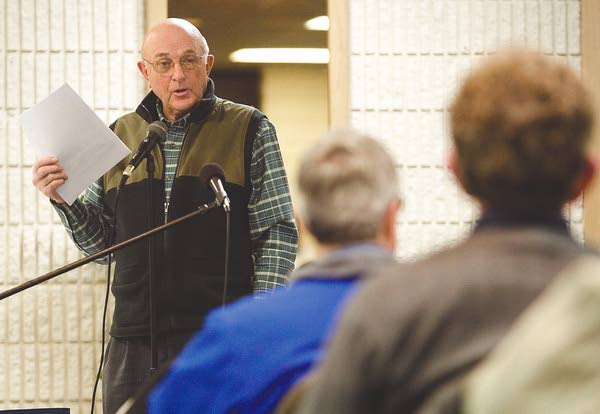
Jack Flack, left, speaks during an open-microphone session at an Idaho Transportation Department hearing at the Best Western Plus University Inn in Moscow on Wednesday (Moscow-Pullman Daily News/Geoff Crimmins photo).
ITD public hearing shows mixed support for three alternatives
The Idaho Transportation Department (ITD) experienced plenty of foot traffic during its public hearing on Wednesday to gather opinions about plans to reroute and widen U.S. Highway 95 from Thorncreek Road to Moscow.
Preferences varied about which of the three alternative routes ITD should use to resolve traffic safety issues along the 6.5-mile stretch of highway, where more than 130 accidents and six deaths have occurred during the past ten years.
Some sided with the transportation department in its preferred eastern realignment, which is the noisiest but also shortest and safest route, according to its Draft Environmental Impact Statement – the focus of Wednesday’s hearing. Continue reading
A Win-Win Option
Keith G. Haley, Moscow
The Moscow-Pullman Daily News 1/24/13
A few important thoughts on the U.S. Highway 95 relocation.
The realignment of 95 south of Moscow will be permanent.
It is important we get it right. I feel certain the C-3 alternative route is absolutely the best choice.
My first reason is highway elevation. Anybody who has lived on the Palouse for more than a summer knows the hill to the north of Moscow, Steakhouse Hill, and to the south, Reisenauer Hill, are the winter danger spots. Black ice, blowing snow and unpredictable weather issues begin in November each year and can last until late spring. Continue reading
ITD to Host U.S. Highway 95 Reroute Hearing Today
The Idaho Transportation Department is hosting an open house 2-8:30 p.m. today at the Best Western Plus University Inn where public comment will be taken regarding its plans to reroute U.S. Highway 95 from Thorncreek Road to Moscow and a recently published draft environmental impact statement for the project.
ITD spokesman Adam Rush said there will be technical and project staff with ITD available to answer questions along with additional informative literature. There are western, central and ITD-preferred eastern realignment routes being considered with open mic times for comment at 3 p.m. and 5:30 p.m. There will also be areas to leave written comments.
The public statements are part of the process as we move forward with this project,” Rush said. “We really encourage people to show up and give us their input and comments.”
(By The Moscow-Pullman Daily News)
Don’t Blame Paradise Ridge Defenders
Kas Dumroese, Moscow
The Moscow-Pullman Daily News
With all due respect to Wayne Olson and Shelley Bennett, their angst is misdirected. The Paradise Ridge Defense Coalition welcomes a new U.S. Highway 95, just not by Paradise Ridge. PRDC members (hunters, farmers, foresters, small business owners, environmentalists, etc.) are concerned about safety and passionate about quality of life issues. My teenager commuted on U.S. 95, too.
We still drive on old U.S. 95 because ITD ignored law. With that mistake, ITD could have selected from many potential routes meeting project objectives without requiring the extensive time and money of a draft environmental impact statement, but instead pursued the route flanking Paradise Ridge (E2) that did. Although we could have been driving on a new route years ago, stubbornly, perhaps out of wounded professional pride, ITD pushes the version they admit is the noisiest and has the most negative effect on wildlife, Palouse Prairie and access by rural residents and emergency responders. ITD’s conclusion E2 will be safest is disingenuous – it does so by forcing nearly everyone who lives south of Moscow and north of Thorncreek Road off the new interstate and restricting them to commute on the existing, dangerous route. First responders to Hidden Village, for example, will still travel the old route. Continue reading
Highway 95 Forum 1-19-13
Opening of the U.S. Highway 95 Reroute Discussion
Part 1 of the U.S. Highway 95 Reroute Discussion
Part 2 of the U.S. Highway 95 Reroute Discussion
(Also see Tim Hatten’s presentation slides: posted soon)
Part 3 of the U.S. Highway 95 Reroute Discussion
C-3 Is Superior Reroute for U.S. Highway 95
Al Poplawski, Moscow
The Moscow-Pullman Daily News 1/22/13
The Paradise Ridge Defense Coalition appreciates the opportunity to respond to several letters to the editor during the last week that made erroneous statements regarding PRDC and the Idaho Transportation Department’s U.S. Highway 95 re-alignment project. Hopefully we can clear up many of these misunderstandings.
In the following discussion we have done our best to provide a factual summary of the draft environmental impact statement.
We share Wayne Olson’s concern for safety. However, we don’t accept responsibility for accidents on the highway. PRDC forced ITD to follow the law that required that they create an EIS. The responsibility is with the laws of our land. We only encouraged following the law. The EIS must consider all factors, propose a wide range of alternatives and select the alternative that best satisfies the “purpose and need” of the project – while observing all laws and regulations. The purpose for this project requires improvement of safety, efficiency and handling of traffic volume. It may take a little longer, but if this process is done well we should get a safe highway. A DEIS usually takes an agency a year or two to perform. It is not our responsibility that ITD took so many years to perform this analysis. Continue reading