Port of Lewiston Wants Megaloads Back


Megaloads are still on the table, as the Port of Lewiston crafts its budget for the coming fiscal year.

The port is seeking to increase the amount it sets aside for legal expenses, from $9,000 this year to $33,000 next year, to be prepared for litigation to keep the U.S. Highway 12 corridor open for megaloads.  It has also more than doubled the money available for administration travel to $21,500.

Those two items are part of a draft budget for the fiscal year that begins July 1, which Lewiston port commissioners reviewed on Wednesday.

No megaload taking up two lanes of traffic has moved on U.S. Highway 12 since last summer, after a federal judge imposed a preliminary injunction halting the shipments in response to a lawsuit filed against the U.S. Forest Service by the Nez Perce Tribe and Idaho Rivers United.  The two groups are in mediation on the issue.

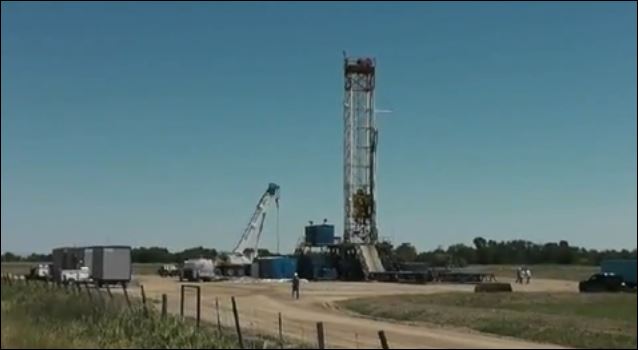
Even though that matter hasn’t been resolved, port commissioners are giving Port Manager David Doeringsfeld the go-ahead to recruit more megaloads. Continue reading →

WIRT Newsletter: Highway 95 Megaload Resistance & Missing Trailer, Grassroots Environmen​tal Summit & Protests


Missing Mammoet Megaload Trailer

At 1 pm on Monday, May 5, 2014, a photo taken by Moscow documentarian Tom Hansen at the Port of Wilma, Washington, revealed breaking news about the heaviest and longest megaloads ever proposed for passage on U.S. Highway 95 and either Interstate 90 or Idaho Highway 200 [1].  During the week since the April 28, 2014 scouting expedition by a core Wild Idaho Rising Tide (WIRT) activist, megaload hauler Mammoet had removed its only trailer from one of three hydrocracker parts, bound on a 1.6-million-pound, 441-feet-long assemblage of cargo, trailers, and trucks for a tar sands refinery expansion in Great Falls, Montana [2, 3].  Like previous observations, push and pull trucks and security guards were noticeably missing from the leased port yard.  Either temporarily or permanently, Mammoet has apparently been dissuaded by a coalition of allied organizations and/or has abandoned both recently identified northern Idaho megaload shipment routes to Montana.  A comment by an aggravated opponent, in response to the last, website-posted WIRT newsletter, at about the same time as discovery of the missing trailer, may indicate that these behemoths and other tar sands modules could take circuitous paths from West Coast ports [4].

These units of an essential, industrial component of Calumet Specialty Products Partners’ $400 million Montana Refining Company expansion project have been awaiting transport at the Port of Wilma by the Snake River near Clarkston, since mid-December 2013.  The installed hydrocracker with a 25,000-barrels-per-day (bpd) capacity could double refinery production from 10,000 to 20,000 bpd, starting during the first quarter of 2016 [5].  Calumet plans to convert crude tar sands bitumen into diesel fuel that powers the mining equipment and trucking fleets operating in the sacrifice zone of fracked Bakken shale oil extraction.  Over the last year, removal of several large refinery tanks, excavation of 15,000 cubic yards of soil contaminated mainly by lead and gasoline, and purported “air-tight” rail car shipment of the hazardous waste to an appropriate facility in Indiana have delayed expansion project construction until after August 1, 2014 [6].  Now, the timely delivery of this rusty remnant of a bygone fossil fuel era and its mechanical integrity under high-pressure and -temperature operating conditions, after years of horizontal exposure to weather, are precarious and questionable, thanks to poor industry planning and commendable public involvement in the situation.

Resistance to Highway 95 Megaloads

Since the onset of this second controversy over Mammoet tar sands transports on Highway 95, after 32 nights of megaload convoys prompted relentless WIRT protests and monitoring forays in 2011-12, northern Idaho and eastern Washington citizens and organizations have demonstrated disapproval of government agency and public input processes [7, 8].  Even while staging and supporting 28 protests of three half-as-large Omega Morgan tar sands mining equipment shipments, each moving 1200 miles across three states during four winter months, WIRT and allies attended and protested at Idaho Transportation Department (ITD) and City of Moscow meetings, requested ITD public records, and publicly posted the results and other information about this Mammoet transportation scheme [9].  Five regional, grassroots, conservation- and climate change-oriented groups including WIRT forced extended and expanded environmental analysis, public involvement, and subsequent diversion of Mammoet’s first proposed hydrocracker route through Coeur d’Alene, via a co-written letter of concern sent to the Federal Highway Administration (FHWA), ITD, and other responsible city, county, state, and federal representatives and environmental, transportation, and wildlife agencies [10].  WIRT organized and scheduled five meetings/presentations and direct action training sessions for tribal and climate activists in four northern Idaho cities, and scouted, photographed, and videotaped both the potential East Coeur d’Alene Lake Drive/temporary Interstate 90 on-ramp route and the proposed alternative course over the almost two-mile-long Highway 95 Long Bridge near Sandpoint and the federally-designated Highway 200 Pend Oreille Scenic Byway through or near six state wildlife management areas or preserves [4, 11, 12]. Continue reading →

Climate Justice Forum: Herb Goodwin 5-12-14


The Monday, May 12, Climate Justice Forum radio program hosted by Wild Idaho Rising Tide (WIRT) gratefully welcomes Herb Goodwin, a core WIRT and Occupy activist resisting coal export and tar sands megaloads from Bellingham, Washington.  Herb will talk about recently rapidly expanding facilities and transports in and through Montana that build Alberta tar sands and Bakken shale oil extraction infrastructure, with megaload shipments, assembly plants, pipelines, and refineries.  Broadcast on progressive, volunteer, community station KRFP Radio Free Moscow every Monday between 7:30 and 9:30 pm PDT, live at 90.3 FM and online, the show covers continent-wide dirty energy developments and climate activism news, thanks to the generous, anonymous listener who adopted program host Helen Yost as their KRFP DJ.

Climate Justice Forum 5-5-14


The Monday, May 5, Climate Justice Forum radio program hosted by Wild Idaho Rising Tide (WIRT) discusses apparent abandonment of the proposal to haul the largest ever Highway 95/200 megaloads through Idaho to a Great Falls, Montana tar sands refinery expansion, Bakken shale oil train explosions and resistance, Oregon and Washington protests of fossil fuel transport schemes, and a special segment of past, broadcast, megaload protest reports by recently deceased KRFP citizen journalist Paul McPoland.  Broadcast on progressive, volunteer, community station KRFP Radio Free Moscow every Monday between 7:30 and 9:30 pm PDT, live at 90.3 FM and online, the show also covers other continent-wide dirty energy developments and climate activism news, thanks to the generous, anonymous listener who adopted program host Helen Yost as their KRFP DJ.

WIRT Newsletter: Congratula​tions, Condolence​s, Upcoming Events, & Highway 95/200 Megaloads


CONGRATULATIONS & CONDOLENCES

Congratulations to all of the diligent, inspiring, fellow Moscow citizens and Earth Day Award recipients, especially Pat Rathmann of the Palouse Environmental Sustainability Coalition (PESC) and Citizens’ Climate Lobby, who make even radical Wild Idaho Rising Tide (WIRT) activists proud to call Moscow home! [1, 2]

Our dear comrade, core WIRT activist Paul McPoland, died unexpectedly of unknown causes at a friend’s dwelling where he had been staying, on the night of April 29-30.  City police officers are still notifying his family and investigating the situation, while friends arrange a memorial that will likely take place in Moscow on the weekend of May 16 to 18.

Moscow also lost our beloved regional outdoor recreation expert and generous benefactor of community causes including WIRT, John Crock, owner of Hyperspud Sports, on April 28.  We extend our deepest sympathies to John’s family and Laurene Sorensen, his long-time partner, new wife, and this year’s Moscow Renaissance Fair Queen [3].

All Against the Haul founder and Oregon anti-megaload activist Trish Weber and her husband Mark Rose of Corvallis, Oregon, and hundreds of friends and family members grieve the death of their seven-year-old son, Nigel Rose-Weber, on April 4, after he stayed home from school due to sudden illness [4].

UPCOMING EVENTS

(Check the WIRT website Events Calendar often!)

May 3-4: Moscow Renaissance Fair

Come out to the Moscow Renaissance Fair this weekend, May 3 and 4.  On Saturday and Sunday, from 10 am until 6 pm (and later on Saturday), WIRT will be roaming the East City Park grounds in Moscow, Idaho, selling Clean Energy Bars: cookie- and brownie-like snack bars made of organic, healthful, non-sugar ingredients [5].  All proceeds support our outreach work, travel funds, and demonstration supplies (and maybe some upcoming, anti-megaload, legal fees…).  Watch for a wandering WIRT vendor that looks like the following linked image, except in Renaissance garb [6].  WIRT activists are welcome to dress the part and take shifts: We are begging for basic, bake-sale survival.

May 9: Nez Perce Grassroots Environmental Summit

Respectfully participate in the Nez Perce Grassroots Environmental Summit between 9 am and 4 pm on Friday, May 9, at the Clearwater River Resort, 17500 Nez Perce Road off Highway 2/95 near Lewiston, Idaho [7-9].  Coordinating partners Nez Perce Tribal Environmental Association and Seventh Generation Fund for Indigenous Peoples invite all tribal nations and supporters among Rising Tide groups and regional environmental and tribal organizations to attend the gathering and speak about Pacific Northwest and greater Northern Plains issues such as treaty rights, tar sands, megaloads, climate change, and wolf protection.  This high-priority summit could occur at about the same time and place as the first of three 1.6-million-pound, Great Falls tar sands refinery megaloads would attempt to climb the seven-percent Lewiston Grade, gaining 2000 vertical feet in seven miles out of the Snake/Clearwater River valley.

For registration and information, contact Julian Matthews at jmatthews@alumni.uidaho.edu or 208-790-4296.  Please widely share and distribute the event poster and facebook and email announcements to your tribal and non-tribal contacts across the region, and let WIRT know how we can assist your attendance of this great convergence.  Portlanders are organizing carpools via Vicki Creel and Kath Cotrell, who have expressed interest in such a trip.  The WIRT Activists House and van, about 30 miles away from this summit, can lodge and transport up to seven people, and core WIRT activist Sharon Cousins has offered space for a few people to sleep indoors or in tents, trucks, or vans.  To protect sacred air, Moscow and Pullman area activists will carpool from the Eastside Marketplace south parking lot, near the Troy Highway, at 8 am on Friday, May 9.

June 24-July 1: Fifth & Final Tar Sands Healing Walk

Join PESC and WIRT carpools and caravans to and from First Nations communities near tar sands mining operations surrounding Fort McMurray, Alberta, via the Tar Sands Solidarity Journey from June 24 to July 1.  This summer marks your last opportunity to participate in the final Athabasca region Tar Sands Healing Walk, happening on Friday to Sunday, June 27 to 29 [10].  As healing walk organizers explain, “The story of the Athabasca region is only one small piece of the immense scope of this issue…It’s time for the Healing Walk to shed light on other communities, other extraction practices, other bodies of water, and other places…In order to stop the destruction, the healing has to start everywhere.”  Hundreds of healing walk participants would greatly appreciate Nimiipuu, Umatilla, Warm Springs, Coeur d’Alene, and Montana tribal participation and stories of tar sands resistance, so please consider involvement in this significant event.  Expect a WIRT event announcement about the Tar Sands Solidarity Journey soon.

HIGHWAY 95/200 MEGALOADS

As described in previous Wild Idaho Rising Tide dispatches, the Federal Highway Administration determined in mid-February that the Idaho Transportation Department (ITD) and megaload hauler Mammoet USA South must produce a more stringent environmental assessment, rather than a categorical exclusion, analysis of the proposed Coeur d’Alene Lake Drive Temporary Overweight Truck Route, likely due to public pressure and attorney and coalition letters [11].  For now, a gravel, “temporary,” wrong-way, Interstate 90 on-ramp, built on a trail between two wetlands, and a lakeside parking lot for megaload layover – both near where previous interchange construction collapsed into the toxic, Superfund sludge-bottomed lake – will not have to withstand three 1.6-million-pound transports of a hydrocracker tripling the tar sands production of a Great Falls, Montana, refinery.  A rapidly approaching recreation and tourism season in the Idaho and Montana Rocky Mountains could crowd these behemoths off area thoroughfares.

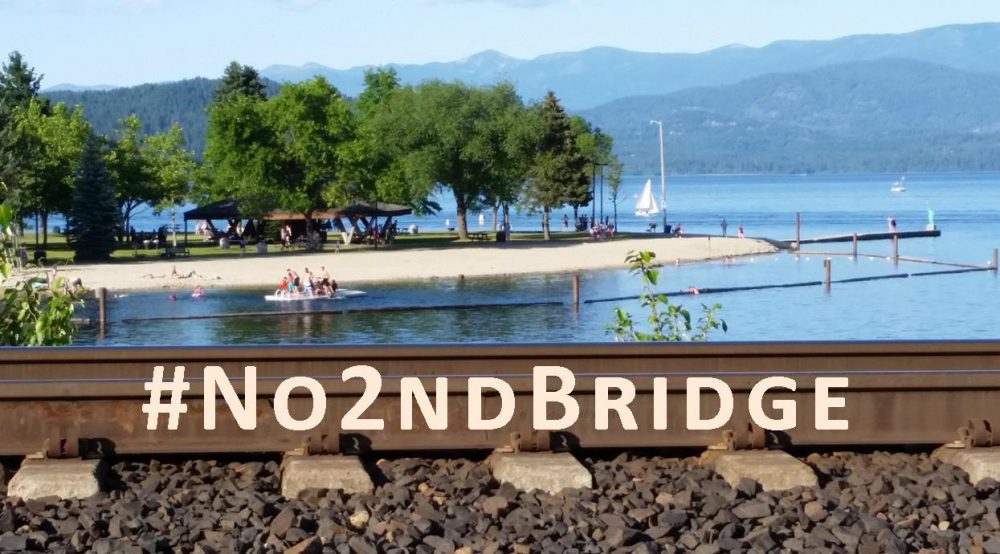
Slowed and blocked by WIRT and other groups, Mammoet and ITD are rerouting the cargo toward the northern Idaho reaches of U.S. Highway 95 and Idaho Highway 200, as a solution to the procedural impasse.  After the megaloads rumble out of the Port of Wilma near Lewiston, up the grade, and through Moscow, they would venture over Lake Pend Oreille toward Sandpoint and Montana.  WIRT organized and scheduled four brief and simple, early-April evening meetings/presentations and weekend direct action training sessions in Sandpoint, Plummer, Coeur d’Alene, and Moscow [12].  As WIRT activists eagerly anticipated talking with concerned Sandpoint area residents about possibly impending Mammoet-hauled shipments at the Sandpoint Library on April 2, public meeting plans appeared on the front page of the Sandpoint newspaper on April Fool’s Day and in the Coeur d’Alene Press [13-15].  After one and a half years since the last WIRT (coal train) protest in Sandpoint, we are grateful for local media coverage stating, “Wild Idaho Rising Tide opposes megaloads, contending they would exacerbate climate change due to their links to controversial tar sands oil development in Canada and the proposed [Keystone] XL pipeline.” Continue reading →
Climate Justice Forum: Jessica Lee 4-28-14


The Monday, April 28, Climate Justice Forum radio program hosted by Wild Idaho Rising Tide (WIRT) gratefully welcomes activist Jessica Lee of the Salt Lake City-based direct action groups Utah Tar Sands Resistance and Peaceful Uprising.  Jessica will provide updates on U.S. Oil Sands’ attempt to mine Utah tar sands, the Utah Supreme Court case considering state permitting of this venture, water testing in the area, regional oil shale projects, and continued resistance and upcoming action camp opportunities to oppose tar sands exploitation.  Broadcast on progressive, volunteer, community station KRFP Radio Free Moscow every Monday between 7:30 and 9:30 pm PDT, live at 90.3 FM and online, the show covers continent-wide dirty energy developments and climate activism news, thanks to the generous, anonymous listener who adopted program host Helen Yost as their KRFP DJ.

Climate Justice Forum 4-21-14


The Monday, April 21, Climate Justice Forum radio program hosted by Wild Idaho Rising Tide (WIRT) discusses the largest ever Highway 95/200 megaloads proposed for a Great Falls tar sands refinery expansion, Rosebud Sioux tribal activism against Keystone XL pipeline megaloads, the Obama administration’s postponement of the Keystone XL permitting decision, and a Boise protest and investigation of Idaho Department of Lands leasing of state lands and minerals rights, even under rivers, for oil and gas exploration and extraction.  Broadcast on progressive, volunteer, community station KRFP Radio Free Moscow every Monday between 7:30 and 9:30 pm PDT, live at 90.3 FM and online, the show also covers other continent-wide dirty energy developments and climate activism news, thanks to the generous, anonymous listener who adopted program host Helen Yost as their KRFP DJ.

Goliath Staggered: Highway 12 Megaloads Book Author Visits Moscow


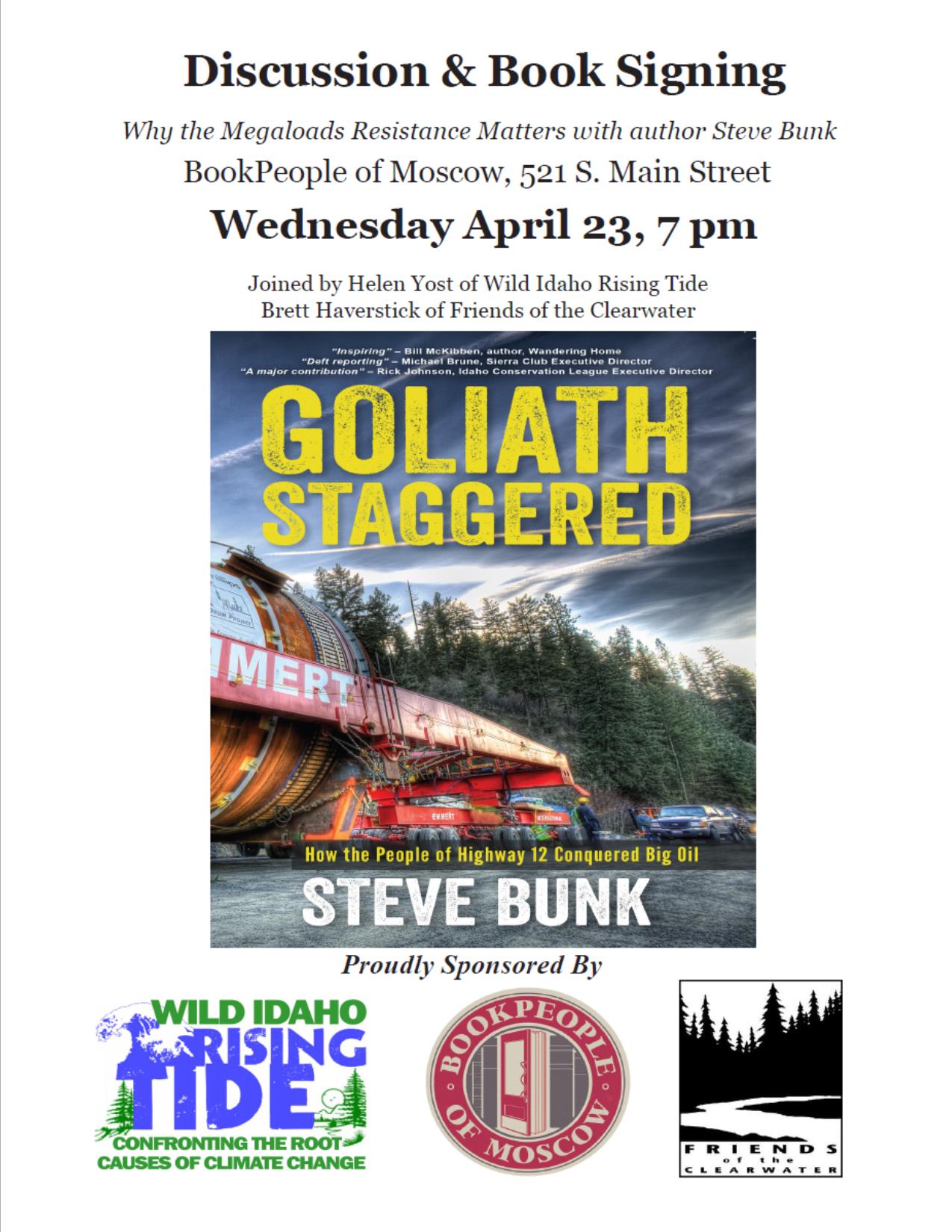
Goliath Staggered Flyer Photo

Idaho author Steve Bunk, who covered resistance to the tar sands “megaloads” on Highway 12 for the Missoula-based online journal New West, has written a book called Goliath Staggered: How the People of Highway 12 Conquered Big Oil (New West Books, 2014).  Throughout April, bookstores in Boise, Clarkston, and Moscow, Idaho, and Missoula, Montana, are launching the book, warmly received by regional conservationists.

Mr. Bunk will visit …and BOOKS, too! in Clarkston on Saturday, April 19, at 4 pm and BookPeople of Moscow on Wednesday, April 23, at 7 pm, for book signings and lively discussions about “Why the Megaloads Resistance Matters.”  Highway 12 outdoor travel company ROW Adventures will co-sponsor the Clarkston event at 918 Sixth Street.  Borg Hendrickson and Linwood Laughy, the central figures in Goliath Staggered and the couple who galvanized the Idaho megaload resistance, will join Steve and answer audience questions.

Friends of the Clearwater (FOC) and Wild Idaho Rising Tide (WIRT) are co-sponsoring the Moscow event happening at BookPeople of Moscow, 521 South Main Street.  Both groups have played key roles in the grassroots opposition to oil company attempts to transform Highway 12’s federally protected Wild and Scenic River corridor into a high-and-wide industrial thoroughfare to Alberta tar sands mines.  Helen Yost of WIRT, who leads a continuing campaign against megaloads traveling through the Northwest, and Brett Haverstick of FOC will also address the audience. Continue reading →

Idaho Gas Lease Auction Protest & Petition Report


20140417_092224

Idaho Gas Lease Auction Protest & Petition 4-17-14 (April 17, 2014, Wild Idaho Rising Tide photos)

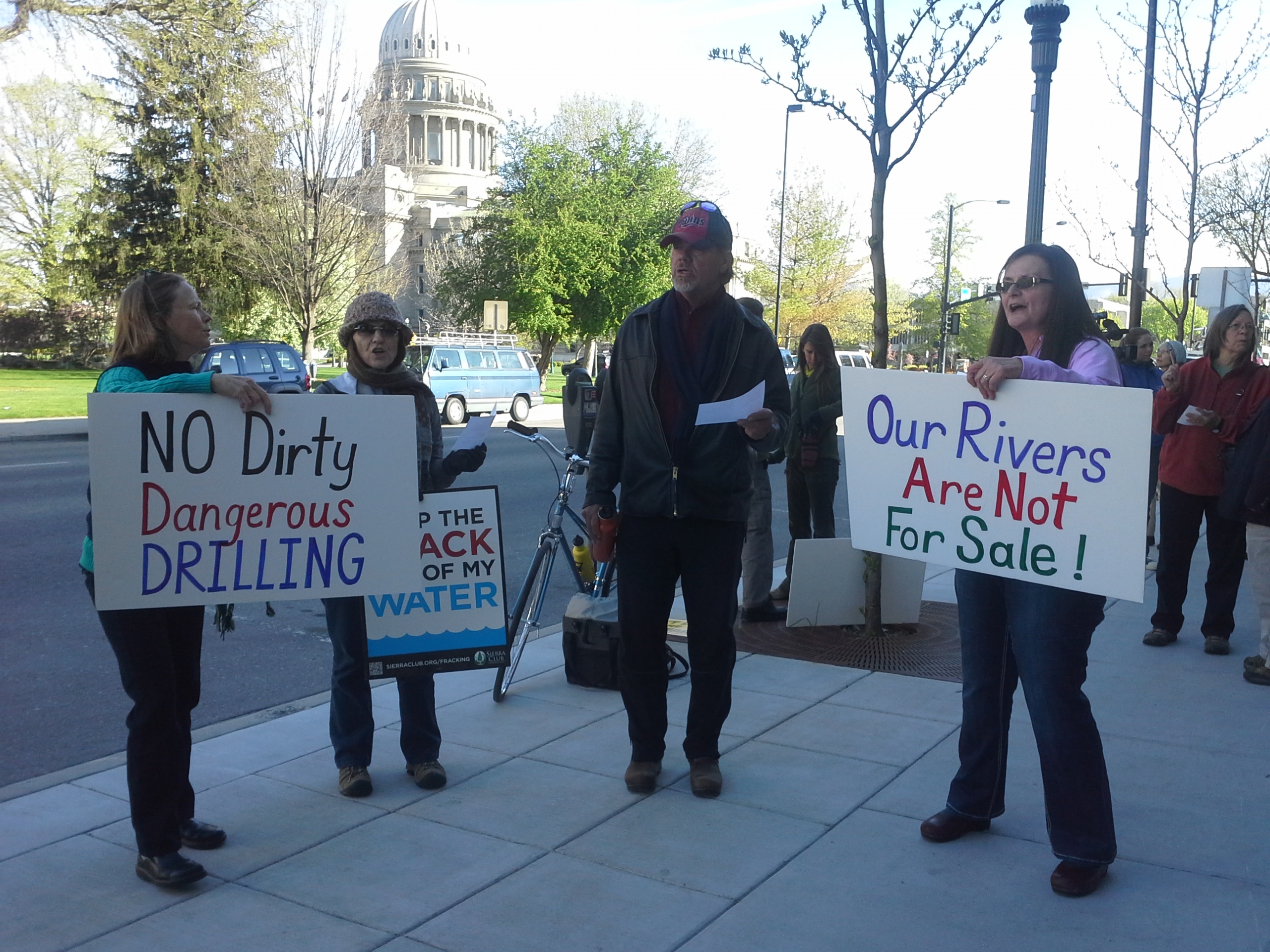
On Thursday, April 17, 2014, twenty members of Idaho Residents Against Gas Extraction (IRAGE), the Muse Project, and Wild Idaho Rising Tide (WIRT) staged a successful protest of the Idaho Department of Lands (IDL) auction of oil and gas leases of state rivers, lands, and mineral rights to the highest bidders among two drilling companies [1-4].  Converging at 8:30 am MDT outside the IDL main office in Boise, Idaho, participants arrived with their protest signs, friends, and family members, including an infant and toddler, and their spirit of solidarity with communities devastated by fossil fuels.  Together they sang multiple rounds of the climate activism song Do It Now near the IDL entrance, as five or more news agencies interviewed and filmed the demonstrators, and as bidders, government officials, and their associates hurried inside.

When protesters filed into the building only minutes before the auction began, the receptionist insisted that they could not bring their posters or voices to the auction.  One organizer asked to see the Idaho code that disallowed this practice, and the crowd soon occupied and packed the back of the conference room.  As bids on 150 public tracts started at $1 per acre and ended as high as $505 per acre, some defaulting to Alta Mesa without competitive bidding, the demonstrators held their protest signs, placed them on tables surrounded by bidders, and scrutinized, videotaped, and photographed the proceedings among irritated oil and gas industry representatives.  Immediately after the auction concluded, two activists asked how the public can comment before state auctions on parcels of their lands and minerals planned for fossil fuel development leases.  To expand Idaho citizens’ right to knowledge of these lands as well as more stringent water protections for leased rivers and increased public engagement in leasing processes, they also requested comprehensive maps of the leased parcels and the auction’s list of tracts, leasees, and bids.

As described in a petition addressed to Idaho Governor Butch Otter and signed by hundreds of Idaho citizens, the auction protesters plan to discuss and democratize these processes with the Idaho Board of Land Commissioners at their next regular meeting on May 22, 2014 [5].  They also request independent baseline testing of all bodies of water near state lands and minerals, prior to their inclusion in future state lease auctions, and the open availability of this water quality data to the public.  Additionally, IRAGE, Muse Project, and WIRT activists assert that: Continue reading →

Idaho Gas Lease Auction Protest, Petition, & Preparatio​n


Smoke Ranch Well 7-9-13

Smoke Ranch Well, Payette County, Idaho 7-9-13 (Alma Hasse photo)

On Thursday, April 17, 2014, beginning at 9:30 am MDT, the Idaho Board of Land Commissioners will offer oil and gas leases of state lands and sub-surface mineral rights for sale to the highest bidder, at the director’s office of the Idaho Department of Lands (IDL), 300 North Sixth Street, Suite 103, in Boise, Idaho [1]. IDL periodically conducts these public auctions and administers subsequent leases, with oversight and approval by the Land Board. The 12.5-percent royalty derived from extracted oil and gas raises funds from lands held for the public trust and state wildlife and transportation departments and for specified beneficiary institutions through the state endowment trust. Of the 150 tracts in Ada, Canyon, Gem, Owyhee, Payette, and Washington Counties, 36 parcels are located under or adjacent to the Boise and Snake Rivers and many involve the split estates of private landowners and state mineral holders [2].

Minimum, competitive bids by drilling companies at the oral auction open at only $0.25 per acre for the 17,700-plus acres available for leasing. Successful bidders must pay their bid and the first year’s annual rental of $1.00 per acre for leases lasting up to ten years. If the lease is not drilled or productive, IDL assesses an additional drilling penalty of $1.00 per acre per year starting in the sixth year. The state requires a $1,000 bond for exploration on each lease, which increases to $6,000 prior to drilling, in addition to a drilling permit bond issued by the Idaho Oil and Gas Conservation Commission. Before entry on state lands for seismic exploration, the company must acquire an IDL permit costing $100 per mile across contiguous tracts or a minimum of $100 per section.

The last state lands and minerals auction on January 16, 2014, in Boise, Idaho, generated $694,000 in bids for the state of Idaho [3, 4]. The Idaho Department of Lands leased 8,714 acres for oil and gas drilling – including 4,130 acres in and alongside the Boise, Payette, and Snake river beds – for an average of $80 per acre to the lone bidder, Alta Mesa Idaho. The April 17 auction will double this previously largest amount of Idaho public lands and minerals leased in one period, bringing the total to nearly 98,000 state acres, leased for as low as $2.35 per acre on average, besides the thousands more private acres leased in six southwestern counties [5]. Fourteen drilled but capped wells, awaiting pending pipelines and processing infrastructure, have prefaced the first producing well in Idaho in February 2014, on the Teunissen Dairy near New Plymouth. The Idaho Department of Environmental Quality found toluene from drilling mud in a water well several hundred feet away in fall 2012 [6].

If the people of Idaho own all of these myriad acres of public trust and endowment trust state lands and minerals auctioned for oil and gas exploitation, which respectively “benefit” the general fund and public schools, how can Idahoans influence and determine how our state stewards these shared resources? Allowing the same agency – the Idaho Department of Lands – to both regulate and lease oil and gas development on state holdings seems like a conflict of interest, especially because the Oil and Gas Conservation Commission that oversees industry regulation is politically appointed and receives a 1.5-percent severance tax on oil and gas production for its “responsibility.” At least Idahoans can vote out of office the state’s highest elected officials on the Land Board, for leasing and selling off our precious, impacted lands, resources, and waterways for bargain basement prices.

Because the last five years of frenzied oil and gas rule-making, legislation, drilling, and exploration, centered primarily in Payette County and the Boise halls of government, represent industry’s first forays into Idaho’s still relatively pristine, and thus increasingly valuable, watersheds, the time has now arrived for communities across the state to organize and resist looming drilling, fracking, and acidizing of oil and gas wells. Historic and current fossil fuel development in the state infers that major portions of Idaho are ripe for development and could eventually suffer in the boom-and-bust crosshairs of dirty energy corporations [7]. Please participate in one or hopefully all of these opportunities for citizen protection of our clean air, water, and lands: Continue reading →