Moscow & Sandpoint Host Tar Sands Pipeline Valve Turners


tar-sands-pipeline-valve-turners-flyer

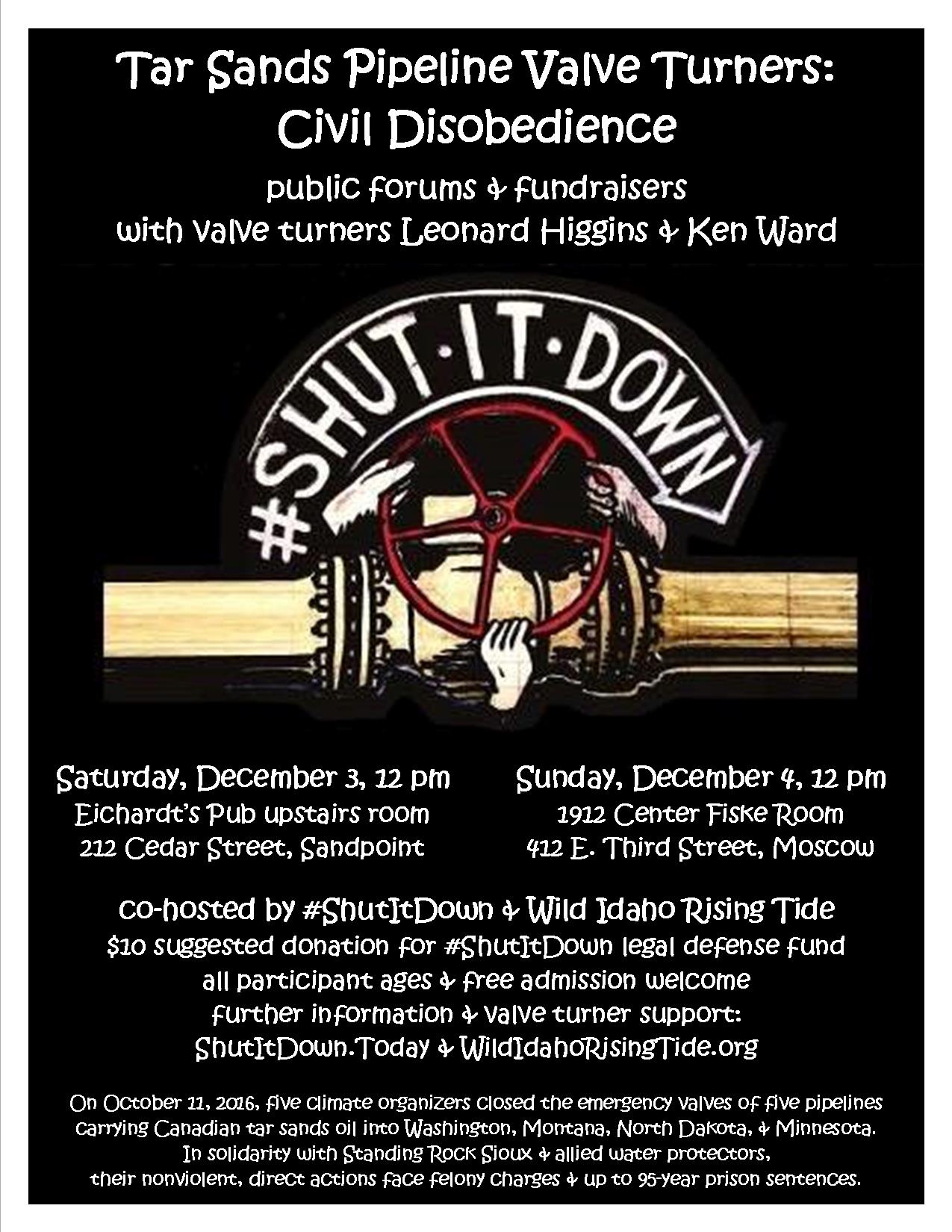
Tar Sands Pipeline Valve Turners: Civil Disobedience

Featuring Leonard Higgins in person and Emily Johnston, Michael Foster, and Ken Ward via Skype

Saturday, December 3, 12 pm to 2 pm, in Eichardt’s Pub upstairs room, 212 Cedar Street, Sandpoint, Idaho

Sunday, December 4, 12 pm to 2 pm, in the 1912 Center Fiske Room, 412 E. Third Street, Moscow, Idaho

Public forums and fundraisers co-hosted by #ShutItDown – Climate Direct Action and Wild Idaho Rising Tide

$10 suggested donation for the #ShutItDown legal defense fund

All ages of participants and free admission are welcome.

On October 11, 2016, five brave climate organizers successfully closed the manual, emergency valves of five pipelines carrying oil from the Canadian tar sands into the northern United States [1, 2].  Their unprecedented acts of nonviolent direct action to avert climate cataclysm shut down 15 percent of U.S. crude oil imports for nearly a day.

Emily Johnston, age 50, and retired attorney Annette Klapstein, 64, each interrupted Enbridge’s Lines 4 and 67 pipelines in Leonard, Minnesota.  Michael Foster, 52, shut down TransCanada’s Keystone pipeline in Walhalla, North Dakota.  Leonard Higgins, 64, who locked down to a tar sands megaload in Umatilla in December 2013, halted the flow of Spectra Energy’s Express pipeline at Coal Banks Landing near Great Falls, Montana.  Ken Ward, 59, a Climate Disobedience Center and #ShutItDown co-founder, stopped Kinder Morgan’s Trans Mountain pipeline in Anacortes, Washington. Continue reading

Climate Justice Forum: Brian Wolcott on Port of Olympia Train Blockade, Clean Energy & Tar Sands Pipeline Blockers Forums, Payette County Oil & Gas Forced Pooling, & Canadian Approval of Tar Sands Pipelines 11-30-16


The Wednesday, November 30, 2016 Climate Justice Forum radio program, hosted by regional climate activist collective Wild Idaho Rising Tide, offers news about upcoming, regional forums on the clean energy revolution and the civil disobedience of five tar sands pipeline valve turners, a driller application to force pool the oil and gas resources of hundreds of Payette County, Idaho residents, and Canadian approval of two pipelines bringing one million barrels of tar sands per day into the U.S.  We also share a one-hour, November 26, Sandpoint presentation by Olympia Stand activist Brian Wolcott, about the week-long, encamped rail blockade of a Bakken-bound, fracking proppant train from the Port of Olympia, Washington.  Broadcast on progressive, volunteer, community station KRFP Radio Free Moscow every Wednesday between 1:30 and 3 pm PST, on-air at 90.3 FM and online, the show covers continent-wide fossil fuel resistance and community opposition to extreme energy projects, thanks to the generous, anonymous listener who adopted program host Helen Yost as her KRFP DJ.

Upcoming WIRT November Events


energy-crossroads-community-forum

Upcoming WIRT November Events

Thanks to Wild Idaho Rising Tide (WIRT) activists, allies, and friends for your patience during a November that opened opportunities for a long-overdue, month-long, event-free break, especially from the rigors of side-job wage slavery. With more time and energy for activism emerging from this healing phase, we plan to soon re-establish a regular WIRT email newsletter and to post WIRT radio program recordings, both drawn from our active facebook page.  Please support ongoing WIRT and allied mobilization of regional residents for coordinated, region-wide actions and agency hearings and comment periods, confronting Northwest coal, oil, gas, and tar sands facility and transportation projects.  Look for upcoming announcements throughout autumn and winter 2016-17 about participatory events including educational presentations, direct action training workshops, peaceful protests, and benefit concerts that advance our shared anti-fossil fuel/climate change campaigns.

Tuesday, November 29: Comment against the Millennium Bulk (Coal) Terminals

During this last opportunity for public input on Millennium Bulk Terminals, please comment on the U.S. Army Corps of Engineers (Corps) draft environmental impact statement (EIS) and a dredging permit application for the Longview, Washington coal export facility proposed by Lighthouse Resources [1-3]. Before the public comment period ends on Tuesday, November 29, urge the Corps to oppose construction and operation of the largest coal export terminal in North America, and to protect public health and natural resources, by supporting the “no action” alternative of the draft EIS and rejecting the permit application.  Millennium’s eight additional, fully loaded, unit coal trains per day and the coal transfer and storage site, annually handling up to 44 million metric tons of coal, would harm the health and safety, air and water quality, and natural resources of communities throughout the Northwest.

As the draft EIS describes, Millennium would receive coal via trains from western U.S. mines and transfer it to Asia-bound, ocean-going vessels, at the 190-acre, leased site of the former Reynolds Aluminum smelter. Its facilities would include an operating rail track and unloading station, a coal stockpile area and eight-track rail loop for storage, a conveyor and two independent ship loaders, and two new docks to berth Panamax-class vessels.  Because Lighthouse Resources seeks to dredge up to 48 acres out to the Columbia River navigation channel, the company has applied for a permit under Section 404 of the Clean Water Act and Section 10 of the Rivers and Harbors Act.

Between April 29 and June 13, 2016, most of the 250,000 commenters on a separate Millennium draft EIS, issued by the Washington Department of Ecology and Cowlitz County, opposed this coal export facility [4]. But the Corps granted the proposal a favorable review in its federal draft EIS released on September 30.  In its 3,000-plus-page document, the agency described potential project damages to air, water, fish, wildlife, and communities, including more train traffic congestion, elevated railroad noise levels, and increased wait times at rail crossings, especially in low-income and minority communities.  The Corps held only two public hearings on its draft EIS, on October 24 in Longview, Washington, and on October 25 in Ridgefield, Washington, “to provide the public an opportunity to share its views and opinions” on this last of six proposed coal export terminals in Oregon and Washington [5, 6].  It did not offer hearings beyond the Longview/Vancouver/Portland area for citizens of Montana, Idaho, and eastern Washington, and no one coordinated testifier buses from these areas to the southwest Washington hearings.

An increase in coal trains across the Idaho panhandle would not only pollute our waters, lands, and bodies with coal dust and diesel fumes, it could also take human and non-human lives. According to the Federal Railroad Administration, Idahoans experienced 21 accidents between vehicles and trains at public and private rail crossings of all railroads in the state between August 2015 and July 2016.  In the northernmost Idaho counties, four incidents without injuries or deaths occurred at one private and three public crossings in Boundary and Kootenai counties.  Two people died at private and public crossings in Bonner County during the last year-plus.

Please join us in working together to stop Millennium Bulk Terminals, by convincing the U.S. Army Corps of Engineers to NOT approve project dredging, construction, and operation. Send your comments on the Corps draft EIS to http://www.millenniumbulkeiswa.gov/submit-comments.html, and your remarks on the dredging permit application, referencing NWS-2010-1225, by e-mail to NWS.MBTL@usace.army.mil.  The Corps will review and consider all comments offered during the public input period.

Wednesday, November 30: Energy Crossroads: A Community Forum

Please attend a forum emceed by Laura Ackerman of The Lands Council, to together learn about, envision, and share the current revolution that is winning a just and equitable shift to a clean energy economy [7]. Speakers include KC Golden of Climate Solutions, Evita Krislock of the Episcopal Diocese of Spokane, and Gavin Tenold of Pura Vida High Performance Builders.  The Lands Council, Climate Solutions, and Gonzaga Environmental Law and Land Use Clinic are co-sponsoring this event, and WIRT and a dozen other Washington and Idaho groups are co-hosting it.  Join us at 7 pm on Wednesday, November 30, in the Gonzaga Moot Law Court at the Gonzaga University School of Law, 721 North Cincinnati Street in Spokane, Washington.

Mass mobilization against unnecessarily expanded development, transportation, and dependence on coal, oil, and other fossil fuels in Northwest communities has increased opposition to their unacceptably devastating local and global impacts. Cleaner, local, and more efficient energy options, like solar and wind power and electric vehicles, have simultaneously improved in their availability, use, and price.  This crossroads is increasing investments in healthier, stronger, and better communities, resources, democracies, and jobs, all building a brighter, more viable future for all.  Thanks! Continue reading

Olympia Stand Blockade Talk


olympia-stand-blockade-talk-flyer

Sandpoint/Olympia Activist Talks about Fracking Sand Train Blockade

Saturday, November 26, 12 noon

East Bonner County Library Room 104

1407 Cedar Street, Sandpoint, Idaho

Please join Wild Idaho Rising Tide (WIRT) and allies at 12 noon on Saturday, November 26, in Room 104 of the East Bonner County Library, 1407 Cedar Street in Sandpoint, Idaho, for a public presentation offered by Brian Wolcott, an Evergreen College student, Olympia Stand activist, and Sandpoint resident.  With photos, videos, and descriptions, Brian will talk about the week-long Olympia Stand blockade of a train transporting Chinese fracking proppants from the Port of Olympia to the Bakken shale oil and gas fields in North Dakota, the source of leaky pipeline oil and explosive oil trains.  Between November 11 and 18, community demonstrations and an encampment on the tracks expressed solidarity with Native-led Dakota Access Pipeline resistance at the Standing Rock Reservation in North Dakota and with indigenous sovereignty movements defending the water, fishing, and hunting rights of local tribes, before riot police injured, arrested, and dispersed blockaders and protesters in downtown Olympia, Washington.  For further event information, Olympia Stand media releases, regional and national news coverage of the blockade, and a donation site for arrestees’ legal funds, see the Olympia Stand public facebook group and the event announcement on the WIRT website [1, 2].

WIRT Meeting with Visiting Olympia Stand Activist

Although WIRT did not hold our usual, third Wednesday, monthly gathering in Sandpoint this November, we invite WIRT activists, allies, friends, and contacts to connect and start collaboration with an Olympia comrade during the Thanksgiving break.  Converge at 10:30 am for a private, closed-door, WIRT planning meeting, before Brian’s greatly appreciated noon presentation, in Room 104 of the East Bonner County Library.  Brian grew up in Sandpoint, and intends to return to the Coeur d’Alene area to organize resistance efforts, when he concludes his Evergreen education.  During his weekend visit with his family and hometown, he hopes to share and discuss with old friends and the Sandpoint activist community ideas and decisions about coal, oil, and fracking sand train protesting and monitoring, the role that police play in demonstrations, and any other helpful information.

Eastbound Fracking Proppant Train Monitoring

During most days and evenings, from our office window (a block away from the Amtrak station) and along Sand Creek, WIRT watches and documents westbound, Burlington Northern Santa Fe (BNSF), unit coal and oil trains crossing downtown Sandpoint.  So we are happy to alert regional residents to the additional opportunity to monitor fracking proppant/sand train movements.  Olympia Stand and WIRT organizers ask that all of us notice and report to them any groups of a dozen, whitish, covered, eastbound rail cars carrying fracking sand from the Port of Olympia to the Bakken Basin in North Dakota.  Traversing the region first as unit trains on a short rail line to a Seattle train yard, then as parts of mixed freight trains on mainline BNSF tracks through Spokane, north Idaho, and the Montana Hi-Line, the hopper cars have a key, confirmed feature of two  (not the usual three) square, funnel-like ports on their bottoms.  To accomplish this trainspotting and report proppant cars, please view the color and shape, number of cars, and overall train composition in the clear photos and videos of the rail cars provided in these links, especially the Olympian video of the heavily guarded train rolling through Olympia after the blockade [3-5].  Together, Northwest climate and indigenous activists are observing and noting the amount of time typically required for fracking supplies to move from Olympia to Sandpoint to North Dakota. Continue reading

Climate Justice Forum: Herb Goodwin on Dakota Access Pipeline Protest Support & Arrest, Idaho Transportation Board Rules for Highway 12 Megaloads, Olympia Stand Blockade of Bakken Fracking Sand Train, Missouri River Pipeline Drilling & Police Brutality, & Upcoming, Inland Northwest Events 11-23-16


The Wednesday, November 23, 2016 Climate Justice Forum radio program hosted by regional climate activist collective Wild Idaho Rising Tide (WIRT) features an interview with Bellingham-based, core WIRT activist Herb Goodwin about his participation and arrest at Dakota Access pipeline resistance camps and actions.  We also share news about Idaho Transportation Board-approved rules for Highway 12 megaloads, the week-long blockade of a Bakken fracking sand train from the Port of Olympia, Missouri River tunnel drilling and police brutality along the Dakota Access pipeline route, and upcoming, inland Northwest presentations, forums, and solidarity actions.  Broadcast on progressive, volunteer, community station KRFP Radio Free Moscow every Wednesday between 1:30 and 3 pm PST, live at 90.3 FM and online, the show covers continent-wide fossil fuel resistance and community opposition to extreme energy projects, thanks to the generous, anonymous listener who adopted program host Helen Yost as her KRFP DJ.

Climate Justice Forum: Coal Train Pollution Settlement, Lewiston Oversize Loads, Grays Harbor Oil Terminal Deadline, Bellingham & Olympia Rail Blockades, Halted DAPL Construction 11-16-16


The Wednesday, November 16, 2016 Climate Justice Forum radio program hosted by regional climate activist collective Wild Idaho Rising Tide features news about a federal court settlement on coal train pollution of Washington waterways, proposed Idaho Transportation Department rules for Highway 12 megaloads, Clearwater Paper oversize loads moving from the Port of Lewiston, last public chances to stop a Grays Harbor oil-by-rail terminal, Bellingham and Olympia rail blockades of fossil fuel trains, and anti-Dakota Access pipeline solidarity actions and halted construction near the Missouri River.  Broadcast on progressive, volunteer, community station KRFP Radio Free Moscow every Wednesday between 1:30 and 3 pm PST, live at 90.3 FM and online, the show covers continent-wide fossil fuel resistance and community opposition to extreme energy projects, thanks to the generous, anonymous listener who adopted program host Helen Yost as her KRFP DJ. ~Helen

http://radiofreemoscow.org/

Climate Justice Forum: Megaload-Built Tar Sands Mine Closures, Grays Harbor Oil Terminal, BNSF Coal Train Dust Trial, NoDAPL Solidarity Actions 11-9-16


The Wednesday, November 9, 2016 Climate Justice Forum radio program hosted by regional climate activist collective Wild Idaho Rising Tide features news about the closure or abandonment of two Alberta tar sands extraction operations built by Northwest megaloads, the last opportunities for public input on a Grays Harbor oil-by-rail terminal, a federal court trial of Burlington Northern Santa Fe Railway polluting Northwest waterways with coal dust and particles, and upcoming solidarity actions demanding a halt of Dakota Access pipeline construction under the Missouri River near the Standing Rock Reservation.  Broadcast on progressive, volunteer, community station KRFP Radio Free Moscow every Wednesday between 1:30 and 3 pm PST, live at 90.3 FM and online, the show covers continent-wide fossil fuel resistance and community opposition to extreme energy projects, thanks to the generous, anonymous listener who adopted program host Helen Yost as her KRFP DJ.

Climate Justice Forum: Public Input on NW Coal & Oil Terminal Proposals, Federal Court Ruling on Coal Dust in NW Waterways, Militarized Assaults on Standing Rock Water Protectors 11-2-16


The Wednesday, November 2, 2016 Climate Justice Forum radio program hosted by regional climate activist collective Wild Idaho Rising Tide features updates on the last opportunities for public input on Northwest coal and oil terminal proposals, a federal court ruling that coal dust and particles pollute Northwest waterways, militarized assaults and arrests of Standing Rock Lakota and allied water protectors in the path of Dakota Access pipeline construction, and other regional fossil fuel resistance topics.  Broadcast on progressive, volunteer, community station KRFP Radio Free Moscow every Wednesday between 1:30 and 3 pm PDT, live at 90.3 FM and online, the show covers continent-wide climate activism and community opposition to extreme energy projects, thanks to the generous, anonymous listener who adopted program host Helen Yost as her KRFP DJ.

Climate Justice Forum: Larry Hildes on Dropped Coal Train Blockade Charges, Ziggy Siegfried on 140 NoDAPL Arrests, Additional Northwest Coal Trains, & Idaho Oil and Gas Lease Auction Protest 10-26-16


The Wednesday, October 26, 2016 Climate Justice Forum radio program hosted by regional climate activist collective Wild Idaho Rising Tide features a conversation with attorney Larry Hildes about dismissed charges by the City of Bellingham and Whatcom County against three Chuckanut Bay, Washington coal train blockaders, and an interview with Spokane climate and environmental activist Ziggy Siegfried, who observed the 140 arrests of Standing Rock Lakota and allied water protectors near the Dakota Access pipeline in North Dakota last Saturday.  We also discuss the current rail transport diversion of 11 additional, weekly, Northwest coal trains from the dropped Boardman, Oregon terminal proposal to a Vancouver, B.C. coal export facility, and the Third Idaho Oil and Gas Lease Auction Protest at the Idaho Department of Lands in Boise.  Broadcast on progressive, volunteer, community station KRFP Radio Free Moscow every Wednesday between 1:30 and 3 pm PDT, live at 90.3 FM and online, the show covers continent-wide climate activism and community opposition to extreme energy projects, thanks to the generous, anonymous listener who adopted program host Helen Yost as her KRFP DJ.

Red Power Energy Screening & Discussion


red-energy-power-flyer

Red Power Energy Screening & Discussion

7 pm, Thursday, October 27

Little Panida Theater

300 North First Avenue, Sandpoint, Idaho

Support for Standing Rock Sioux legal defense fund

Discussion with Kalispel Tribe members & canoeists

Suggested $5 or more admission donation

Across the American West, indigenous tribes are grappling with the dilemma of balancing development of energy resources on their ancestral homelands with sustaining their traditional beliefs of respect and care for the Earth. Previously the victims of environmental degradation and federal mismanagement, Native people are in the midst of an extraordinary resurgence within the current, controversial, energy and climate change debate.  Many tribes are challenging long-held stereotypes, asserting their sovereign rights to control their lands, and implementing strategies to develop their natural and mineral resources without further disrupting their environment.  As microcosms of conflicts between progress and tradition, between the material needs of today and the potentially negative consequences of tomorrow, American Indian reservations hold ten percent of potential renewable energy, 20 percent of known oil and gas reserves, and 30 percent of the coal reserves in the United States west of the Mississippi River.  As demands for energy increase, so does the pursuit of untapped resources, both below and above the ground.

Among Washington coastal tribes, the Lummi Nation has victoriously opposed the massive Gateway Pacific coal train and export terminal at Cherry Point, while the Swinomish Indian tribal community has successfully resisted a Shell oil-by-rail unloading facility at an Anacortes refinery. Both tribes have effectively stopped proposed fossil fuel projects through legal challenges protecting their treaty rights and with supportive community participation in public processes, rallies, marches, rail blockades, and intertribal networking.  But the litigation and direct actions of the Standing Rock Sioux Tribe and allies continue, through efforts to protect their water and land for future generations from Dakota Access pipeline construction and operation impacts.  Tunneling from North Dakota through South Dakota and Iowa to Illinois, this Bakken oil pipeline would cross under the Missouri River upstream of their reservation in North Dakota, polluting their drinking water sources and threatening their burial grounds and sacred sites.  Symbolizing the ongoing Native struggle between tradition and progress, this fossil fuel project has galvanized thousands of Indians from over 200 tribes to gather with the Standing Rock Sioux in peaceful and prayerful resistance along the pipeline route near the Cannonball River.

Sponsored by the Idaho Mythweaver and Wild Idaho Rising Tide (WIRT), a public screening of the new documentary Red Power Energy and an indigenous-led discussion of Dakota Access pipeline opposition together serve as a fundraiser for the Standing Rock Sioux legal defense fund, with suggested theater admission donations of $5 or more.  Immediately after the one-hour film, showing at 7 pm on Thursday, October 27, at the Little Panida Theater (300 North First Avenue, Sandpoint, Idaho), members of the Kalispel Tribe of Indians will speak about their participation in the Standing Rock convergence and in a multi-tribal protest where they paddled their traditional dugout canoe on the Missouri River from Bismarck, North Dakota, to the Cannonball River confluence. Continue reading