Montana Closes Book on Plan to Roll Mega-Loads Across U.S. 12


The two-year battle between residents who live along U.S. Highway 12 and ExxonMobil’s mega-loads is formally over.

“We’re gratified that the industrialization of the beautiful Lochsa-Clearwater U.S. 12 corrdior has, for now, been stopped,” wrote Borg Hendrickson to Citydesk.  “And that the Imperial Oil/ExxonMobil threat to north-central Idaho’s outdoor recreation paradise and its single growing industry, tourism, has been removed.”

It was July 2010 when BW first told you about something called “mega-loads” – hundreds of giant rigs of oil equipment that ExxonMobil wanted to crawl across U.S. 12, before heading north to the oil-rich tar sands of Alberta, Canada.

Read more: Montana Closes Book on Plan to Roll Mega-Loads Across U.S. 12

(By George Prentice, Boise Weekly)

Megawoes on Megaloads


A scene from the documentary film Tipping Point: The Age of the Oil Sands

Idaho activists try to fire-up public over trafficking of tar-sands equipment

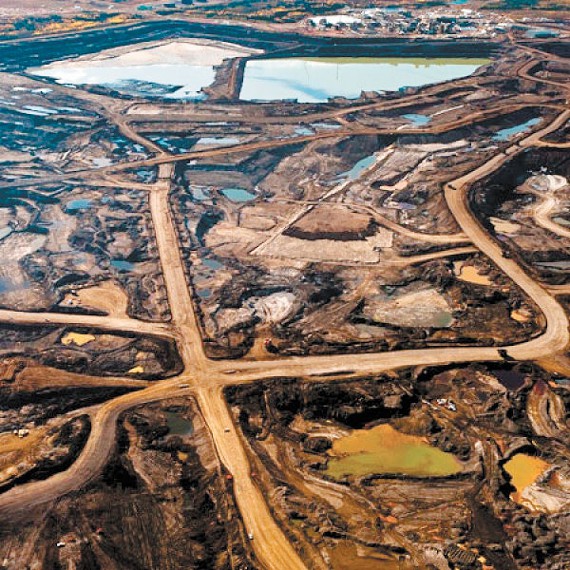
In the opening scenes of the documentary Tipping Point: The Age of the Oil Sands, a helicopter glides over Alberta’s Athabasca River.  Wending through a boreal forest the size of Greece, the river and its attendant countryside is as rugged and beautiful as any in the world.  Then, over a rise, gargantuan smokestacks suddenly spear the sky, lording over a landscape that can only be described as apocalyptic: the single largest source of CO2 emissions in North America.

These are the oil sands, a geological formation in which vast quantities of bitumen lie just below the earth’s crust — the largest proven reserves of oil in the world.

More than 1,000 miles to the south, cities like Moscow and Coeur d’Alene, along the I-90 and U.S. 95 corridors, are front and center in the development’s debate.

Read more: Megawoes on Megaloads

(By Zach Hagadone, Boise Weekly)

Imperial Gets Last of Kearl on Road


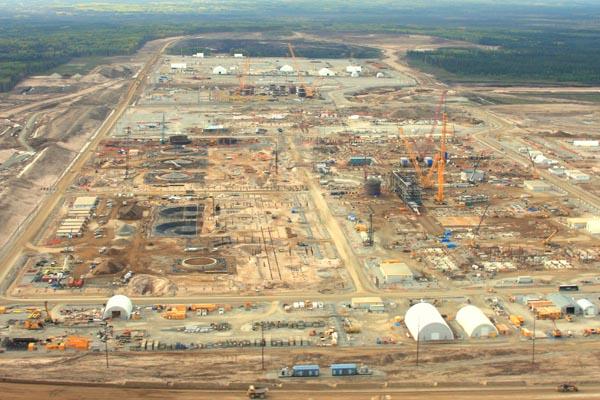
The foundation and underground services are in place at the first phase of the $8-billion Kearl Oil Sands project, seen in a recent aerial photo of the site north of Fort McMurray (Imperial Oil photo).

$11-billion plant on schedule to start up at year’s end

After months of delays, route changes, and extra work to disassemble huge oil sands modules sent from South Korea, the last loads are on the road to Imperial’s $10.9-billion Kearl project.

The final shipment of 33 modules left the Port of Lewiston, Idaho, last week on the way to Edmonton, where they will be reassembled and sent to Fort McMurray.

Meanwhile, about half of the 205 imported modules remain at the Port of Pasco, midway between Lewiston and the Port of Vancouver, Washington.  The Korean units represent about 20 percent of the modules needed for the vast Kearl project.  Almost all of the remainder were constructed in Edmonton-area yards, primarily in Nisku.

The Pasco modules are being disassembled and sent off in batches of two or three shipments twice a week, following a four-lane highway to Spokane, Washington, and Butte, Montana, then north to Alberta on a route that will take them east of Calgary.

“We’ve been moving multiple loads but on fewer nights,” said spokesman Pius Rolheiser.  Imperial has day park locations along the route.

Kearl is scheduled to start up at the end of this year with work now about 90 percent complete.

…Depending on weather and permits, all Pasco modules will be at Kearl by the summer.

…Imperial won’t be building an upgrader at Kearl but is using a patented paraffinic froth treatment system to produce a solids-free bitumen that will be blended with diluent and shipped by pipeline to North American refineries.

…A key feature of Imperial’s plan is to ship the Kearl diluted bitumen on the proposed 500,000 barrels-per-day TransCanada Keystone XL pipeline, which has become a hot political issue in the U.S.

Read more: Imperial Gets Last of Kearl on Road

(By Dave Cooper, Edmonton Journal)
Lakotas and Idahoans Forming Human Roadblocks


Debra White Plume: “If you don’t see the importance of the Lakotas and the Idahoans forming human roadblocks against tar sands contracted trucks in this nation’s heartland, know that those people are putting their lives on the line for this nation’s water and food security.  With all the folks freaking out over foreign terrorists poisoning our food and water supplies in this country, the real threat to our nation’s homeland security is a threat to the water supplies of this nation’s heartland, which produces the bulk of the food you eat throughout the year.”

The Last Two Imperial Oil Megaloads Set to Leave the Port of Lewiston Tuesday


Two Imperial Oil megaloads are expected to leave Tuesday from the Port of Lewiston.

The modules are the last two left at Idaho’s only seaport, according to an email from David Doeringsfeld, manager of the Port of Lewiston.

Two cranes used in handling the extra big shipments at the Port of Lewiston were dismantled last week, Doeringsfeld said in the email.

This could mean that Lewiston will no longer play a role in getting Korean-made components to an Imperial Oil processing plant at the Kearl Oil Sands in Alberta, Canada.

But that’s not entirely clear. Imperial Oil hasn’t confirmed it only has two megaloads left in Lewiston or disclosed what plans, if any, it has for Lewiston in the future.

As always, the Tribune will stay on the story. A photographer will join me at the Port of Lewiston Tuesday to watch the Imperial Oil megaloads depart.

I’ll continue to ask the Idaho Transportation Department and Port of Lewiston officials about any plans that may surface for other megaloads.

(By Elaine Williams, The Lewiston Tribune)

Tar Sands and Its Discontents


On Friday, February 24, Scott Parkin of Rising Tide North America (whom we hosted on our Climate Justice Forum show last week) published the article Tar Sands and Its Discontents in the online journal of “dispatches from the youth climate movement,” It’s Getting Hot in Here.  Scott opens his piece by asking readers, “Besides the story of the massive campaign to stop the Keystone XL pipeline, do you know about the other battles going on around the U.S. to stop the tar sands?”  He then relates Wild Idaho Rising Tide’s (WIRT) numerous rowdy protests, civil disobedience, citizen journalism, and megaload monitoring since last summer in our small town and reveals that, “Now only a few megaloads remain, and WIRT is organizing final actions to challenge Exxon’s supremacy.”  His article also references our Rising Tide colleagues’ work to stop tar sands development “in the red rocked canyons of southern Utah” (please see Utah Tar Sands) as well as Maine opposition to a proposed pipeline flow reversal, which could bring Canadian tar sands to the rocky coast, and unrest throughout the country, where “Big Oil has been modifying and building facilities solely for tar sands refining.”  Scott’s conclusion offers confirmation that WIRT’s actions stand at the forefront of long-overdue rebellions “of die-hard anti-tar sands fighters” against this industry’s “money, corrupt politicians, and institutional power and influence,” with “uprisings against powerful oil interests [not] that far off.”

Please read the rest at: Tar Sands and Its Discontents.

(From WIRT Newsletter)

District Judge Sends Kearl Megaloads Back to MDT for Environmental Review


Late Friday, February 17, 2012, Montana District Judge Ray Dayton upheld his July 2011 preliminary injunction against Imperial Oil/Exxon Mobil’s plan to move megaloads of equipment to the Alberta tar sands via U.S. Highway 12 and Montana Highway 200 in western Montana. He ordered the Montana Department of Transportation to pursue a more extensive environmental review considering alternative routes, the permanence of… two-lane highway turnouts (constructed to clear traffic around megaloads within 10-minute limits), and thus the ultimate impacts of a possible high-wide industrial corridor. As the last few megaloads travel Highway 95 soon, hundreds of these transports are still traversing Interstates 395, 90, and 15 through the Northwest.

Read District Judge Sends Kearl Megaloads Back to MDT for Environmental Review by Kim Briggeman, Missoulian, Montana.

Hearing Officer Recommends OK for Megaloads


More than 200 megaloads of Korean-made oil equipment bound for Canada should be given the go-ahead to roll across northern Idaho’s scenic U.S. Highway 12, an Idaho state hearing officer ruled Monday.

Retired state Judge Duff McKee, in a 63-page ruling, discounted every protest against the megaloads from a group of residents and business owners along the twisting, two-lane highway, from safety to business interruptions to environmental harm.  His ruling is a recommendation to the Idaho Transportation Department; there’s still an opportunity for motions for reconsideration, a process that could take weeks more.

“I conclude there was no error in procedure on the part of ITD in the issuance of the permit in this case, or any other basis to interfere with the executive determinations of the department in issuing the permits in this case,” McKee wrote in his ruling.

Imperial Oil/ExxonMobil wants to ship more than 200 giant loads of oil field equipment across the Idaho highway, en route from the Port of Lewiston to the Alberta oil sands.  The loads are so large that they’ll block both lanes of the two-lane road, creating a rolling roadblock.

Read more: Hearing Officer Recommends OK for Megaloads

(By Betsy Russell, The Spokesman-Review)

Stop the Megaloads Now!


“Monstrous machines over wild and scenic Idaho and Montana highways could destroy the wilderness and roads. … To block Exxon in this deal is to start breaking chains.  This Exxon tar sands obscenity is a prime example of all that is tyrannical and evil in our sick, dead system.  Join us, fight the power, if not for the land, for the water, for the world you live in, then for yourself, because this is the first battle in the fight to free us all…”

(By Paul Edward, ClassWarFilms)

Winona LaDuke Speaking about the Alberta Tar Sands


Winona LaDuke, noted Native American activist and author, speaking recently at the Native American Center at Portland State University.  Winona spoke for about half an hour about the Alberta tar sands and also about the large oil extraction equipment being shipped from South Korea through Portland and along narrow highways though Idaho and Montana.  (www.honorearth.org/stop-tar-sands)