Idaho Gas Lease Auction Protest, Petition, & Preparatio​n


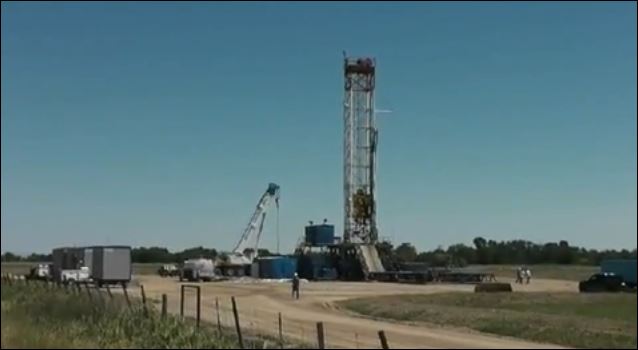
Smoke Ranch Well 7-9-13

Smoke Ranch Well, Payette County, Idaho 7-9-13 (Alma Hasse photo)

On Thursday, April 17, 2014, beginning at 9:30 am MDT, the Idaho Board of Land Commissioners will offer oil and gas leases of state lands and sub-surface mineral rights for sale to the highest bidder, at the director’s office of the Idaho Department of Lands (IDL), 300 North Sixth Street, Suite 103, in Boise, Idaho [1]. IDL periodically conducts these public auctions and administers subsequent leases, with oversight and approval by the Land Board. The 12.5-percent royalty derived from extracted oil and gas raises funds from lands held for the public trust and state wildlife and transportation departments and for specified beneficiary institutions through the state endowment trust. Of the 150 tracts in Ada, Canyon, Gem, Owyhee, Payette, and Washington Counties, 36 parcels are located under or adjacent to the Boise and Snake Rivers and many involve the split estates of private landowners and state mineral holders [2].

Minimum, competitive bids by drilling companies at the oral auction open at only $0.25 per acre for the 17,700-plus acres available for leasing. Successful bidders must pay their bid and the first year’s annual rental of $1.00 per acre for leases lasting up to ten years. If the lease is not drilled or productive, IDL assesses an additional drilling penalty of $1.00 per acre per year starting in the sixth year. The state requires a $1,000 bond for exploration on each lease, which increases to $6,000 prior to drilling, in addition to a drilling permit bond issued by the Idaho Oil and Gas Conservation Commission. Before entry on state lands for seismic exploration, the company must acquire an IDL permit costing $100 per mile across contiguous tracts or a minimum of $100 per section.

The last state lands and minerals auction on January 16, 2014, in Boise, Idaho, generated $694,000 in bids for the state of Idaho [3, 4]. The Idaho Department of Lands leased 8,714 acres for oil and gas drilling – including 4,130 acres in and alongside the Boise, Payette, and Snake river beds – for an average of $80 per acre to the lone bidder, Alta Mesa Idaho. The April 17 auction will double this previously largest amount of Idaho public lands and minerals leased in one period, bringing the total to nearly 98,000 state acres, leased for as low as $2.35 per acre on average, besides the thousands more private acres leased in six southwestern counties [5]. Fourteen drilled but capped wells, awaiting pending pipelines and processing infrastructure, have prefaced the first producing well in Idaho in February 2014, on the Teunissen Dairy near New Plymouth. The Idaho Department of Environmental Quality found toluene from drilling mud in a water well several hundred feet away in fall 2012 [6].

If the people of Idaho own all of these myriad acres of public trust and endowment trust state lands and minerals auctioned for oil and gas exploitation, which respectively “benefit” the general fund and public schools, how can Idahoans influence and determine how our state stewards these shared resources? Allowing the same agency – the Idaho Department of Lands – to both regulate and lease oil and gas development on state holdings seems like a conflict of interest, especially because the Oil and Gas Conservation Commission that oversees industry regulation is politically appointed and receives a 1.5-percent severance tax on oil and gas production for its “responsibility.” At least Idahoans can vote out of office the state’s highest elected officials on the Land Board, for leasing and selling off our precious, impacted lands, resources, and waterways for bargain basement prices.

Because the last five years of frenzied oil and gas rule-making, legislation, drilling, and exploration, centered primarily in Payette County and the Boise halls of government, represent industry’s first forays into Idaho’s still relatively pristine, and thus increasingly valuable, watersheds, the time has now arrived for communities across the state to organize and resist looming drilling, fracking, and acidizing of oil and gas wells. Historic and current fossil fuel development in the state infers that major portions of Idaho are ripe for development and could eventually suffer in the boom-and-bust crosshairs of dirty energy corporations [7]. Please participate in one or hopefully all of these opportunities for citizen protection of our clean air, water, and lands: Continue reading

Comments on the Trendwell West Application to Drill the Smith 1-10 Well


February 12, 2014

Sent via email and attachment

Idaho Department of Lands

Boise Staff Office

P.O. Box 83720

Boise, ID 83720-0050

comments@idl.idaho.gov

Director Schultz and IDL staff,

On behalf of over 2200 members of Wild Idaho Rising Tide (WIRT), I respectfully offer and request inclusion in the public record of these comments concerning the application submitted to the Idaho Department of Lands (IDL) by Trendwell West, Inc. (“Trendwell”) requesting permits to drill the Smith 1-10 well, the first recently proposed oil or natural gas well in Canyon County, Idaho (LU600553 Trendwell West Application for Permit to Drill 2-12-14).

WIRT activists oppose permitting, drilling, and potential hydraulic fracturing (“fracking”) of the proposed Trendwell West Smith 1-10 well, due to the inadequacy and incompleteness of Trendwell’s plans submitted for public review and the potential impacts of the well and its development on human and environmental health and safety.  Considering that corrections to the original, posted application, compelled by Trendwell’s non-compliance with the IDL instructions stated in the application, and additional documents such as the Surface Use Agreement, are currently missing and thus unavailable for public review during the comment period before potential IDL permitting of this application, we request that, if the Trendwell application to drill the Smith 1-10 well is modified or augmented in any way, the Idaho Department of Lands re-open the comment period for this application.  Failure to post this revised application and re-open its public review violates section 51 of IDAPA 20.07.02 Rules Governing Oil and Gas Conservation in the State of Idaho. Continue reading

Payette County P&Z Approves Conditional Use Permits for Alta Mesa


Facilities would allow company to collect and treat natural gas.

Payette County Planning and Zoning Commission (P&Z) members have approved two conditional use permits for two facilities that would allow a natural gas company to collect and treat natural gas.

So far this year, two wells have been drilled in Payette County, and the state has approved a third.  With the approval of these two conditional use permits, the company, Alta Mesa, will be able to sell the natural gas commercially, and Idaho would officially become a gas-producing state.

One of the permits approved by commission members on Thursday was for a hydrocarbon liquid treatment facility near 4303 Highway 30 South in New Plymouth.  This facility would take up nearly six acres of land outside New Plymouth.

The facility would have no liquids open to the atmosphere but held in a sealed, closed container, according to John Peiserich, representing Alta Mesa.

The facility would require a turnaround for 18-wheelers to come through, though Peiserich said the number of trucks would be in the single digits in a week’s time.  A small truck would service the area, and an employee would be present every day, with additional remote monitoring by a computer checking for any fluctuations in the liquids.

A dehydrator would be on the location to extract water vapor from the natural gas.  This dehydrator, which would be out in the open, would run nearly 24 hours per day, seven days per week, Peiserich said.

The size of the dehydrator that would go on the property is built for 40 wells serviced at constant capacity, or approximately 20 million cubic feet of gas per day, Peiserich said. Continue reading

Idaho Global Frackdown 2


FWW Horizontal Global Frackdown 2013 Logo

During the last two Idaho legislative sessions, a majority of our state senators and representatives succumbed to the mercenary ambitions of the oil and natural gas industry and the state of Idaho.  They passed state laws, rules, and regulations allowing hydraulic fracturing or “fracking” that pollutes surface and ground water, sanctioning associated waste injection wells that leak or re-use water wells, permitting seismic testing and gas flaring that jeopardize geologic stability and air quality, granting corporate hegemony over local jurisdictions that undermines democratic oversight of oil and gas facilities, and consenting to drilling on state lands and near or under rivers, wetlands, and wildlife refuges that sustain drinking water, agriculture, and native species [1, 2].

Despite ongoing outcry from thousands of citizens and diligent input from scientists, attorneys, elected officials, and conservation organizations, our delegates have negligently accommodated oil and gas exploration, production, and transportation in Idaho, especially where the state owns the subsurface mineral rights, at the likely expense of their constituents’ health, safety, livelihoods, and self-governance.  In the wake of increasingly erratic weather and horrific oil and gas spills in the flooded South Platte River bottomlands of Colorado, honest, hard-working Idahoans dread the impacts of similar probable scenarios on their families and communities, homes and businesses, and resources and recreation in the Payette River floodplains, where drilling resumed this summer, and in the wild, downstream Snake River canyons [3, 4]. Continue reading

One Gas Well Drilled in Payette County


One natural gas well has been drilled and a second is nearly done in Payette County, as the natural gas industry settles into the local area.

A total of three permits have been submitted to drill wells in the county, with one permit awaiting approval for the third well location.

“It’s going well,” said John Foster, spokesman for Snake River Oil and Gas.  “We’ve been very fortunate to be able to utilize a lot of Idaho businesses and residents in moving forward in drilling.”

The first well, which is located outside of New Plymouth, is completed, Foster said.  You wouldn’t know it is even there, he said.

But one local resident, Alma Hasse, filed a public records request to the Idaho Department of Lands for an oil spill report. Continue reading

Put Residents Above Oil Companies


Linda Widner, Weiser

The Argus Observer 8/29/13

(Washington County) Commissioner Anderson and Commissioner Chandler, I’m writing this letter to ask you why you feel following reasonable ordinances is too much for oil companies?  Are they not a multibillion-dollar industry?

Yes, I agree we need more job opportunities in Washington County.  However, I also believe if the oil company causes damage to land, water, animals, and people, it needs to be responsible to take care of whatever damages it causes.  If it decides to drill on your property and it stirs up methane gas, are you going to pay to fix that problem?  Do you think your insurance company will gladly pay?  I don’t think so.

I recently read an MSN article regarding fracking and how banks and lending agencies are revisiting their lending policies to account for potential impacts of drilling.  Also, home insurance policies do not cover residential properties with gas leases or gas wells.

You, like other politicians, were elected by voters to watch out for our best interests.  Instead, it seems politicians only want the job for their own personal agendas.  Please work for our community.

Smoke Ranch Well Protest 8-2-13


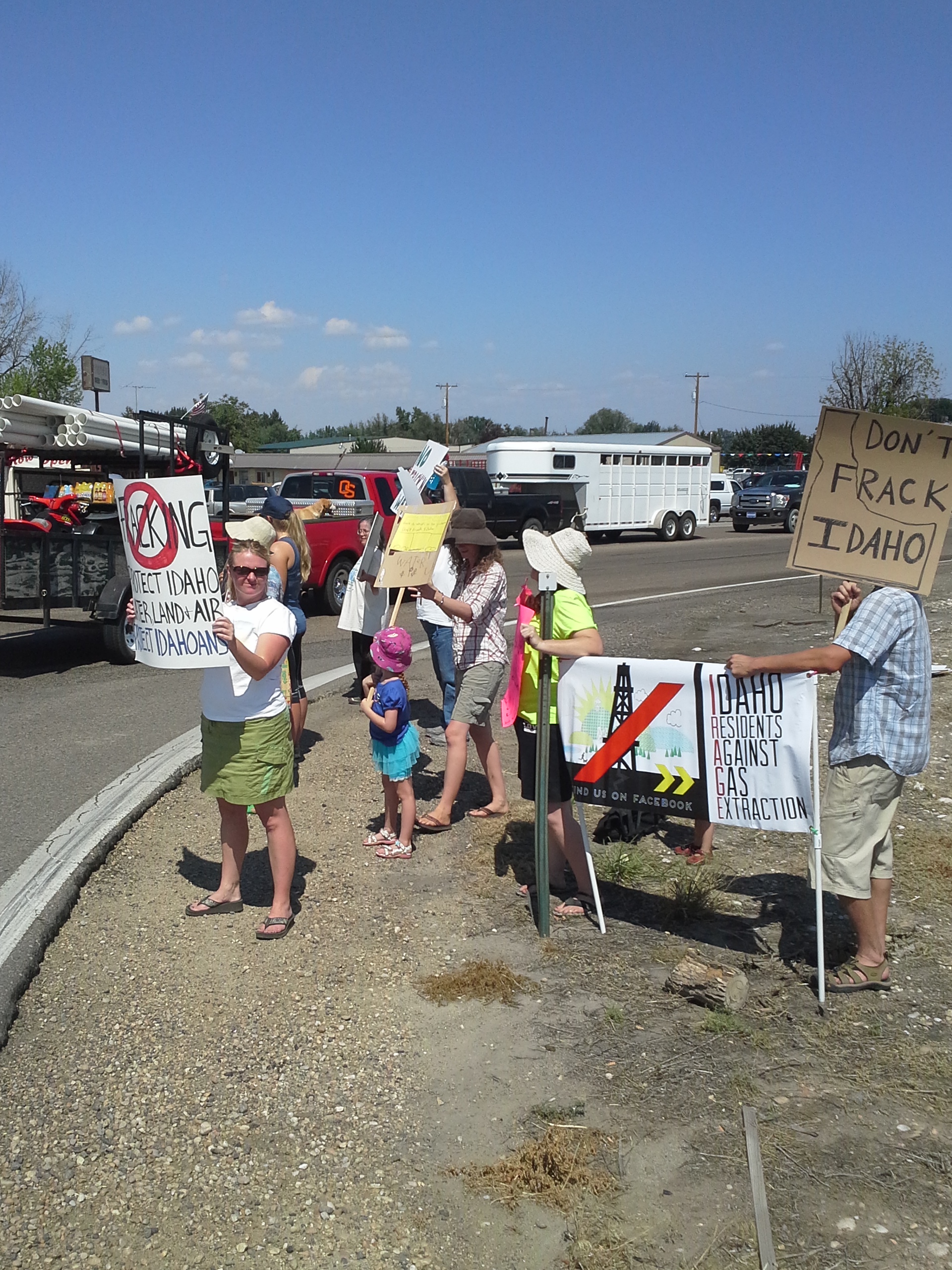
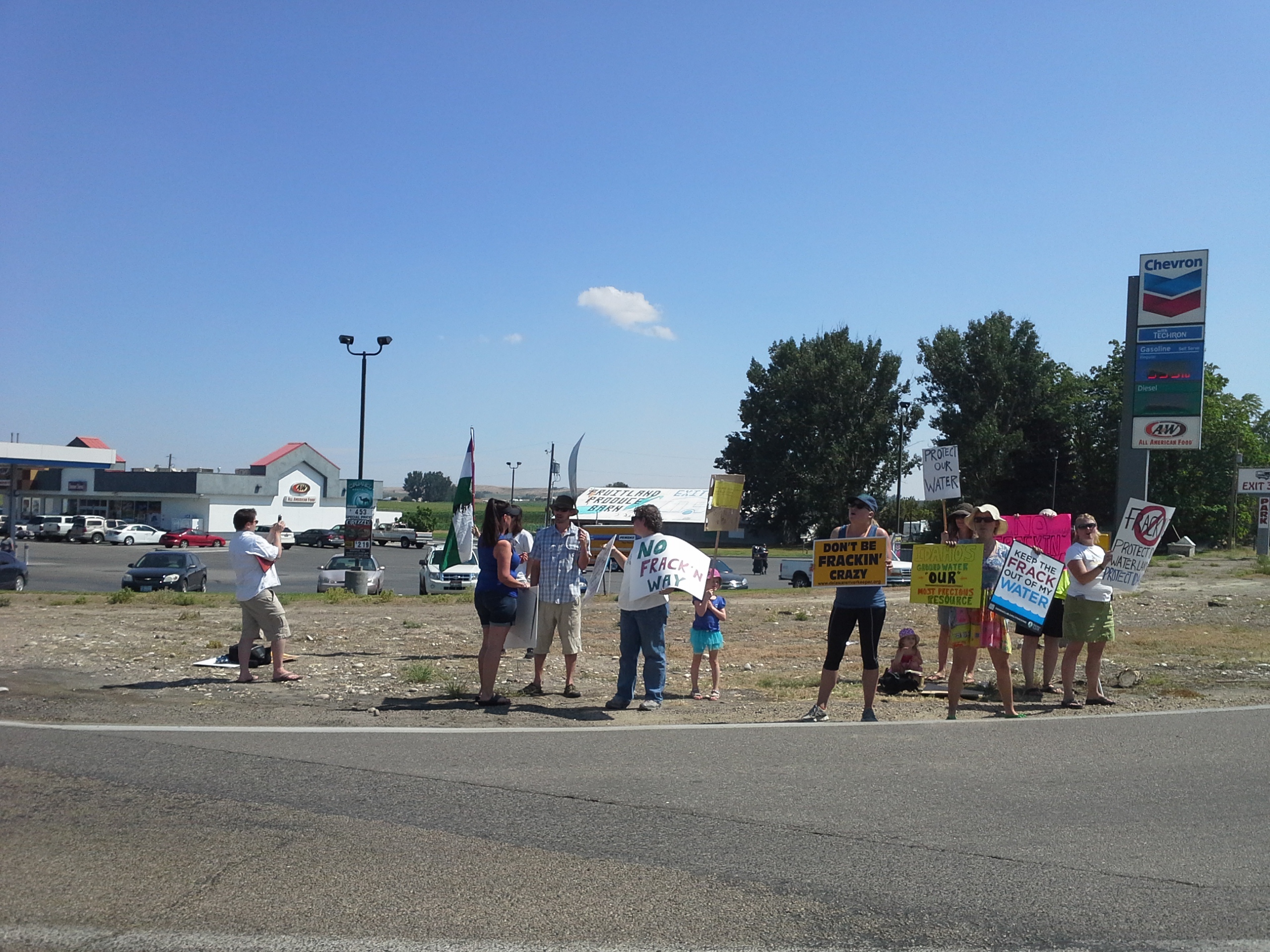
On Thursday and Friday, August 1 and 2, Idaho Residents Against Gas Extraction (IRAGE) and Wild Idaho Rising Tide (WIRT) arranged carpools from north Idaho and Boise to the current Payette County drilling area, to stage the first, overdue, public, on-site, oil and natural gas drilling protest in Idaho history.  With continent-wide recognition through Earth First! Newswire coverage, even Utah comrades called WIRT and considered participation.  At 3 pm MDT on August 2, friends, family, and neighbors gathered with their fracking/drilling protest signs and banners, cameras and binoculars at the A & W Restaurant/Chevron gas station just north of Interstate 84 Exit 3 in southwestern Idaho.  These dozen protesters from across the state and country chanted and waved signs at the nearby high-traffic corner of Highways 95 and 30.  They then followed organizers to the Smoke Ranch well site on Highway 52, from where Alta Mesa Services had moved a drilling derrick to the new ML Investments well pad, soon after the IRAGE/WIRT announcement of this demonstration of outrage.

Along Highway 52, the protesters observed the capped well head and pad of the first directionally drilled natural gas well in the state, located in a floodplain full of standing water, wetlands, riparian areas, and a wildlife refuge, between the Payette River and Big Willow Creek.  The ultimate outcome of the Smoke Ranch well could set a precedent for looming drilling/fracking on and under nearby state lands and waters already leased by Alta Mesa and Snake River Oil and Gas.  From the roadside only a few miles upstream from the City of Fruitland municipal water intake and the Payette/Snake River confluence, IRAGE activists had monitored the well site daily.  On that sunny August afternoon, the first time that many of the demonstrators had seen Idaho oil and gas facilities, Alma Hasse of IRAGE described the prior activity and equipment at the well site, and pointed out the location of a possible diesel fuel or drilling mud spill clean-up that she and Tina Fisher documented on July 21.  Everyone also noticed the close proximity of working ranches and community irrigation canals to the well situated below distantly recognizable sandstone cliffs and bluffs.

At the last stop during this great educational and expressive event, concerned citizens converged along Little Willow Road, to view the derrick and operations of the ML Investments 2-10 well, situated on a private road and property.  No news reporters joined the protesters as they considered, discussed, and learned about the strong, impending possibilities of compromised air and surface and ground water quality, threatened environmental and human health, and jeopardized local agricultural, recreational, and economic productivity, which oil and gas exploration and production of the Hamilton/Willow gas field could impose on the surrounding rural landscape.  Participants talked about a looming third new well since drilling resumed after a few years in June, as well as a proposed pipeline connecting Payette County gas wells to Idaho Power Company’s Langley Gulch natural gas-fired power generation plant near New Plymouth.  As industry and government continue to hide their fracking intentions for the region, which do not require public notice or comments and could spur well treatments soon, several state, county, and city police cruised by or chatted with demonstrators at all three sites visited on that Friday.

Protest at Smoke Ranch Well (July 29 Earth First! Newswire)

Protesters from across the state and country chant and wave fracking/drilling protest signs at the high-traffic corner of Highways 95 and 30 near Interstate 84 Exit 3 in southwestern Idaho.

Protesters from across the state and country chant and wave fracking/drilling protest signs at the high-traffic corner of Highways 95 and 30 near Interstate 84 Exit 3 in southwestern Idaho.

Protesters from across the state and country chant and wave fracking/drilling protest signs at the high-traffic corner of Highways 95 and 30 near Interstate 84 Exit 3 in southwestern Idaho.

Protesters from across the state and country chant and wave fracking/drilling protest signs at the high-traffic corner of Highways 95 and 30 near Interstate 84 Exit 3 in southwestern Idaho.

Protesters from across the state and country chant and wave fracking/drilling protest signs at the high-traffic corner of Highways 95 and 30 near Interstate 84 Exit 3 in southwestern Idaho.

Protesters from across the state and country chant and wave fracking/drilling protest signs at the high-traffic corner of Highways 95 and 30 near Interstate 84 Exit 3 in southwestern Idaho.

Protesters from across the state and country chant and wave fracking/drilling protest signs at the high-traffic corner of Highways 95 and 30 near Interstate 84 Exit 3 in southwestern Idaho.

Protesters from across the state and country chant and wave fracking/drilling protest signs at the high-traffic corner of Highways 95 and 30 near Interstate 84 Exit 3 in southwestern Idaho.

Protesters observe the capped well head and pad at the Smoke Ranch site south of Highway 52, the first directionally drilled natural gas well in the state, located in a floodplain full of standing water, wetlands, irrigation canals, riparian areas, and a wildlife refuge, between the Payette River and Big Willow Creek, only a few miles upstream from the City of Fruitland municipal water intake and the Payette/Snake River confluence.

Protesters observe the capped well head and pad at the Smoke Ranch site south of Highway 52, the first directionally drilled natural gas well in the state, located in a floodplain full of standing water, wetlands, irrigation canals, riparian areas, and a wildlife refuge, between the Payette River and Big Willow Creek, only a few miles upstream from the City of Fruitland municipal water intake and the Payette/Snake River confluence.

Continue reading

Commissioners Pass Gas and Oil Ordinance with Amendments


New ordinance reduces 500 foot setback

Payette County Commissioners passed a gas and oil drilling ordinance after a public hearing on Monday at the courthouse.

They heard testimony from Payette County residents, who mostly said the ordinance needed to expand the setback from 200 feet in the new proposed ordinance to the 500 feet that it had been in the previous ordinance.

Several testified that a neighbor who signs a lease allowing drilling to be done on his or her property would force another neighbor to endure the drilling, despite their possible refusal to sign a lease.  They said that 200 feet is not an adequate distance.

New Plymouth resident Tina Fisher said that if one neighbor signs a lease but the other neighbor doesn’t want to, it is unfair to that neighbor.  “Two-hundred feet is woefully inadequate,” Fisher said. Continue reading

Smoke Ranch Well Protest


Gas Well with Bluffs

As oil and gas drilling resumed in Payette County this month after a few years, Alta Mesa Services raised a derrick at the Smoke Ranch natural gas well on June 9 [1].  This directionally drilled well – the focus of the intensive Stop the Frack Attack! campaign of Wild Idaho Rising Tide (WIRT) and Idaho Residents Against Gas Extraction (IRAGE) during June – embodies the myriad infringements of environmental and human health that conventionally-drilled and hydraulically-fractured (“fracked”) oil and gas wells famously impose [2].  The Smoke Ranch well occupies a floodplain, where operators pumped standing water from the well pad before drilling between the Payette River and Big Willow Creek, within a half-mile of a riparian area/wetland wildlife refuge, and only a few miles upstream from the City of Fruitland municipal water intake and the Payette/Snake River confluence.  Its ultimate outcomes could set a precedent for looming drilling/fracking on and under nearby state lands and waters already leased by Alta Mesa and Snake River Oil and Gas.  IRAGE activists have been monitoring the site daily and, along with other information sources in the southwest Idaho region, have observed multitudes of hidden equipment, transport trailers, drill pipes, and well pads awaiting likely escalating utilization, as well as water for Smoke Ranch operations withdrawn from irrigation canals.  They have recently taken unreleased pictures and videos of several Schlumberger tank trucks covered with radioactive warning placards. Continue reading

Gas Exploration Benefits Southwest Idaho Farmers


Snake River Oil and Gas officials explain details of gas exploration in southwest Idaho last fall, during a legislative tour.  Many farmers and ranchers stand to benefit from the drilling and exploration taking place in the region (Capital Press/industry photo).

Snake River Oil and Gas officials explain details of gas exploration in southwest Idaho last fall, during a legislative tour. Many farmers and ranchers stand to benefit from the drilling and exploration taking place in the region (Capital Press/industry photo).

Now that seismic testing has proven what folks in this area have known for decades – there is a substantial amount of natural gas below them – farmers, ranchers, and other landowners in this region are beginning to reap the benefits.

“You talk to any farmer or rancher whose family has been over there for a couple of generations, and everybody has stories of methane in their well water or bubbling up from a creek,” John Foster, a spokesman for the Idaho Petroleum Council, said.

While it’s been clear for many years that there is natural gas in that area of southwest Idaho, the infrastructure never existed to retrieve and transport it to market economically.  But a major seismic exploration project by Snake River Oil and Gas last year is changing that.

The company says there are substantial natural gas deposits in an area known as a “play” that stretches from part of Canyon County through New Plymouth, Fruitland, and Payette in Payette County, and up into Weiser in Washington County.

It’s is beginning to drill wells, and the gas will be transferred via a major, multi-state, gas pipeline that passes near New Plymouth.

Read more: Gas Exploration Benefits Southwest Idaho Farmers

(By Sean Ellis, Capital Press)