WIRT Response to Idaho Department of Lands Media Counter-Release


Wild Idaho Rising Tide (WIRT) organized several upcoming statewide protests and commented against Alta Mesa Services’ (AMS) plans to drill the Smoke Ranch natural gas well on private land in Birding Island, Payette County.  In response to nationwide WIRT publicity of this gas extraction scheme, the Idaho Department of Lands (IDL), the administrative arm of the Idaho Land Board and Oil and Gas Conservation Commission authorized to both lease lands and consider and permit such drilling on them (conflicting roles?), released a Fact Sheet for Media with information that counters WIRT assertions and displays alarming duplicity.

No Fracking?

Even though IDL states that “oil and gas resources in Idaho generally do not have the [fracking?] issues with extraction that have been reported over the last few years in other states,” they likely will experience these problems, considering the mercenary objectives of oil and gas companies and the state’s conflict of public interest as the major holder of subsurface mineral rights in the target region.  State rules “include the requirement that an operator must disclose all materials used for well treatments and fracking [if they are not proprietary brews], and to inform the state of where it will dispose of fracking fluid.  Disposal could include the recycle and reuse of the fluid for the fracking process.”  If Idaho resources do not require fracking, why has the state established rules about it?

“Small Frac Jobs”?

“The IDL has received no applications to date for hydraulic fracturing.  However, approximately half of the currently completed [eleven] wells in Idaho will need a SMALL FRAC JOB to clear the drilling mud from the POROUS reservoir rocks.  This frac job is estimated to be only about three percent of the size of frac jobs performed to extract oil or gas from shale, as is currently being done in North Dakota, Pennsylvania, and other places outside Idaho.  This means they would only be using thousands of gallons of water and not millions…”  This IDL statement represents written proof that Idaho is about to be fracked in a similar although smaller way as the places most poisoned by this risky extraction method. Continue reading
WIRT Comments to the Idaho Department of Lands on Alta Mesa Services’ Permit Application for Drilling Well 1-21


The 1500+ members of Wild Idaho Rising Tide (WIRT) oppose Idaho Department of Lands (IDL) permitting of the Alta Mesa Resources (AMS) application to drill well number 1-21 of the Smoke Ranch lease on Birding Island in Payette County, Idaho.  We are concerned that AMS drilling through subsurface shale would require utilization of hydraulic fracturing (“fracking”) in close proximity to the Payette River, Big Willow Creek, and their confluence and surrounding floodplains and wetlands.  Even without fracking, the majority of drinking water contamination problems across the United States have arisen from natural gas and oil drilling and improper well casing construction: Approximately half of all oil and gas well casings fail within twenty years.  Surface water contamination can carelessly occur from the fluids that result as a byproduct of this kind of drilling: the deeper the well, the more radioactive the returning material.

Furthermore, if the Smoke Ranch 1-21 well proves productive during this first foray into the deeper Willow gas field, Alta Mesa Services, Snake River Oil and Gas (SROG), and their peers, backed only by questionable financial resources, could drill in the state lands (leased by IDL at ridiculously low rates) along the Payette River.  With only expensive, exploratory progress in the southwestern Idaho target area that geologists have stated holds very little oil and gas resources, AMS and SROG drilling in riverine places most vulnerable to water contamination is not in the best interests of the health and safety of Idahoans and the environment upon which we rely for our economic activities.  Moreover, oil and natural gas resources in Idaho can only be developed and moved to market with great difficulty and cost, due to lack of existing infrastructure. Continue reading

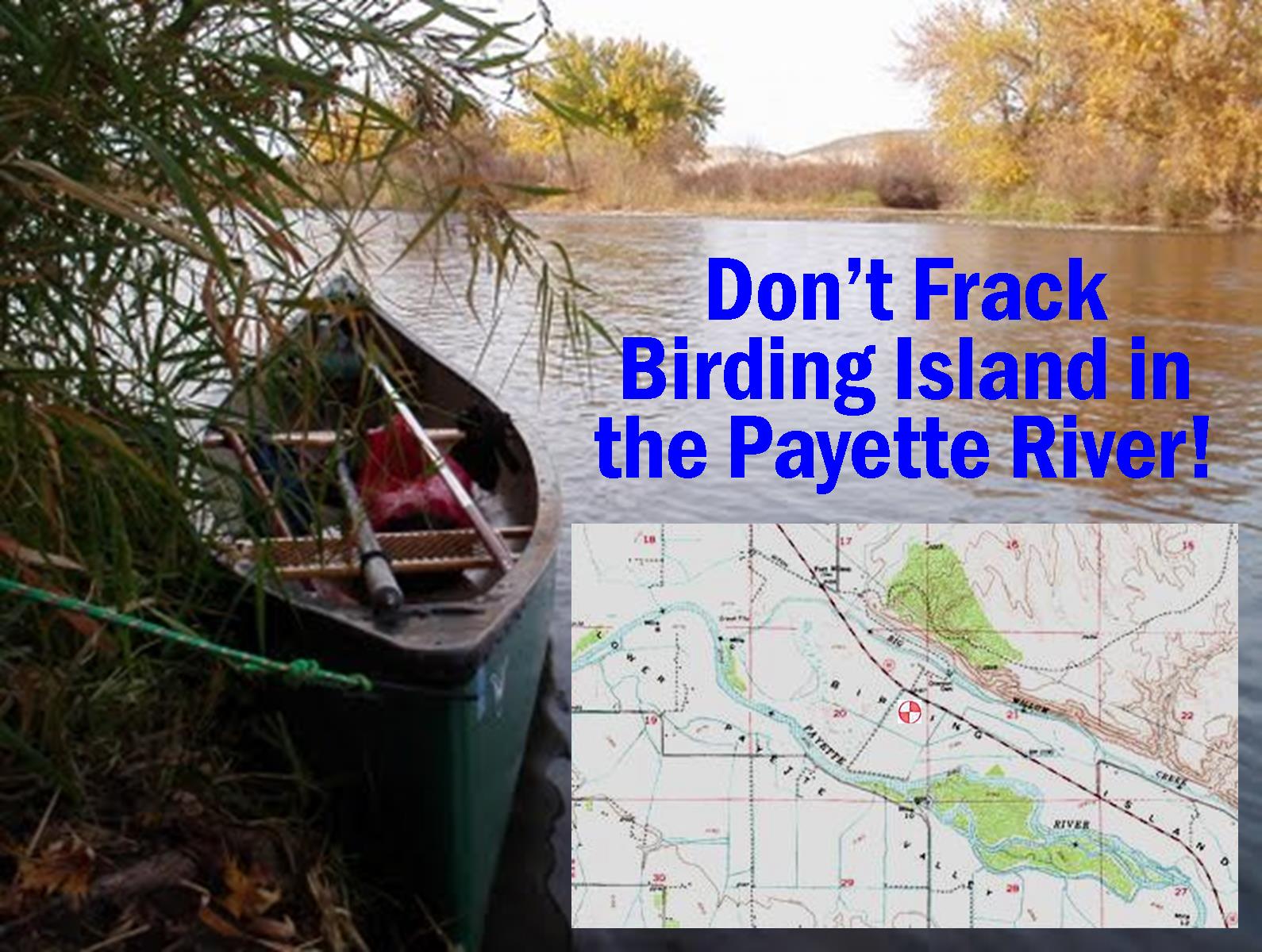
Don’t Frack Birding Island in Idaho’s Payette River


The Idaho Legislature’s changes to the state’s ballot initiative process will make it harder to change laws from the grassroots up and have stymied efforts to launch a statewide hydraulic fracturing and waste injection ballot initiative.

This year, Gem State lawmakers passed SB 1108, making it more difficult to gather enough signatures to push successful petition campaigns.

Currently, petitioners are required to collect six percent of registered voters’ signatures statewide.  Under the new law taking effect July 1, petitioners must collect six percent of registered voters’ signatures from a minimum of 18 of the state’s 35 legislative districts.

Read more: Don’t Frack Birding Island in Idaho’s Payette River

(By Blair Koch, Earthworks Earthblog)

Stop the Frack Attack, Idaho


Idaho activists are concerned that Alta Mesa Services (AMS) of Houston, Texas, could hydraulically fracture rocks almost a mile underground to obtain natural gas and oil.  AMS submitted an application to the Idaho Department of Lands (IDL) on April 30, for a permit to directionally drill a natural gas well under Highway 52 in Payette County, Idaho, using a lease to the mineral rights under Smoke Ranch.

Like the 11 wells sunk by Bridge Resources in 2010 and 2011 through the “tight” gas sandstone formation of the Hamilton field under Payette River bottomlands (at about 1,400 to 1,750 feet), this well represents another incursion into the Willow gas field.  This deeper of two potential plays in southwestern Idaho lies beneath the lowlands, hills, and buttes surrounding the agricultural communities of New Plymouth and Fruitland, below the Hamilton sandstone and underlying shale, at depths between 4,500 and 5,800 feet in sands over basalt.

Read more: Stop the Frack Attack, Idaho

(By EcoWatch, from a Wild Idaho Rising Tide media release)

Stop the Frack Attack, Idaho!


Don’t Frack Birding Island

Alta Mesa Services (AMS) of Houston, Texas, submitted an application to the Idaho Department of Lands (IDL) on April 30, 2013, for a permit to directionally drill a natural gas well under Highway 52 in Payette County, Idaho (1).  Unlike the eleven wells sunk by Bridge Resources in 2010 and 2011 in the shallower (1400 to 1750 feet), “tight” gas sandstone formation of the Hamilton field under Payette River bottomlands, this well represents the first incursion into the Willow gas field.  This deeper of two potential plays in southwestern Idaho lies beneath the hills and buttes surrounding the agricultural communities of New Plymouth and Fruitland, below the Hamilton sandstone and underlying shale, at depths between 4500 and 5800 feet in sands over basalt.  Idaho activists are concerned that the company could hydraulically fracture (“frack”) rocks almost a mile underground, like drilling practices used to extract hydrocarbon deposits from shale formations, to obtain natural gas and/or oil from this Smoke Ranch lease of mineral rights.

A dangerous method of oil and gas well stimulation, fracking forces millions of gallons of pressurized water and toxic substances down wells to crack subsurface rocks and release small, substandard pockets of oil and natural gas.  In dozens of states across the country, this process has produced hazardous, radioactive wastewater, contaminated air and water, generated cancer-causing pollution, compromised human and environmental health and safety, and released greenhouses gases causing climate change.  Earthquakes triggered by fracking’s explosive charges and wastewater well injections could exacerbate Idaho’s fifth greatest amount of seismic activity in the nation and consequently shatter the mechanical integrity of such inherently toxic oil and gas wells.

The proposed Smoke Ranch well would drill and potentially frack Birding Island, within the extensive wetlands and floodplain confluence of the Payette River and Big Willow Creek, only a few miles upriver from the City of Fruitland drinking water intake and the Payette/Snake River convergence (2).  Under the surrounding landscape full of farms, ranches, livestock, and wildlife dependent on clean surface streams and irrigation canals, aquifers only 660 feet deep perch, without much distance or barriers, over gas-bearing zones in porous layers punctured by drilling activities. Continue reading

Climate Justice Forum: Alma Hasse & Tina Fisher 2-4-13


On the Monday, February 4, Climate Justice Forum radio program, Wild Idaho Rising Tide (WIRT) again welcomes Alma Hasse and Tina Fisher of Idaho Residents Against Gas Extraction, talking about natural gas developments and resistance in southwest Idaho.  As the legislature approves state oil and gas commission appointments by the governor and industry-compromised injection well regulations, citizens are crafting a statewide petition to ban toxic drilling practices and are voicing their concerns about private and state land leases (even UNDER the Payette River), flaring and seismic testing impacts, and impending fracking, waste wells, and pipelines.  WIRT invites listeners to share their insights during the show broadcast on KRFP Radio Free Moscow between 7:30 and 9:30 pm PST live at 92.5 FM and online, by calling the station studio at 208-892-9200.  Thanks to the generous, anonymous supporter who adopted program host Helen Yost as his KRFP DJ, the show also covers continent-wide dirty energy schemes and climate activism news.

Rebuttal to Snake River Oil and Gas Could Start Drilling in Payette County this Spring


Brad,

It would have been fantastic if you had given a bit of time to some of the local citizens opposed to this development!

Industry has been very successful at convincing everyone else across the state that they do not have anything to worry about – that they are just going to operate a few wells in Payette and Washington counties and that they are not going to frack (at least, that is what we were told originally).

The problem is that does not exactly jive with what they have been doing these past couple of years.

Idaho House Bill 464 went through the legislature last year and totally strips the municipal governments of ANY control over the siting of oil and gas wells in Idaho.  What used to be a process that involved an application to the city/county – a formal public notice and public hearing process – has now became a rubber-stamp process at the state level.  There are only two ways that the state can deny a well permit: if there would be a wasting of the resource and/or if groundwater would be contaminated.  Good luck proving that water will be contaminated BEFORE it happens!  And if it happens – because the state is not requiring ANY baseline testing of well water in the drilling areas – it would be this side of impossible to PROVE that well water was contaminated by drilling activities!  Just ask Mr. Brown if Snake River Oil and Gas or AM Idaho did ANY baseline testing of area water wells.  Ask him if they are required to do any testing! Continue reading

Snake River Oil and Gas Could Start Drilling in Payette County this Spring


Snake River Oil and Gas is testing three of its gas wells in Payette County.  Gas left over from the testing is flared off.

While 2012 was a year of acquisition and information gathering for Snake River Oil and Gas, 2013 is poised to be a year of drilling for natural gas in southwestern Idaho.

“We will probably start drilling in the spring,” said Richard Brown, CEO of Snake River Oil and Gas.  His company has close to 130,000 acres of gas and oil leases in Payette and Washington counties as well as seven productive wells.  Snake River bought the wells last year from Bridge Resources, which initially drilled the productive wells.

Along with buying the wells and negotiating leases with landowners, Snake River spent $14 million last year exploring its new holdings, using large, earth-shaking trucks and high tech sensors in the ground to get three-dimensional data on how natural gas is situated underground.  That data is still being analyzed.  It looks promising, according to company officials.  Now the company is testing three of its seven wells to learn more about the gas reservoir underneath the wells.  After that could come drilling to extract that gas.

If all goes well, the next step for the drillers would be building a pipeline to connect the wells.  They are close to the multi-state gas pipeline as well as Idaho Power’s new Langley Gulch gas-fired power plant near New Plymouth.  Brown speculates that pipeline work could start in the summer. Continue reading

Fracking Brothers Buy Chunk of Idaho County


With latest purchase, Texans own 35,934 acres

GRANGEVILLE – The recent purchase of a 17,947-acre ranch on the Doumecq Plains southwest of Grangeville likely makes the two Texas billionaire brothers who bought it the second-largest landowners in Idaho County.

Farris C. Wilks, 60, and Dan H. Wilks, 56, of Cisco, Texas, bought the Delos Robbins Ranch in December.  In January 2011, the brothers bought the 17,987-acre Hitchcock Ranch in the same area.

With a total of 35,934 acres, that ranks the brothers just behind Western Pacific Timber Company in total county holdings, Idaho County Assessor James Zehner said.  Western Pacific owns about 38,000 acres in the Upper Lochsa region of Idaho County. Continue reading

Natural Gas Well Testing in Payette County


Natural Gas Flaring [Larger] - Argus Observer

Natural gas is burned off at a test well on Friday morning, January 4, 2013, just outside New Plymouth (Argus Observer/Cherise Kaechele photo).

People looking or driving northeast of New Plymouth or east of Payette need not be concerned about fire they are seeing, as the flames are the result of natural gas well testing, the latest step in an effort to begin getting production started in Payette County.

Richard Brown, CEO of Snake River Oil and Gas, said the testing will go on for two to three weeks.

Snake River Oil and Gas, in partnership with Alta Mesa Holdings, purchased the assets of Bridge Resources last year, including 11 wells, seven of which have production capability, Brown said.

Three of the wells are now under intensive testing, which will help company officials understand the size of the reservoir and will be indicative of the production of the other four wells, Brown said.

The companies have approximately 300 to 400 oil and gas leases on about 130,000 acres with a number of landowners, he said.  Seismic work was conducted in the area last fall, ending in November, Brown said. Continue reading