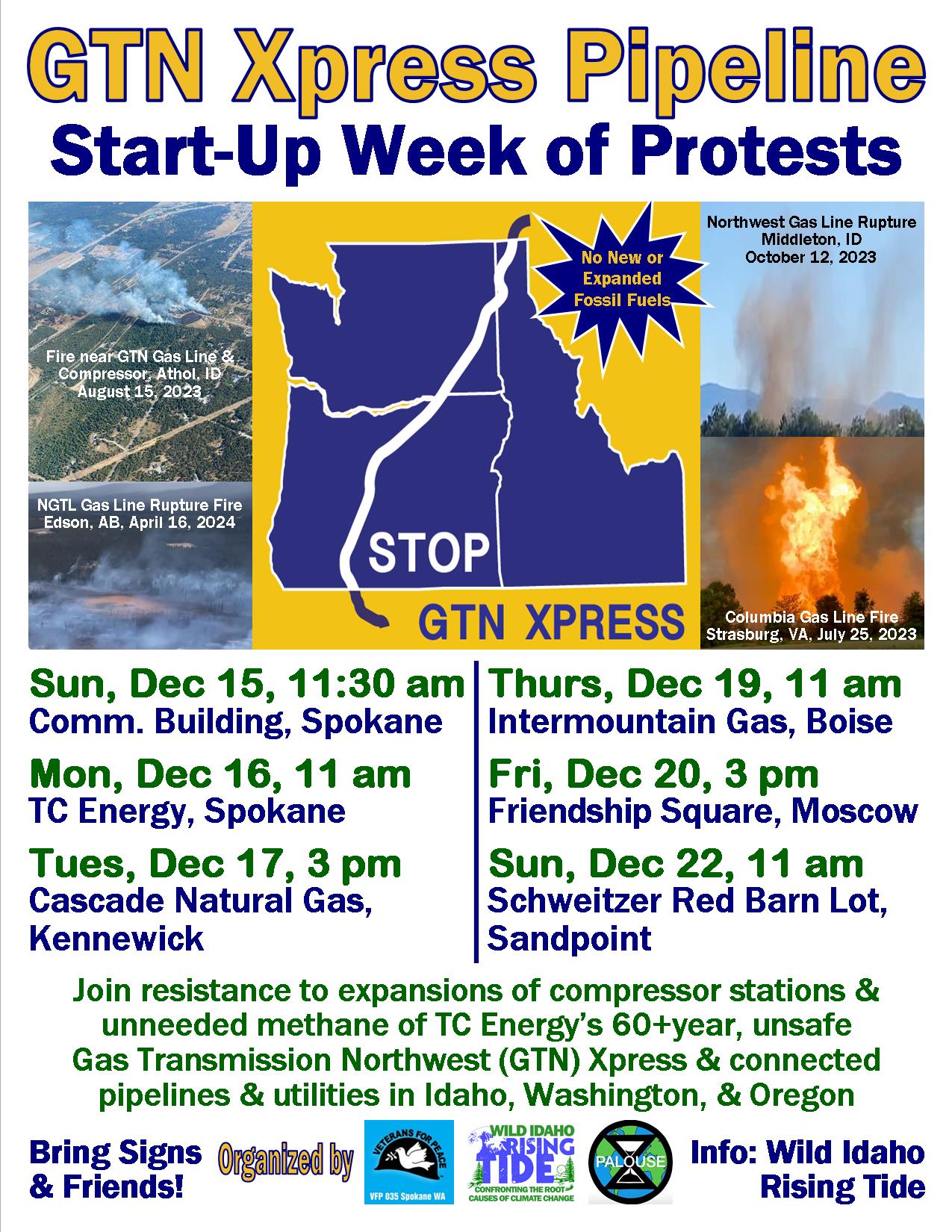
In July 2024, Gas Transmission Northwest (GTN) began larger replacement construction of its pipeline compressors in Starbuck, Walla Walla County, Washington, and Kent, Sherman County, Oregon, near Bend, for its GTN Xpress pipeline expansion moving increased methane volumes and pressures through its dangerously corroded (according to whistleblowing inspectors), 63-year pipeline across north Idaho, eastern Washington, and central Oregon. During the same month, it started pumping one third of its expansion capacity, 50 million of 150 million cubic feet of additional gas per day. GTN finished Kent compressor “auxiliary facilities” and obtained Federal Energy Regulatory Commission (FERC) permission to bring them online for existing GTN volumes on November 22. On December 2, GTN requested FERC approval to start using the full capacity of the upgraded GTN Xpress pipeline on Wednesday, December 11. FERC predictably granted entire GTN Xpress start-up on Thursday, December 12, as Starbuck compressor installation and site restoration neared completion.
Meanwhile, the fate of GTN Xpress remains unresolved by litigation in the Fifth Circuit Court of Appeals in oil industry friendly Texas. Among case opening briefs filed on October 28, GTN complains that its replacement facilities did not garner the usual FERC predetermination of “rolled-in rates” afforded similar projects. These rates allow gas shippers to pass the costs of their expansions onto all regional utility customers, whether they receive the extra methane or not. Stop GTN Xpress coalition member groups Columbia Riverkeeper and Rogue Climate assert that FERC violated federal laws by refusing to consider a “no action” alternative to GTN Xpress, by segmenting its administrative review, and by failing to disclose the safety risks of pipeline expansion. And state attorneys general of Washington and Oregon argue that FERC excluded compressor upgrade expenses from GTN Xpress costs and relied on unexplained public benefits and GTN agreements with utilities to falsely predict future gas demand, causing consumers to bear pipeline expansion costs for several decades.
Despite GTN discovering pipeline anomalies in November, which reduced flows in north Idaho, GTN Xpress started pushing extra methane this week. Fracked gas infrastructure expansions like GTN Xpress jeopardize the health, safety, and lands of not only concerned Northwest communities, but also the people and places around source gas wells and pipelines in western Canada. All these facilities inflict public and environmental harms, pollute shared global air and water, worsen climate change, risk explosive ruptures and fires, and force energy users into decades of fossil fuels dependence. Clean, renewable energy offers less expensive and hazardous options that create sustainable jobs and a healthier future.
In response to reckless GTN Xpress approval and start-up, Wild Idaho Rising Tide (WIRT) and appreciated allies Extinction Rebellion (XR) Palouse, Spokane Veterans for Peace Chapter 35, and visiting climate activists invite you to join in rejecting Northwest fossil fuels expansions, by participating in a week of protests at GTN’s parent company, TC Energy, the two gas utilities receiving GTN Xpress methane, and other locations in five inland Northwest cities along and beyond the pipeline route: Continue reading



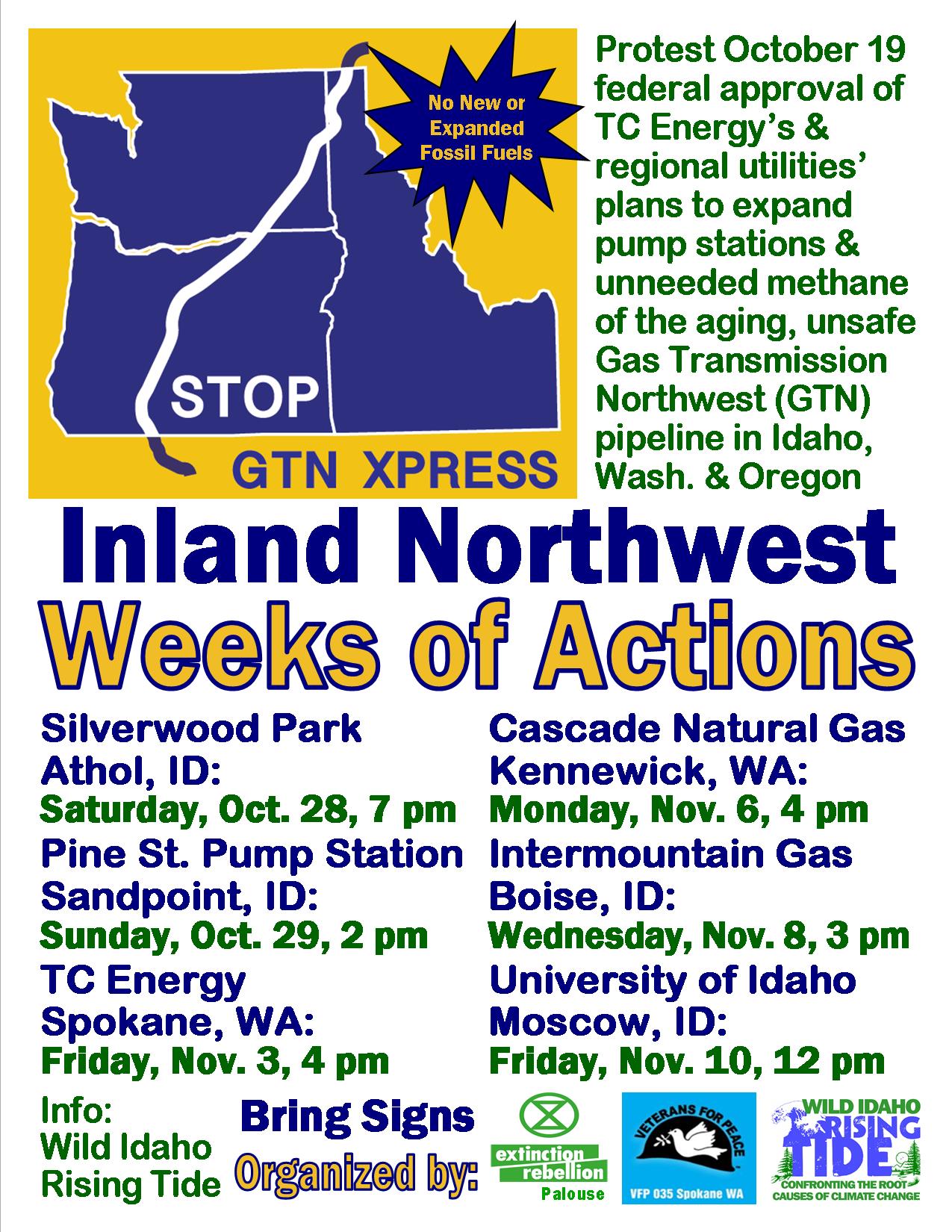 On October 19, the Federal Energy Regulatory Commission (FERC) approved the Gas Transmission Northwest (GTN) Xpress expansion of an unsafe, potentially explosive, six-decade-plus, methane (“natural” gas) pipeline across Idaho, Washington, and Oregon to California [1-7]. The Calgary, Alberta-based, Canadian owner of the rejected Keystone XL and rupture-prone Keystone tar sands pipelines in the Great Plains and the fiery Columbia Gas Transmission line in the northeast U.S., TC Energy (formerly TransCanada) proposes to increase the pump pressures of three compressor stations in Athol, Idaho, Starbuck, Washington, and Kent, Oregon, and push an additional 150 million cubic feet per day of unneeded, fracked gas volumes through the almost 1,400-mile-long GTN line from Eastport, Idaho, to Malin, Oregon, suspiciously the origin point of the defeated Pacific Connector gas pipeline to the also vanquished Jordan Cove liquefied natural gas (LNG) export terminal planned for Coos Bay, Oregon [8, 9].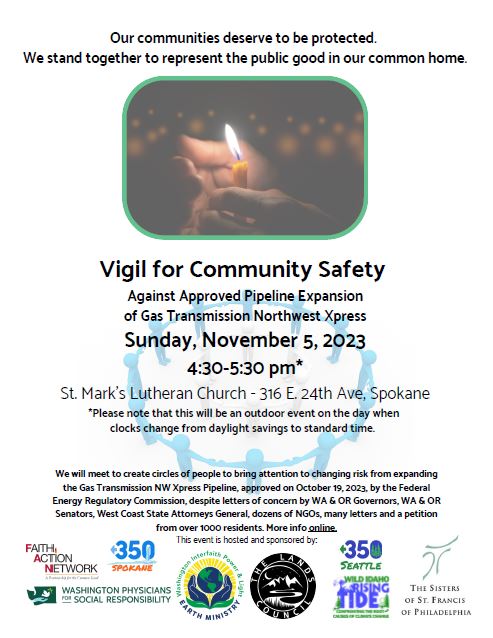
 On Monday, July 31, through Friday, August 4, Kalispel and regional tribal members and the River Warrior Society are holding the annual Remember the Water Kalispel Powwow canoe journey [1, 2]. The paddle usually voyages from Lake Pend Oreille and Qpqpe (Sandpoint), Idaho, to the Qlispe (Kalispel) Village in Cusick, Washington, during the week before the yearly Kalispel Powwow and around the time of the Festival at Sandpoint music concerts. In this cultural journey, families and friends are again paddling in traditional, dugout, wooden and sturgeon nose canoes, like their ancestors did for travel, fishing, and fun, over 50 miles through their home lands and waters among the tributaries, lake, and river of the Pend Oreille watershed.
 WHAT THE FERC?!
 On Wednesday evening, April 12, in Spokane, Washington, faith, spiritual, health, and environmental advocates will lead a community gathering, teach-in, and procession in opposition to the proposed Gas Transmission Northwest (GTN) Xpress fracked gas pipeline expansion [1]. The 62-year-old GTN pipeline runs under the Spokane River and through Liberty Lake, Spokane Valley, and other parts of Spokane County [2, 3]. Canadian company TC Energy, owner of the leaking Keystone and rejected Keystone XL tar sands pipelines, and its subsidiary GTN threaten to pump up to 150 million cubic feet of additional methane gas per day through the GTN pipeline that crosses north Idaho, eastern Washington, and central Oregon.
 Wild Idaho Rising Tide