Third Idaho Oil & Gas Lease Auction Protest


idaho-oil-gas-lease-tracts-for-auction-10-19-16

On Wednesday morning, October 19, southwest Idaho activists and Wild Idaho Rising Tide (WIRT) are holding the third protest of a state oil and gas lease auction.  The Idaho State Board of Land Commissioners is selling 225 oil and gas leases of state lands and minerals at another public auction in Suite 103 Syringa North and South Conference Rooms at the Idaho Department of Lands (IDL) offices, 300 North Sixth Street in Boise, Idaho [1].

Before bidder arrival for registration begins at 8:30 am MDT for the 9 am auction, gather with us at 8 am at the east side of Capitol Park, across the street from IDL, and then on the public sidewalk in front of the main IDL west entrance.  Please bring your posters, signs, chants, and songs objecting to further liquidation of state resources for private industry profit, despite state-perceived benefits for public agencies, institutions, and programs.  See descriptions of the last two state oil and gas lease auction protests for ideas about messages and tactics to challenge this first such state auction in over two years [2-5].

The state of Idaho has already, currently leased tens of thousands of surface and subsurface acres to only a few companies, for looming oil and gas drilling and potential hydraulic fracturing, acidizing, and other risky well stimulation treatments.  Since 2009, Bridge Resources and its more aggressive successor, Alta Mesa of Houston, Texas, have drilled or received state permits for dozens of wells, planning more dirty energy development for the Treasure Valley and elsewhere in Idaho than the company ever reveals.

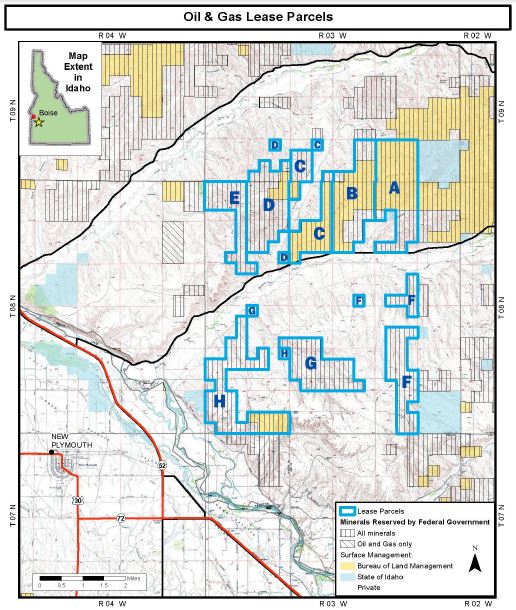
Apparent from the strange placement of bargain priced lease parcels, shown in the maps of this October 19 round of IDL auctions, the latest scheme of Alta Mesa and bidder accomplices may involve visions of corridors for access, transportation, pipelines, or other infrastructure.  The state is almost giving away 4,404 acres in seven counties as 82 oil and gas leases in Canyon County, 73 in Payette County, 31 in Gem County, 23 in Ada County, 13 in Washington County, two in Bonneville County, and one oil and gas lease in Cassia County.  Remarkably, most of these leases lie along and adjacent to ten state and federal highways in the Treasure Valley – Idaho Highways 16, 19, 44, 52, 55, and 72, U.S. Highways 20, 30, and 95, and Interstate 84 – all threatening blocked public access to private lands [6, enclosed photo]. Continue reading

Comment by Friday on ITD’s Proposed Highway 12 Megaload Rules!


Nickel Brothers Weyerhaeuser Highway 12 Megaload

Nickel Brothers Weyerhaeuser Highway 12 Megaload

On Wednesday, September 28, dozens of Nimiipuu (Nez Perce) activists, friends, and allies across the state rallied in solidarity and spoke at concurrent, teleconferenced, public hearings on U.S. Highway 12 megaload rules proposed by the Idaho Transportation Department (ITD), at its headquarters in Boise and its district offices in Coeur d’Alene, Lewiston, Pocatello, Rigby, and Shoshone [1]. As the region prepares to confront another onslaught of megaloads through the ancestral lands and waters of the Nimiipuu people, protectors requested the presence of legal observers, state legislators, and various protest props signifying exclusion from public processes at these statewide hearings and accompanying demonstrations.

Police but no protests attended the Lewiston hearing, where Nimiipuu tribal members expressed concerns about their homelands above the Nez Perce Reservation, still essential to traditional hunting, fishing, and gathering practices in the Nez Perce-Clearwater National Forest and the Lochsa-Middle Fork Clearwater Wild and Scenic River corridor in north-central Idaho. “Members of the Nez Perce Tribe have made it clear that, if megaloads return to U.S. 12, they’ll once again meet the shipments with protest.  ‘If those loads roll through here, [protests] will happen,’ Mary Jane Oatman, of Kamiah, told the Lewiston Tribune.  ‘I guarantee it will happen.’” [2, 3]

Although tribal officials did not participate in the Lewiston hearing, the Tribe issued a strong, critical statement against ITD’s “ineffectual” proposed rulemaking on Highway 12 megaloads [4]. The statement revealed that “ITD made no effort to contact the Nez Perce Tribe or the U.S. Forest Service before unilaterally proposing this rule.”  Amid three years of ongoing, confidential mediation among the Tribe, Forest Service, and Idaho Rivers United, mandated by the Ninth Circuit Court of Appeals after a federal judge placed an injunction on certain Highway 12 megaloads, the statement also disclosed that these litigants invited ITD to join their negotiations in 2015.  ITD apparently declined this offer, intent on maintaining and imposing its perceived megaload permitting authority on unreceptive tribal and allied Highway 12 corridor residents and American citizens concerned about their public lands and waters.

Since October 2015, the most successful Highway 12 megaload hauler has applied for permits from ITD to move more behemoths of unknown kind and destination along the same route through the reservation, national forest, and protected river corridor. This Nickel Brothers application probably explains ITD’s rush to devise new Highway 12 megaload rules that attempt to circumvent federal court-ordered mediation.  While Wild Idaho Rising Tide (WIRT) and allies monitored, protested, blockaded, and got arrested for resisting ExxonMobil/Imperial Oil tar sands megaloads rerouted from Highway 12 to U.S. Highway 95 and downtown Moscow streets in 2011 and 2012, Nickel Brothers transported 23 “unchallenged” megaloads up Highway 12 to a Weyerhaeuser pulp and paper mill in Grand Prairie, western Alberta [5, 6, enclosed photo].  Allies tried to convince WIRT to confront these shipments, then asked us not to protest the first Highway 12 megaloads to reach Alberta tar sands operations in late 2012, before the Nez Perce rose up in August 2013. Continue reading

NO Means NO Megaloads Sit-In


highway-12-near-clearwater-river-casino-8-5-13-2

Are megaloads preparing to again invade U.S. Highway 12, through the remote Nez Perce-Clearwater National Forest and the Lochsa-Middle Fork Clearwater Wild and Scenic River corridor? [1] On September 7, 2016, the Idaho Transportation Department (ITD) distributed a media release, read by a Wild Idaho Rising Tide (WIRT) activist to participants in the #NoDAPL Fundraiser and Rally in Lapwai, Idaho [2, 3].  ITD is proposing new, illegal rules for oversize shipments – megaloads – on Highway 12, seemingly to circumvent ongoing mediation among several parties to a federal lawsuit.  In September 2013, in response to this case argued by Advocates for the West for Idaho Rivers United (IRU) and the Nez Perce Tribe against the U.S. Forest Service, a federal district court in Boise issued an injunction blocking any transport wider than 16 feet, longer than 150 feet, and traveling slower than 12 hours on the 100 miles of Highway 12 between Kooskia, Idaho, and the Montana border [4, 5].  ITD’s version of the situation suggests that:

Recent federal litigation raised new considerations for certain oversize vehicles and non-reducible loads traveling through the Nez Perce National Forest (NPNF) on U.S. 12. The federal district court held that the United States Forest Service (USFS) has concurrent jurisdiction of vehicles and loads traveling through the NPNF.  The USFS responded and stated it would review all oversize vehicles/loads greater than 16 feet wide and/or 150 feet in length, when such vehicles or loads travel on U.S. 12 between milepost 74 and milepost 174.

While current federal lawsuit litigants have necessarily remained silent about the results of confidential negotiations developing criteria and rules for Highway 12 megaloads over the last three years, the Forest Service has only established interim oversize vehicle definitions, which the proposed ITD rules mimic, not regulations governing their movement. An outsider to mediation talks, ITD is currently rushing the usual, inclusive, rulemaking procedures, contending that IRU, the Nez Perce Tribe, and the Forest Service “have no apparent motivation to pursue a resolution in the mediation mentioned above.  Thus, a compromise or consensus cannot be reached through negotiation.” [5]  Anxious to devise new Highway 12 megaload rules and lure commenters to its side of this issue, the state transportation agency is perhaps again attempting to gain some legal control over megaload permitting decisions for the stretch of highway requiring U.S. Forest Service approval and consultation with Nez Perce officials.  But since U.S. District Court Judge B. Lynn Winmill issued the Highway 12 megaload injunction, the state of Idaho lacks both the authority and discretion to allow certain types of shipments through this federally protected Wild and Scenic River corridor managed by the Forest Service, with required tribal and public input, for values generally contrary to massive, industrial equipment traffic.

Because tribal, conservation group, and federal agency representatives still engaged in mediation processes ordered by the Ninth U.S. Circuit Court of Appeals cannot talk about this issue, indigenous and grassroots groups and individuals who know the extended history, background, and complex intricacies of the megaload issue must lead this round of resistance. We again call on allies across the region to assert diverse, creative responses seeking to abolish ALL fossil fuel and industrial infrastructure from Highway 12 and beyond, while supporting tribal and non-Native partners in this opposition.  Let’s maximize this opportunity to proactively unify our voices: NO MEANS NO to megaloads in Idaho!

Please join strong, statewide protests and sit-ins against proposed ITD rules for Highway 12 megaloads, led by Nimiipuu (Nez Perce) activists between 3 and 6 pm Pacific time/4 and 7 pm Mountain time on Wednesday, September 28, at the Idaho Transportation Department district office at 2600 Frontage Road in Lewiston, Idaho, during ITD’s public hearing presumably only livestreamed/teleconferenced from Boise, rather than from all of the hearing locations at ITD district offices [6]. As the region apparently readies to confront another onslaught of megaloads through the traditional, ancestral lands and waters of the Nimiipuu people, protectors have requested the presence of legal observers and state legislators at these protests.  We are encouraging friends across the state to arrive early and sign-up to speak, pack hearing rooms, rally at solidarity actions, reject these premature ITD rules, ask for an extension of the comment period and an expansion of hearing sessions to include impacted communities, and keep ITD officials listening long into the night at ITD headquarters in Boise at 3311 West State Street and at ITD district offices in Coeur d’Alene, Lewiston, Pocatello, Rigby, and Shoshone concurrently on Wednesday.  Moscow-Pullman carpools to Lewiston are departing at 2 pm on Wednesday from the parking lot near the Rosauers sign at 411 North Main Street in Moscow, Idaho. Continue reading

#NoDAPL Solidarity Rallies: Moscow 9/16 & Sandpoint 9/17


moscow-stands-with-standing-rock-flyer

In response to requests by indigenous and allied activists at the direct action camps challenging Dakota Access pipeline construction in North Dakota, Wild Idaho Rising Tide (WIRT), Nimiipuu (Nez Perce) Protecting the Environment, and Palouse Environmental Sustainability Coalition are co-hosting weekend #NoDAPL solidarity rallies in Moscow and Sandpoint, Idaho (see attached event flyers). Join dozens of concerned citizens at the water fountain in Friendship Square at Fourth and Main streets in downtown Moscow at 5 pm on Friday evening, September 16, and near the spray pool in Jeff Jones Downtown Square at Third and Main streets in Sandpoint at 1 pm on Saturday afternoon, September 17.  Please bring your signs and banners supporting this pipeline opposition, your reflections on water protection and fossil fuels resistance in the Great Plains and inland Northwest, and your willingness to protest investors proliferating destructive fossil fuel transport.  WIRT hopes to provide a more comprehensive report about the situation soon, with information about opportunities to support this historic convergence and campaign.  For now, we gratefully anticipate seeing you at these actions in Moscow and Sandpoint this weekend.  Thanks!

sandpoint-stands-with-standing-rock-flyer

Totem Poles & Kayaks Against Fossil Fuels: Second Panhandle Paddle


Totem Poles & Kayaks Against Fossil Fuels Flyer

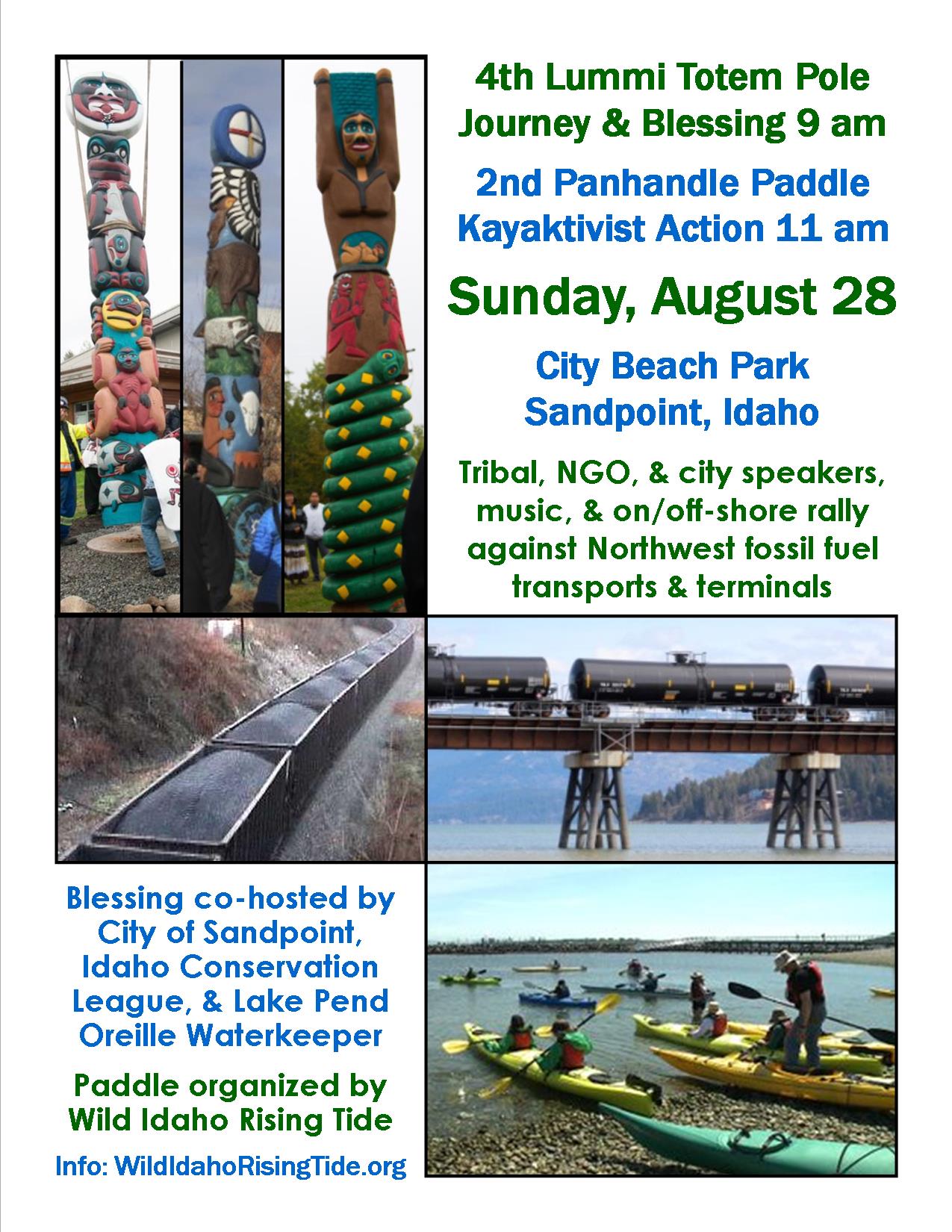
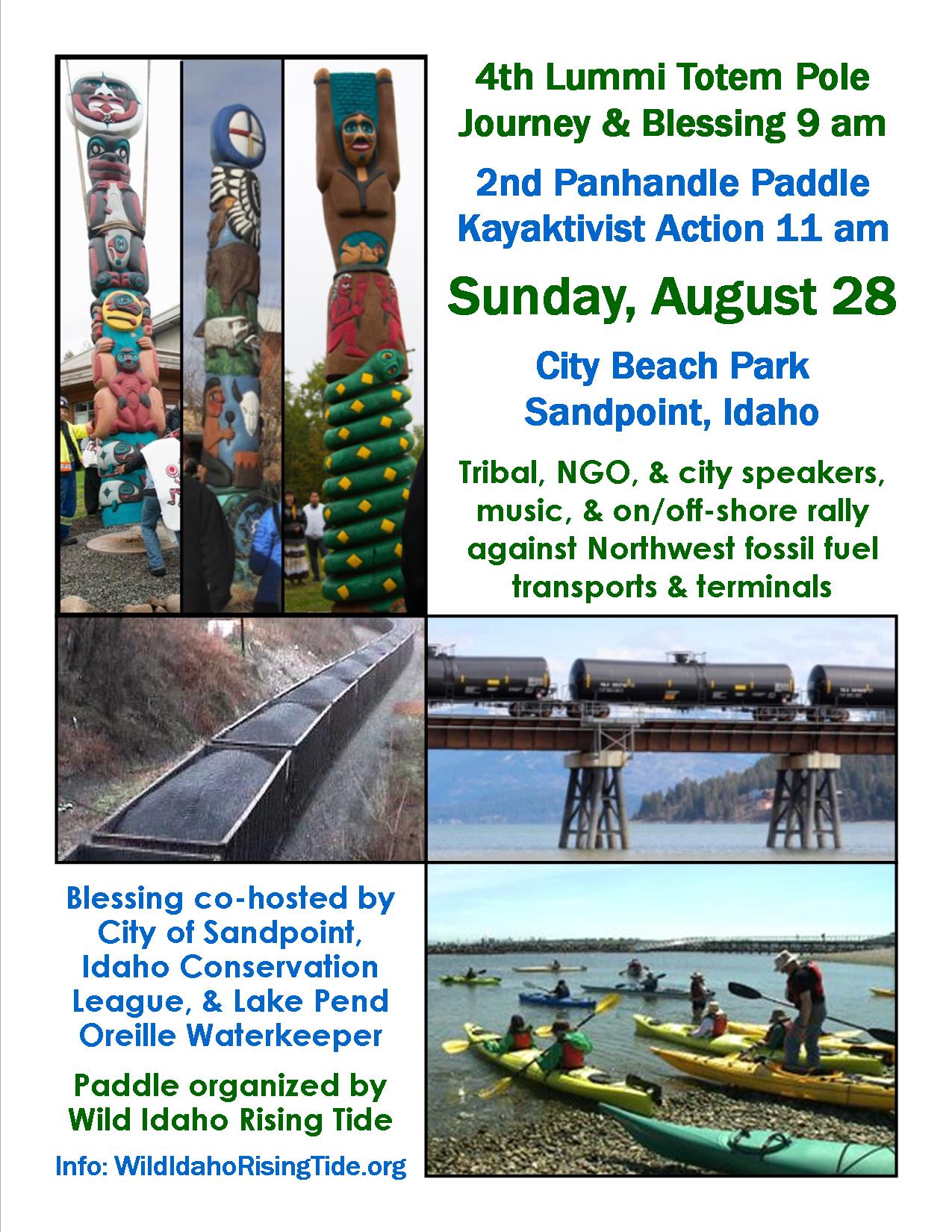
Join in some summer fun on the water and beach to show Big Oil and King Coal and their railroad industry haulers and government facilitators that north Idahoans will not stand for their reckless endangerment of our lives, communities, water, air, and climate with their explosive Alberta tar sands and Bakken crude oil trains and their heavy, dusty Powder River Basin coal trains. Wild Idaho Rising Tide (WIRT) activists, members, and friends in Sandpoint, Moscow, Spokane, and across the interior Northwest are organizing and hosting the second annual Panhandle Paddle at 11 am on Sunday, August 28.  We invite everyone to bring their boats of any kind and converge after the Lummi Totem Pole Journey visit at City Beach Park in Sandpoint, Idaho, for music, speakers, and on- and off-shore protests of Northwest fossil fuel transports and terminals and Lake Pend Oreille rail bridge deterioration, use, and expansion [1].  Please also participate in these second Panhandle Paddle activities:

Sign Preparation Party

RSVP and meet at 1 pm on Saturday, August 27, at the WIRT outreach table under the Farmin Park clock at the Farmers’ Market at Sandpoint, or anytime on Saturday afternoon at the WIRT Sandpoint office at 301 North First Avenue, Suite 209B, above Finan McDonald Clothing Company in Sandpoint, Idaho. We welcome assistance with creating and constructing huge, attractive banners and signs that kayaktivists, boaters, and rally participants can hoist from watercraft or the beach and that observers can see at great distances.

Palouse Area Carpool

Gather on Sunday, August 28, by 6 am for the totem pole blessing or 8 am for the kayaktivist action, in the parking lot beneath the Rosauers sign at 411 North Main Street in Moscow, Idaho. Panhandle Paddle activists could return to the Palouse region by 3 or 4 pm or later that evening, depending on carpooler arrangements.  Please contact WIRT for further information about this shared travel.

Watercraft Rental

Several downtown Sandpoint local businesses can provide rentals of single and tandem/double kayaks, paddle boards, and boats. Please respond to WIRT with your watercraft rental intentions for the event, so we can cover some of this equipment availability and cost for participants.

* Outdoor Experience, 314 North First Avenue, 208-263-6028, OutdoorExperience.us

First-come, first served rentals of two single kayaks for two hours ($30) or 24 hours ($45), or of two tandem/double kayaks for two hours ($40) or 24 hours ($55), or of paddle boards for $20 per hour

* Action Water Sports, 100 North First Avenue, 208-255-7100, ActionWaterSportsLessons.com

Reservable rentals of two single kayaks, two tandem/double kayaks, or paddle boards for $20 per hour or for four hours ($50) or for eight hours ($90), provided with brief instructions before departure

Grassroots Climate Activism Support

Can you donate toward watercraft rental fees or offer boats, gear, or supplies for this event [2]? Could you contribute your inspiring words and/or melodies or delicious snacks and beverages?  Would you drive enthusiastic Panhandle Paddle participants to Sandpoint?  Can your group or organization endorse and/or co-sponsor this demonstration of people power?  Please contact WIRT through any of the enclosed channels, to bolster this community event or assist with our collective expenses.

Peruse the following background information about these opportunities and profusely print and post the attached, color, letter-sized Totem Poles & Kayaks Against Fossil Fuels Flyer.  We eagerly anticipate sharing these experiences with you and your family, friends, neighbors, and co-workers, thankful that regional community members are actively opposing dirty energy extraction and transportation.

Panhandle Paddle Background Continue reading

Totem Poles & Kayaks Against Fossil Fuels: Lummi Visit Sandpoint


Totem Poles & Kayaks Against Fossil Fuels Flyer

On Sunday morning, August 28, at 9 am, the Lummi Nation House of Tears carvers are bringing their fourth totem pole to City Beach Park in Sandpoint, Idaho, and at 11 am on the same morning (instead of August 27), north Idaho kayaktivists are launching the second Panhandle Paddle around the Lake Pend Oreille rail bridge. These successive events share the goals of the Lummi Totem Pole Journeys: To “defeat proposed fossil fuel projects, while laying the foundation for a broad-based alliance on future issues of common concern related to fossil fuels and climate change.”

Please join the co-hosts and coordinators of the Totem Pole Journey stop in Sandpoint – Idaho Conservation League, Lake Pend Oreille Waterkeeper, and the City of Sandpoint – and other regional groups actively opposing fossil fuel projects, such as 350Sandpoint, Idaho Mythweaver, Wild Idaho Rising Tide (WIRT), and allies, at the paved area behind the snack shack at City Beach Park, 102 Bridge Street in Sandpoint, Idaho [1].

Welcoming and blessing ceremonies commence at 9 am, with guest speakers from tribes, nongovernmental organizations, and municipalities raising awareness of the impacts of fossil fuels and the necessity of broad citizen opposition. Before group members of this final Lummi tour pack up and haul the totem pole to Missoula, Montana, and ultimately Winnipeg, Manitoba, it will remain on display until 11 am.

The Second Panhandle Paddle will launch an on- and off-shore rally and kayak and boat flotilla from City Beach Park after the Lummi totem pole event, to voyage around the Lake Pend Oreille rail bridge with a recently discovered crack [2, 3]. Physically demonstrating local resistance to coal, shale oil, and tar sands trains traversing north Idaho and the lake, the action organized by WIRT and allies further mobilizes frontline, inland Northwest communities unjustly impacted by the risks and pollution of fossil fuel transports.

Peruse the following background information about these opportunities and profusely print and post the attached, color, letter-sized Totem Poles and Kayaks Against Fossil Fuels Flyer. We eagerly anticipate sharing these experiences with you and your family, friends, neighbors, and co-workers, grateful that tribes across the continent are leading the current movement to protect lands and waters for future generations.

Lummi Totem Pole Journey Background Continue reading

Keep It in the Ground: Idaho BLM Oil & Gas Lease Protest 2


BLM Sheep Ridge Oil & Gas Lease Parcels 7-27-16

Activists Call on the Obama Administration to End Fossil Fuel Leases on Public Lands

On Wednesday, July 27, at 8 am, dozens of activists from five regional conservation and climate activist groups are holding a “Keep It in the Ground” (KING) rally and protest of the second Bureau of Land Management (BLM) oil and gas lease auction of Payette County federal lands and minerals [1, 2].  At its Idaho State Office in Boise, the BLM plans to offer and sell leases for fossil fuel development on 9,242 acres of Sheep Ridge public lands around the producing and plugged-pending-pipelines oil and gas wells in the Big Willow Creek area seven miles north of New Plymouth [3, 4].

This protest contributes toward a growing, nationwide Keep It in the Ground movement concerned about the climate warming and environmental destruction caused by ongoing fossil fuel extraction and consumption.  KING coalition organizations, such as the Center for Biological Diversity, Friends of the Earth, Great Old Broads for Wilderness, and the Sierra Club, are urging President Obama to expand his climate legacy by stopping new oil and gas leases on public lands, just as he did with coal leases.  On June 18, 2016, in Yosemite National Park, the president said that the greatest threat to all national parks is climate change.

Groups across the western U.S. are planning similar “Keep It in the Ground” rallies for upcoming lease sales, like the one in Roswell, New Mexico, that the BLM has postponed, and past demonstrations in Salt Lake City, Utah, and Reno, Nevada.  The organizations co-sponsoring the rally and protest in Boise on July 27 include Citizens Allied for Integrity and Accountability, Great Old Broads for Wilderness, Idaho Chapter Sierra Club, Idaho Residents Against Gas Extraction, and Wild Idaho Rising Tide (WIRT).

Educating the public about and confronting southwest Idaho oil and gas development throughout our five years, WIRT members are grateful and relieved to work with other groups joining the too-few activists under great duress at three previous auctions of public lands and minerals since April 2014 [5-10].  We encourage you to accompany us on the frontlines of public lands liquidation to the oil and gas industry, at this fourth oil and gas lease auction protest in Boise.  If you can carpool to and from Boise with other north Idaho activists for this significant demonstration, please contact WIRT by email, phone, or facebook message.

Concerned Idahoans are standing up for their rights on Wednesday, July 27, and telling the BLM that public lands in Idaho are not for sale to dangerous extractive industries overrunning our beautiful state.  Bring your soft signs, banners, and enthusiasm, and meet at 8 am MDT at the southwest corner of the Walmart parking lot, close to Burger King, near West Overland Road and South Vinnell Way in Boise.

Participants will cross Vinnell to the BLM Idaho State Office at 1387 South Vinnell Way (on the left, to the south).  The oil and gas lease auction in the Sagebrush Conference Room begins at 9 am and will likely conclude by 12 noon.  Entering this government building requires presenting photo identification and signing in for the auction (and action!). Continue reading

8 pm Tuesday, July 12: #StopOilTrains Candlelight Vigil & March in Sandpoint


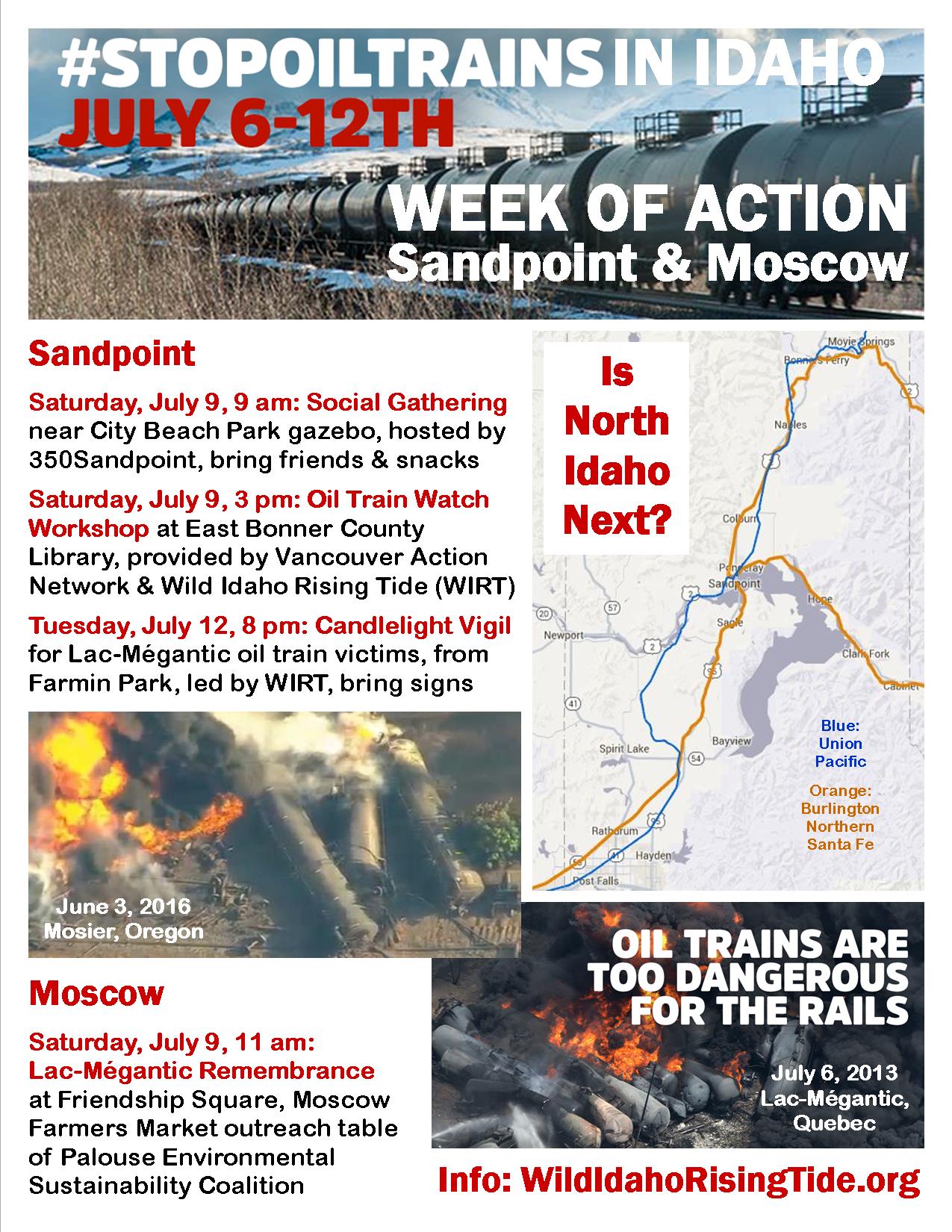
PLEASE JOIN US on Tuesday, July 12, at 8 pm, starting from the Farmin Park clock in Sandpoint, for a candlelight vigil and march commemorating the 47 lives lost to a fiery oil train derailment in Lac-Mégantic, Quebec, on July 6, 2013 [1-3].  Regional climate activist groups Wild Idaho Rising Tide, 350Sandpoint, and allies encourage you and hundreds of concerned area citizens to participate and bring candles (we can provide some), protest signs, ideas for creative street theater, and reports and reflections on life in a vulnerable, rural, Northwest oil train corridor.

“The Week of Action includes events in dozens of cities and towns. In Lac-Mégantic, Quebec, residents gathered on Saturday, July 9, to honor the 47 people who perished in the fire.  ‘These are solemn events,’ says Marilaine Savard, a resident of Lac-Mégantic, Quebec.  ‘Once an oil train derails and catches fire, you and your town will never fully recover.’” [4, 5]

In Bonner County, Idaho, over 15,500 people live in oil train “blast zones,” under the increasing threat of potential derailments, spills, explosions, and fires of mile-long crude oil trains hauled by Burlington Northern Santa Fe Railroad (BNSF) and Union Pacific Railway from the Alberta tar sands and Bakken shale oil fields to Pacific Rim refineries and ports [6-8]. Currently, 8,419 people reside within one half-mile of the tracks, and another 7,087 people live between one half-mile and one mile of the rail lines in the county.  #StopOilTrains in Idaho Week of Action events emphasize and seek to resolve this environmental injustice.

We will report soon on #StopOilTrains Week of Action demonstrations in Lac-Mégantic, the Northwest, and Idaho, as the movement against fossil fuel exacerbation of climate change grows. The Quinault Indian Nation hosted the likely largest anti-oil train gathering during the last week, on Friday, July 8, when more than 600 tribal members, neighbors, and regional allies attended [9].  Together, they boated, marched, and rallied to call on the City of Hoquiam to reject proposed crude oil terminals in Grays Harbor, Washington.

Hoping to see you on Tuesday evening: Thanks! Continue reading

Stop Oil Trains in Idaho Week of Action


Stop Oil Trains in Idaho Week of Action Flyer

Groups stage week of action to #StopOilTrains in Idaho

Continent-wide demonstrations mark three-year anniversary of Lac-Mégantic explosion

North Idaho activists invite the public to join them at four events on July 9 and 12 commemorating the 47 lives lost to a Bakken crude oil train derailment and explosion in downtown Lac-Mégantic, Quebec, on July 6, 2013. During the three years since this tragedy, dozens of similar, fiery accidents have risked and wrecked public and environmental health and safety and the global climate – more than in the previous four decades – including the Union Pacific oil train derailment, spill, and fire in the Columbia River Gorge town of Mosier, Oregon, on June 3, 2016.

In response, Sandpoint and Moscow groups 350Sandpoint, Palouse Environmental Sustainability Coalition, and Wild Idaho Rising Tide are participating with thousands of people across North America in the July 6 to 12 ‪#‎StopOilTrains Week of Action.* Partner organizations providing event support around the continent include 350.org, Credo, Sierra Club, Sightline Institute, Oil Change International, and Waterkeeper. Continue reading

Last, Largest Coal Port DEIS Hearings


On Thursday, April 29, 2016, as required by the Washington State Environmental Policy Act (SEPA), the Washington Department of Ecology and Cowlitz County, Washington released a draft environmental impact statement (EIS) on the huge Millennium Bulk Terminals coal export terminal proposed for Longview, Washington [1, 2]. Along with the U.S. Army Corps of Engineers, which is preparing a separate federal draft EIS, the agencies are studying the potential environmental and social impacts and evaluating the risks of this project [3].  They will review and consider all concerned citizen input after the 45-day comment period ends on June 13, while performing further analyses for the final EIS.  Once this document emerges, terminal owners would begin application processes for local, state, and federal permits.

Millennium proponent Lighthouse Resources (formerly Ambre Energy) owns 62 percent of the project; 38 percent owner Arch Coal has filed for bankruptcy. Their potentially largest such facility in North America, built and operated on the site of the former Reynolds Aluminum smelter, could annually transfer and stockpile 44 million metric tons of Powder River Basin coal, strip-mined in Montana and Wyoming, between unit coal trains and ships bound for Asia.  Besides eight empty, returning trains daily, the terminal would impose on trackside communities eight fully loaded, additional coal trains per day.

This last remaining Northwest coal export project of an original six proposals should concern Idahoans, who live among relatively clean air and water, abundant wildlife, and scenic beauty, just as much as Washington citizens [4]. Coal transport through Sandpoint and surrounding north Idaho communities, 400-plus miles away, directly pollutes, threatens, and impacts regional public and environmental health and safety and economic vitality, all for private profit.  Each coal train engine spews carcinogenic diesel fumes, and its 110 open rail cars together shed 55,000 pounds of coal dust from mine to port, laden with arsenic, lead, mercury, nickel, tin, and other heavy metals.  Health experts link exposure to diesel exhaust and coal dust with decreased lung capacity and exacerbated asthma, bronchitis, emphysema, pneumonia, lung cancer, and heart disease.  Increased, slow-moving coal traffic can also obstruct and delay vehicles at rail crossings, extend the travel times of emergency responders, and block access to hospitals, schools, businesses, and neighborhoods.  Heavy coal trains damage rails with their pressure and clog the pores of gravel under tracks, reducing wet ballast permeability and stability and thus risking derailment of other hazardous and explosive freight.

Why support the significantly faltering coal industry and world markets [5, 6]? In recent months, owners of a dozen of the most productive coal mines in the Powder River Basin and country, Peabody, Arch, and Alpha Natural Resources, have filed for bankruptcy [7].  With the downturn in Wyoming coal, oil, and gas production, 2,400 dirty energy sector employees have lost jobs since January 1, most from the two largest coal companies [8].  Burlington Northern Santa Fe Railway has furloughed 4,600 workers nationwide over the last several months, and Union Pacific Railroad has laid off 4,100 employees.  After 30-plus years of endlessly fighting coal projects, tribal and Montana activists have stopped the Otter Creek coal mine in the Powder River Basin, and the federal Surface Transportation Board has dismissed the permit for the Tongue River Railroad [9].  Agencies temporarily suspended EIS preparation for the Gateway Pacific Terminal at Cherry Point near Bellingham, before the Lummi Nation and supportive Northwest tribes convinced the U.S. Army Corps of Engineers to reject permits for the once biggest proposed coal port in North America, in defense of their Constitutionally-protected treaty rights to fishing grounds and practices [10].  And these developments represent only the most salient of recent, historic Northwest victories over extreme energy projects.

But the Washington Department of Ecology has announced three informational open houses and public hearings on the proposed Longview coal terminal draft EIS in three cities across the state. Various organizers with the Power Past Coal and Stand Up To Oil coalitions are hosting 4 pm rallies at each location, before oral testimony restarts after 5 pm agency presentations (also at 1 pm).  Please read the draft EIS on the Department of Ecology’s website, wear red, and come prepared to speak for only two minutes and/or provide comments to a court reporter and/or in written form during the meeting.

* Tuesday, May 24, 1 to 9 pm at the Cowlitz Regional Conference Center, 1900 Seventh Avenue in Longview, Washington [11]

* Thursday, May 26, 1 to 9 pm at the Spokane Convention Center, 334 West Spokane Falls Boulevard in Spokane, Washington [12]

* Thursday, June 2, 1 to 9 pm at the TRAC Center, 6600 Burden Boulevard in Pasco, Washington [13] Continue reading