 WHAT THE FERC?!
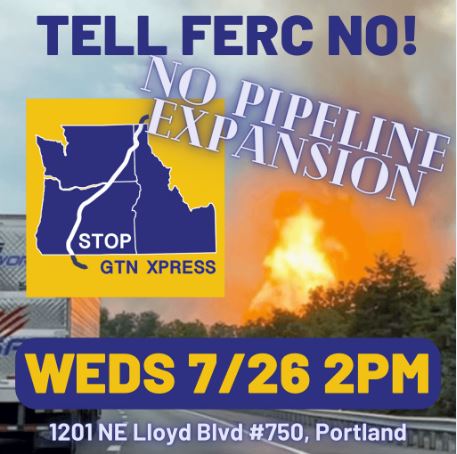
On Thursday, July 20, a Northwest coalition of groups working to stop the Gas Transmission Northwest (GTN) Xpress pipeline expansion learned that the Federal Energy Regulatory Commission (FERC) listed GTN Xpress on its certificate agenda for its monthly meeting on Thursday, July 27. In an apparent, massive, rubberstamp attempt to rush approvals before FERC’s August non-meeting break, the federal agency will likely permit a slew of fossil fuels projects including the GTN Xpress application of TC Energy, owner of the rupturing Keystone and rejected Keystone XL tar sands pipelines. Along with thousands of Northwest citizens and dozens of organizations, the Columbia River Inter-Tribal Fish Commission and West Coast governors, state attorneys general and legislators, and U.S. senators have opposed and organized against GTN Xpress for almost two years.
GTN Xpress is essentially a fossil fuels invasion of southern Idaho, thankfully challenged by neighboring states and Sandpoint and Spokane fossil fuels sacrifice zones that would receive only 13 percent or none of additional GTN gas. More than half of the 150 million cubic feet per day of extra, unnecessary, fracked gas that TC Energy plans to push with three upgraded compressors through the 60-year-plus GTN pipeline would threaten the health and safety of north Idaho and eastern Washington pipeline corridor residents, for delivery to southern Idaho. GTN and Intermountain Gas of Boise, who requested gas customer price hikes last winter, intend to essentially take over and reverse westward Williams Northwest pipeline flows, to bolster their profits at the 30-year expense of utility ratepayers increasingly favoring alternative energy.
WIRT is exploring the GTN Xpress record for information about probably missing Williams agreements and to produce second WIRT comments before July 27, welcoming other, also issue-underrepresented, Idaho and inland Northwest groups and residents to send your remarks to FERC. Despite postponed railroad double-track construction impeding public transportation and requiring citizen monitoring at the Sandpoint Amtrak station, we will next coordinate regional protests in Athol (site of one of three compressor expansions), Sandpoint, Spokane, Moscow, and Boise, denouncing GTN’s proposal and FERC’s predictable decision, while supporting FERC re-hearing petitions filed by coalition partners and hopefully Northwest states, before the August 26 challenge deadline. We appreciate your interest in GTN Xpress resistance and your input toward comments and demonstrations that demand FERC justice from the ongoing dangers and compounded risks of GTN Xpress expansion, leaks, and resulting climate disasters.
ANOTHER TC ENERGY PIPELINE RUPTURE
On July 25, the TC Energy-owned Columbia Gas Transmission pipeline catastrophically failed, causing a large explosion and fire and temporarily closing Interstate 81 in rural Shenandoah County, Virginia, approximately 80 miles west of Washington, D.C. [1, 2]. Thankfully, the incident neither injured nor killed anyone, and its causes and impacts remain unknown. But like the December 2022 rupture and 600,000-gallon spill from TC Energy’s Keystone tar sands pipeline into a Kansas stream only weeks after FERC release of the GTN Xpress final environmental impact statement (EIS), the Virginia disaster demonstrates the terrible safety record of TC Energy and timely illustrates the major risks posed by TC Energy’s GTN Xpress, less than 48 hours before FERC could approve this expansion scheme [3]. The proposal would increase flammable, climate-wrecking, methane gas flows through a six-decade-old pipeline among fire-prone rural lands and urban residential areas in Idaho, Washington, and Oregon. As multiple wildfires burn and blanket the Northwest with smoke, a pipeline accident like the one that just occurred in Shenandoah County could devastate nearby communities. Continue reading →
 Wild Idaho Rising Tide