 Friday, February 21:
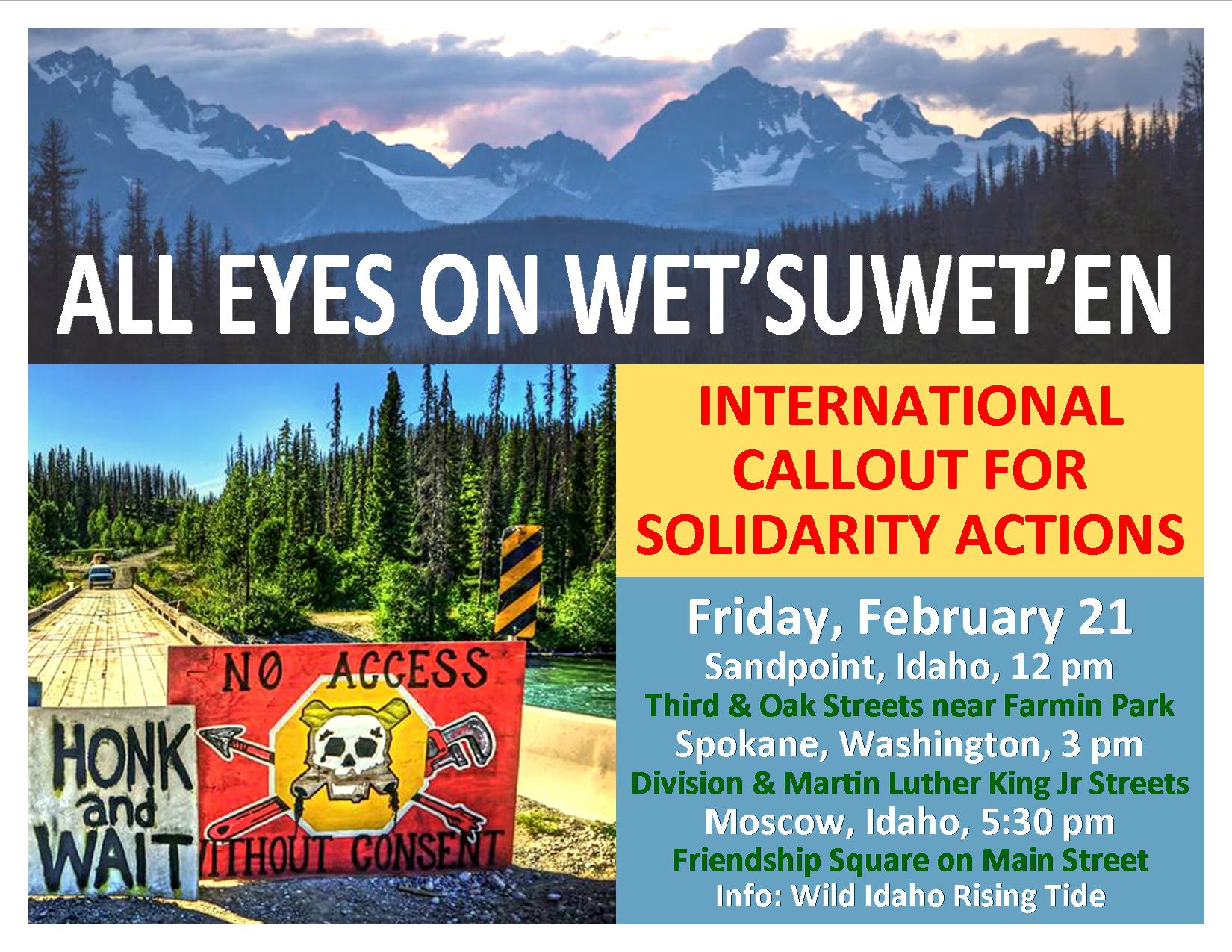
Sandpoint, Idaho (Kalispel Territory): 12 pm on the southwest corner of North Third Avenue and Oak Street, across from the Farmin Park clock, with the weekly, 350 Sandpoint Climate Strike action
Spokane, Washington (Spokane Territory): 3 pm at the park on the southeast corner of North Division Street and East Martin Luther King, Jr. Way
Moscow, Idaho (Nimiipuu (Nez Perce) Territory): 5:30 pm at Friendship Square on the west side of South Main Street at West Fourth Street, with the weekly, Palouse Peace Coalition demonstration
Fossil fuels extraction and transportation onslaughts continue to use public police for private profit, invade indigenous, private, and public lands, and criminalize defenders of healthy waters, climate, lands, and life ways. A British Columbia (B.C.) Supreme Court injunction granted in December 2019 seeks to block Wet’suwet’en people from their unceded, traditional territories in west central B.C., by establishing a tribal and public exclusion zone easing Coastal GasLink (CGL) access to its pipeline construction and work camp sites within the zone [1, 2]. Under Wet’suwet’en law, the hereditary chiefs of all five clans have unanimously opposed the fracked gas project and all pipeline proposals, and have not provided their free, prior, and informed consent [3]. They closed the West Morice Road, and in early January, evicted the company from their lands, where “Coastal GasLink was building a work camp to house up to 400 people,” about 20 kilometers beyond the Unist’ot’en Healing Center at kilometer 66 [1]. Wet’suwet’en chiefs have criticized Royal Canadian Mounted Police (RCMP) for arbitrarily expanding the exclusion zone and moving their checkpoint closer to Highway 16.
With an office in Spokane, TC Energy (formerly TransCanada) owns the Keystone tar sands pipeline that has leaked numerous times across the Great Plains and the Gas Transmission Northwest pipeline that runs from western Canada through north Idaho and eastern Washington. The company is proposing the Keystone XL pipeline across Montana, South Dakota, and Nebraska, and is building the $6.6-billion Coastal GasLink pipeline from northeastern B.C. to a coastal, liquefied natural gas (LNG) plant in Kitimat, B.C.
Amid rising tensions during the first week of February, RCMP attempted to enforce the injunction and allow Coastal GasLink to resume work. On Thursday, February 6, militarized police launched a pre-dawn raid on the first Wet’suwet’en camp at kilometer 39 of the Morice Road [4]. They detained journalists, arrested six land defenders and their supporters at gunpoint, but later released them without charges, and dismantled the camp. With rifles, vehicles, and helicopters on Friday, February 7, tactical squad members invaded the Gidimt’en clan camp at kilometer 44 on the road, eventually arresting four people, while others refused to leave and remained in a cabin, and police towed their vehicles. On Saturday, February 8, RCMP arrested another 11 community members, who had barricaded and chained themselves inside the Gidimt’en checkpoint warming center. Police have accused Wet’suwet’en of placing two blockades and spikes in the road, to deter and damage vehicles, and cutting support beams of the kilometer 44 bridge, damaged by RCMP pulling down the metal, bridge gate with trucks.
Also on Saturday, two helicopters reached the last of three Wet’suwet’en, pipeline opponent strongholds, with police ready to evict the residents of the Unist’ot’en Healing Center. The activists had built a large fire blockade on the snowy, Morice River bridge, and had strung dozens of red dresses along it and the road, symbolizing the violence against indigenous communities that transient, resource extraction “man camps” increase. Among legal observers at the camp gate, they donned regalia, engaged in songs and ceremony to save the waters and lands for all humans, rang bells to summon ancestors, named missing and murdered, indigenous women and girls, and burned a copy of the injunction. Unist’ot’en clan spokesperson and healing center director Freda Huson refused to talk with RCMP before they left the scene. On Monday, February 10, police invaded the Unist’ot’en camp with dogs, vehicles, and helicopters, and arrested and removed Wet’suwet’en matriarchs, including Freda, while in ceremony [5, 6]. Continue reading
 Wild Idaho Rising Tide